Do Your Supplement Needs Change From Your 30s to Your 60s?
Pregnancy potential, menstrual bleeding, diet, and changes in absorption tell you more than your decade does.
Yes, some nutrient considerations change over time, but your birthday doesn’t determine a supplement stack. Folic acid matters before and during a possible pregnancy; heavy periods can raise questions about iron; and diet, medications, or absorption problems can make vitamin B12 worth a closer look. In later adulthood, review calcium intake and vitamin D risk rather than assuming everyone needs the same pills.63471
Start with the reason, not the age label
A “supplements for your 40s” list can sound reassuringly simple. It can also miss what’s happening in your life. Two people the same age may have very different questions: one has heavy periods, another is planning a pregnancy, and a third eats no animal foods. Those differences point toward different nutrients, while a decade on its own rarely tells you whether food is falling short or a deficiency is present.364
Use this table as a way to sort the question, not as a shopping list:
| What’s happening? | Nutrient to consider | What changes the decision? |
|---|---|---|
| Pregnancy is possible or planned | Folic acid | Getting enough before and during pregnancy helps prevent major birth defects of the baby’s brain or spine. If food isn’t providing enough, a supplement is an option.6 |
| Periods are heavy, including around perimenopause | Iron | Blood loss can contribute to anemia. Heavy bleeding that affects daily life deserves attention to the bleeding itself, not just a decision about iron pills.23 |
| You’re pregnant or breastfeeding | Several nutrients, depending on circumstances | Vitamin B12 intake recommendations differ from those for other adults, and pregnancy is a period of concern for iron deficiency. That’s a reason for an individual nutrition discussion, not a universal stack.45 |
| You avoid animal foods or have an absorption risk | Vitamin B12 | Natural food sources are animal foods; fortified foods and supplements can help fill a gap. Gastrointestinal conditions or surgery, metformin, and acid-reducing medicines can also affect B12 status.4 |
| You’re reviewing bone-related nutrition in later adulthood | Calcium and vitamin D | Compare calcium intake from food with age-appropriate guidance. Older adults are also at greater risk of vitamin D deficiency, which matters because vitamin D helps the body absorb calcium.71 |
A pregnancy question can come before a pregnancy
Folic acid is the clearest example of why life stage matters more than a decade. The relevant question isn’t whether you’re in your 30s or 40s. It’s whether pregnancy could happen: getting enough folic acid before pregnancy, as well as during it, helps prevent major brain and spine birth defects. Leafy greens, beans, and enriched grain products are among the food sources MedlinePlus identifies; a supplement is another way to get folic acid if food isn’t providing enough.6
Pregnancy and breastfeeding can also change nutrient intake needs. For example, NIH lists different vitamin B12 intake recommendations for pregnancy and lactation than for other adults. That establishes a nutritional difference, but it doesn’t tell you which product, if any, you personally need.4
Periods make iron a different question from age
If you’re still having periods in your 40s or 50s, bleeding patterns may matter more for iron than a decade-based plan. Periods can become heavy approaching menopause. Changing a pad or tampon every one to two hours, or finding that bleeding disrupts daily life, are concrete reasons to bring up the bleeding. Tests may be used to check for an underlying problem such as iron-deficiency anemia.3
Iron isn’t the answer to every episode of fatigue. Anemia can leave you tired, cold, dizzy, or short of breath, but it can have causes besides too little iron, and treatment depends on the type found.2 If heavy periods are the reason iron is low, addressing the blood loss belongs in the conversation too. A gynecology guideline on iron deficiency emphasizes both iron replacement and reducing menstrual blood loss.5
Once periods stop, menstrual blood loss no longer explains a new iron concern. That doesn’t rule out anemia or create a reason to take iron routinely; it means the cause matters more than an old habit of buying iron “for women.”23
In your 50s and 60s, look at intake and absorption
Calcium is a good example of the difference between a nutrient requirement and a supplement requirement. NIH lists adult calcium recommendations that vary by age and sex, generally from 1,000 to 1,200 mg a day. It also recommends meeting nutritional needs primarily through food, including fortified foods, while recognizing that supplements may be useful when food can’t meet a specific need.7 The useful first question is what calcium-containing foods and fortified products you regularly eat, not whether you’ve reached an age when a calcium pill becomes mandatory.
Vitamin D helps your body absorb calcium. Older adults have a higher risk of vitamin D deficiency partly because skin produces it less efficiently with sun exposure and kidneys become less able to convert it to its active form. Diet, absorption problems, and certain medicines can matter too. Those are reasons to discuss your risk; they aren’t reasons to take increasingly large amounts on your own. Too much supplemental vitamin D can be harmful.1
Vitamin B12 brings a different later-life issue: absorption. The adult intake recommendation in NIH’s table is the same from age 19 onward, but older adults can have more difficulty absorbing B12 from food. A vegan diet, gastrointestinal surgery or certain digestive conditions, prolonged metformin use, and acid-reducing medicines are other relevant clues.4 For example, someone in her 30s who eats no animal products may have a more immediate B12 question than someone in her 60s with no apparent intake or absorption risk. Numbness or tingling in the hands or feet is worth mentioning promptly because B12-related neurological symptoms can occur even without anemia.4
The goal is to identify a real gap or risk, not to collect products for each new decade. B12 supplements haven’t shown an athletic-performance benefit in people whose B12 status is sufficient, and trials haven’t shown improved cognitive function from B12 or B-vitamin combinations in older adults. Those findings don’t diminish treatment for a deficiency. They help separate treating a problem from buying a promise.4
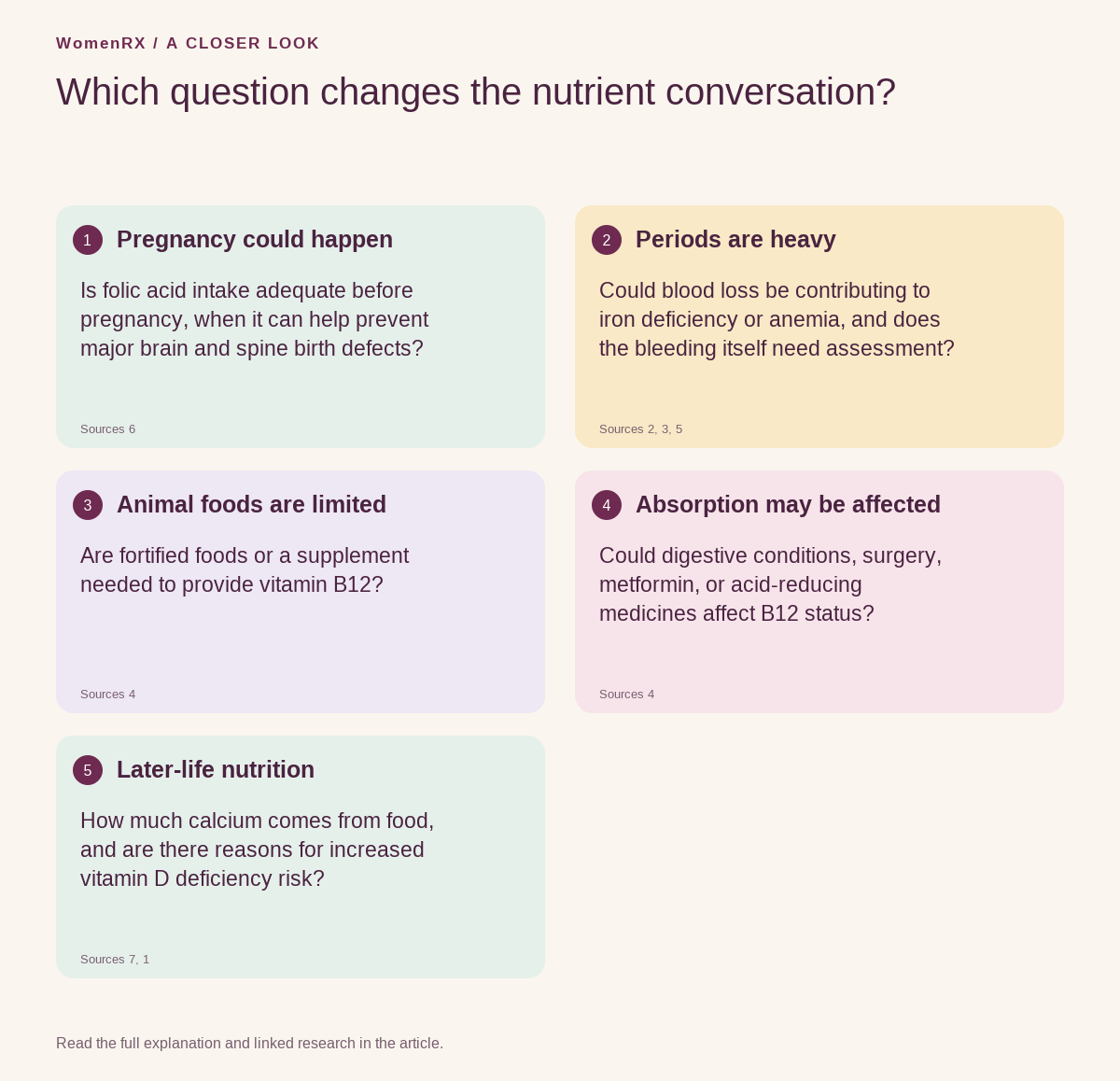
Which question changes the nutrient conversation?
Pregnancy could happen: Is folic acid intake adequate before pregnancy, when it can help prevent major brain and spine birth defects?6
Periods are heavy: Could blood loss be contributing to iron deficiency or anemia, and does the bleeding itself need assessment?235
Animal foods are limited: Are fortified foods or a supplement needed to provide vitamin B12?4
Absorption may be affected: Could digestive conditions, surgery, metformin, or acid-reducing medicines affect B12 status?4
Later-life nutrition: How much calcium comes from food, and are there reasons for increased vitamin D deficiency risk?71
Read the figure as text
These situations can overlap or happen at different ages. Match the question to your circumstances rather than following a decade-based stack.- Pregnancy could happen: Is folic acid intake adequate before pregnancy, when it can help prevent major brain and spine birth defects?6
- Periods are heavy: Could blood loss be contributing to iron deficiency or anemia, and does the bleeding itself need assessment?235
- Animal foods are limited: Are fortified foods or a supplement needed to provide vitamin B12?4
- Absorption may be affected: Could digestive conditions, surgery, metformin, or acid-reducing medicines affect B12 status?4
- Later-life nutrition: How much calcium comes from food, and are there reasons for increased vitamin D deficiency risk?71
Sources you can check
- Vitamin D Deficiency: MedlinePlusAccessed 2026-09-25Return to first citation
- Anemia | MedlinePlusAccessed 2026-09-25Return to first citation
- Heavy periods - NHSAccessed 2026-09-25Return to first citation
- Vitamin B12 - Health Professional Fact SheetAccessed 2026-09-25Return to first citation
- No. 469 Iron Deficiency and Iron Deficiency Anemia in Obstetrics and Gynaecology.Chen I, Khamisa K, Murji A, Coolen J, Evans D, Lett R, Rittenberg D, Lett C, Special Contributors:. · Journal of obstetrics and gynaecology Canada : JOGC = Journal d'obstetrique et gynecologie du Canada : JOGC · 2026Return to first citation
- Folic Acid: MedlinePlusAccessed 2026-09-25Return to first citation
- Calcium - Health Professional Fact SheetAccessed 2026-09-25Return to first citation