Do You Need a Multivitamin? Check the Ingredients First
Folic acid, iron, and vitamin D deserve different attention depending on pregnancy plans, periods, diet, and what you already take.
A multivitamin is worth considering when its ingredients fit a specific need, not simply because it says “for women.” If pregnancy is possible, check for folic acid; if you have heavy periods, iron may deserve attention. During pregnancy, a regular multivitamin may be the wrong fit. Compare any bottle with your diet, known deficiencies, and other supplements before adding it. 2 3 4
Start with the gap, not the front of the bottle
A multivitamin can contain nutrients you already get from food, nutrients you need more of, and ingredients that aren’t especially relevant to you. Before comparing brands, ask what you want the product to do. Is pregnancy possible? Do heavy periods make low iron a concern? Has a test found a deficiency? The answers point to different label ingredients.
Food belongs in that comparison. Leafy greens and enriched grain products are among the food sources listed for folic acid, while iron comes from foods and fortified products. A diagnosed deficiency is a different question from general nutrition: low iron, for example, is usually treated with iron supplements rather than assumed to be covered by any multivitamin. 2 4
Three ingredients that change the comparison
Folic acid: pay attention before pregnancy, not only after a positive test. Getting enough before and during pregnancy can prevent major birth defects of a baby’s brain or spine. If you could become pregnant, check whether a product contains folic acid instead of assuming every multivitamin has the same formulation. 2
If you’re pregnant, a regular multivitamin isn’t necessarily a substitute for a prenatal vitamin. It may have too much or too little of some vitamins needed during pregnancy. Prenatal care is a good time to compare the exact product you take with a pregnancy-appropriate option, rather than adding both without checking their shared ingredients. 3
Iron: let blood loss and known results guide the question. Heavy periods increase the likelihood of low iron. Iron deficiency can develop without symptoms at first and may eventually cause fatigue or shortness of breath. If you’ve been told your iron is low, check whether your multivitamin contains iron, but don’t assume its presence means it meets your treatment needs. On the other hand, extra iron isn’t automatically helpful because you menstruate: too much from supplements can cause digestive symptoms and, at very high levels, serious harm. 4
Vitamin D: consider intake, risk, and overlap. Vitamin D helps the body absorb calcium and appears in many multivitamins. MedlinePlus lists 600 IU a day as the recommended amount for pregnant and breastfeeding women; that’s a daily intake reference, not an instruction to get the entire amount from a multivitamin. If you already take vitamin D separately, check both labels before adding a multi. Too much vitamin D from supplements can raise blood calcium and damage the kidneys. 1
What changes with life stage and health history?
While breastfeeding, your own vitamin D needs and your baby’s guidance are separate questions. MedlinePlus recommends vitamin D supplementation for breastfed infants; choosing a multivitamin for yourself doesn’t replace that infant guidance. 1
After menopause, don’t treat a “50+” label as proof that you need everything in the bottle. Older adults have a higher risk of vitamin D deficiency partly because skin makes less vitamin D with sun exposure and kidneys become less able to convert it to its active form. That’s an age-related consideration, not a deficiency caused by menopause itself or a reason to take a high-dose product without checking your circumstances. A blood test can measure vitamin D status when deficiency is a concern. 1
After bariatric surgery, a standard multivitamin comparison may miss a more complicated need. Surgery can affect nutrient intake and absorption. In a prospective study of 69 pregnant women who had previously undergone bariatric surgery, deficiencies during pregnancy included iron, vitamin B12, and vitamin D; the study couldn’t establish which supplement intake predicted deficiency. If this history applies to you, especially during pregnancy, your test results and follow-up matter more than a general-purpose label. 5
Compare the whole stack
Put your multivitamin beside any prenatal vitamin or separate iron or vitamin D product you take. Read the amounts for the same ingredient across the labels, rather than judging each bottle on its own. Iron and vitamin D are both sold separately and included in multivitamins, and excessive amounts can be harmful. If you have a known deficiency, take a proposed high-dose product, or are pregnant, the useful question to bring to your care team is specific: Does this combination fit my results and circumstances, or am I doubling up on something I don’t need? 1 3 4
What to check on the label
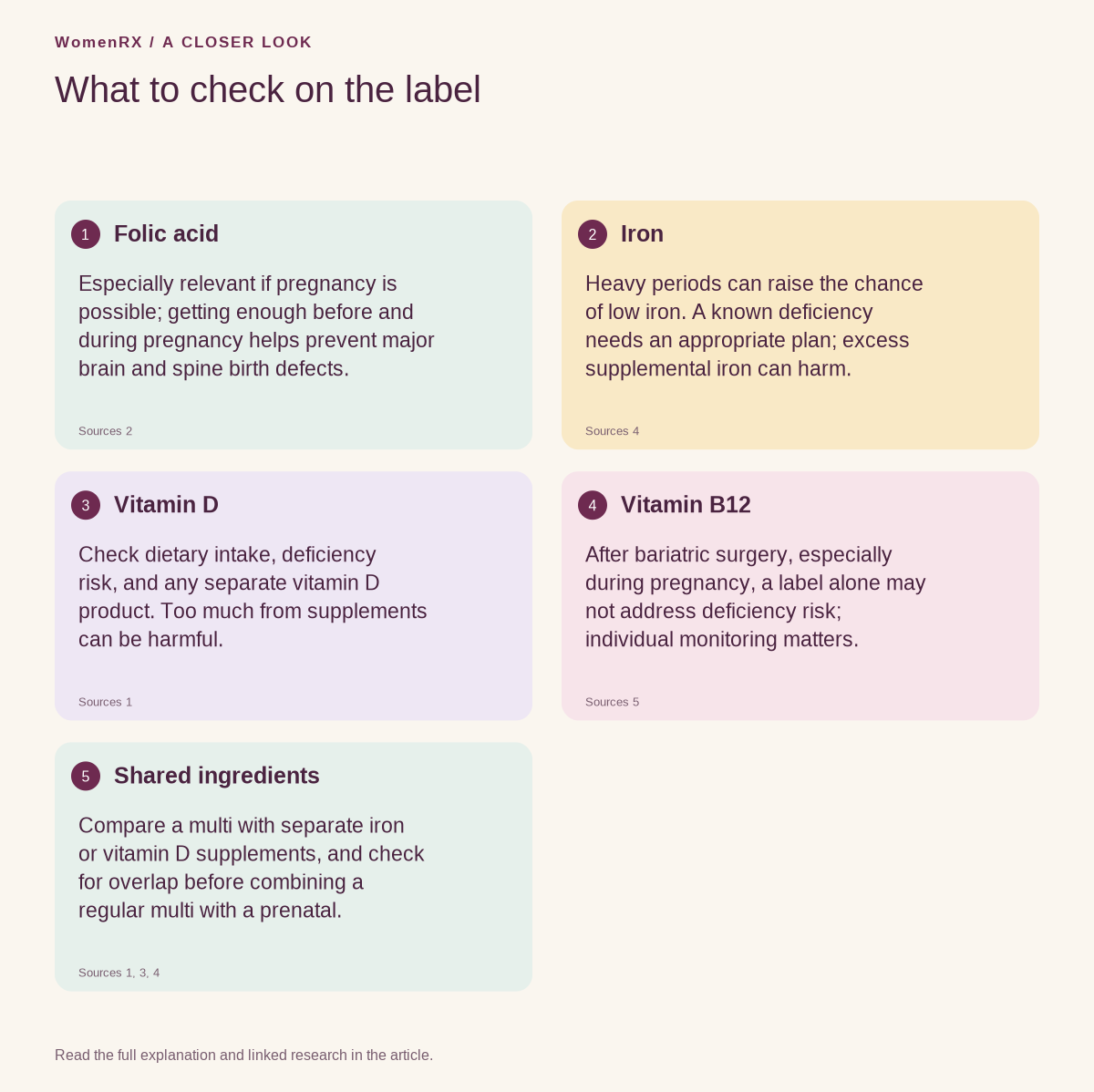
Folic acid: Especially relevant if pregnancy is possible; getting enough before and during pregnancy helps prevent major brain and spine birth defects.2
Iron: Heavy periods can raise the chance of low iron. A known deficiency needs an appropriate plan; excess supplemental iron can harm.4
Vitamin D: Check dietary intake, deficiency risk, and any separate vitamin D product. Too much from supplements can be harmful.1
Vitamin B12: After bariatric surgery, especially during pregnancy, a label alone may not address deficiency risk; individual monitoring matters.5
Shared ingredients: Compare a multi with separate iron or vitamin D supplements, and check for overlap before combining a regular multi with a prenatal.134
Read the figure as text
Compare each ingredient with the reason you’re considering a multivitamin, then check whether another product contains it too.- Folic acid: Especially relevant if pregnancy is possible; getting enough before and during pregnancy helps prevent major brain and spine birth defects.2
- Iron: Heavy periods can raise the chance of low iron. A known deficiency needs an appropriate plan; excess supplemental iron can harm.4
- Vitamin D: Check dietary intake, deficiency risk, and any separate vitamin D product. Too much from supplements can be harmful.1
- Vitamin B12: After bariatric surgery, especially during pregnancy, a label alone may not address deficiency risk; individual monitoring matters.5
- Shared ingredients: Compare a multi with separate iron or vitamin D supplements, and check for overlap before combining a regular multi with a prenatal.134
Sources you can check
- Vitamin D Deficiency: MedlinePlusAccessed 2026-09-25Return to first citation
- Folic Acid: MedlinePlusAccessed 2026-09-25Return to first citation
- Pregnancy and Medicines | MedlinePlusAccessed 2026-09-25Return to first citation
- Iron: MedlinePlusAccessed 2026-09-25Return to first citation
- Micronutrient Deficiency During Pregnancy After Bariatric Surgery: The Role of Micronutrient Supplements and Dietary Intake.Guthrie T, Eccles-Smith J, Lee S, Kothari A, Pinzon Perez W, Truby H, de Jersey S. · Obesity surgery · 2026Return to first citation