Iron: Food, Tests, Supplements, and What to Ask
Low iron can show up before anemia, so understanding your ferritin, life stage, and likely cause can shape the next step.
Iron deficiency and iron-deficiency anemia aren’t the same: iron stores can run low while hemoglobin is still normal. Ferritin helps assess those stores, but inflammation can make it look higher than it is. Food can support iron intake; a confirmed deficiency may call for a supplement and a search for its cause. Menstrual bleeding, pregnancy, and the years after menopause change that conversation. 1
Start with the distinction: low iron isn’t always anemia
Iron is needed to make hemoglobin, the red blood cell protein that carries oxygen. As iron stores fall, ferritin can become low before hemoglobin does. That means you can have iron deficiency without anemia; anemia is a later stage in which hemoglobin is low. A normal hemoglobin result on its own may not tell the whole story about iron stores. 1
Ferritin is a blood measure of stored iron. The NIH Office of Dietary Supplements says a ferritin below 30 micrograms per liter suggests iron deficiency, and below 10 suggests iron-deficiency anemia. Those values are useful context, not a reason to interpret a result in isolation: inflammation can raise ferritin, and clinicians may consider other blood measures and your health history. Newer American Society of Hematology guidelines also emphasize that diagnostic thresholds depend on population and that inflammation affects interpretation. 15
A complete blood count can show whether anemia is present, while ferritin helps assess iron stores. If your results don’t fit together, ask what other measures or clinical context were considered, rather than assuming one number settles the question. 1
Your life stage changes the likely explanation
If you menstruate, blood loss is one possible reason iron stores fall. Heavy or prolonged bleeding raises the chance of deficiency, but it isn’t the only possible cause. Low intake, poor absorption, and blood loss elsewhere can also matter. If bleeding is heavy enough to disrupt daily life, lasts unusually long, or happens between periods, finding and addressing the bleeding may be part of the iron plan, not just taking iron to replace what’s lost. 134
During pregnancy, the body makes more red blood cells and iron needs rise as blood volume and red-cell mass expand. Pregnancy care commonly includes anemia screening. Guidance differs on routine screening and supplementation for pregnant people without symptoms: ACOG recommends screening and low-dose supplementation, while the USPSTF has found evidence insufficient to judge the balance of benefits and harms for routine screening and supplementation in asymptomatic pregnant women. That difference is about routine prevention, not a reason to ignore an abnormal result or personal risk. Ask your obstetric care team how your test results, prenatal vitamin, and individual circumstances fit together. 1
After menopause, regular menstrual blood loss no longer explains low iron. If iron deficiency appears then, don’t assume it’s simply a dietary issue. Discuss other possible causes, including gastrointestinal blood loss, low intake, or problems absorbing iron. The right evaluation depends on your history and results. 123
When food may help, and when it may not be enough
Iron-rich foods can help you meet everyday needs and support a varied diet. Meat and seafood provide heme iron, which is generally absorbed more readily. Beans, lentils, nuts, vegetables, and iron-fortified breads and cereals provide nonheme iron. Vitamin C and meat, poultry, or seafood can help your body absorb nonheme iron. Some compounds in grains and legumes can reduce absorption, but their effect is often muted in a typical mixed diet. 1
For example, pairing beans or lentils with a vitamin-C-containing food can help your body absorb nonheme iron. You don’t need to avoid grains or beans to get iron from them. 1
Food may be enough to help meet needs when there isn’t a diagnosed deficiency, but it shouldn’t be assumed to correct depleted stores or anemia on its own. If tests confirm deficiency, discuss whether food changes, a supplement, or both make sense, and whether the underlying cause also needs attention. 12
Comparing supplements: read the elemental iron
Common supplement forms include ferrous salts, such as ferrous sulfate and ferrous gluconate, and ferric salts. Ferrous iron is more bioavailable than ferric iron, but products can contain different amounts of elemental iron even when their names or tablet weights look similar. The Supplement Facts panel lists elemental iron; that is the useful amount to compare, not just the name of the iron compound. 1
Iron supplements can cause nausea, constipation, abdominal discomfort, and other stomach or bowel symptoms. High supplemental intakes, including 45 mg a day or more, are more likely to cause gastrointestinal effects; the amount used to treat a deficiency may be higher than the general upper intake level, so don’t use that limit to change a prescribed plan on your own. Some other forms may cause fewer stomach effects, but that possibility doesn’t establish that one product is best for everyone. Keep iron supplements out of children’s reach; accidental overdose can be fatal to young children. 1
Iron can also affect certain medicines. Taking it at the same time as levothyroxine can reduce absorption of the thyroid medicine; some product labels advise separating them by four hours. Iron can reduce absorption of levodopa, and medicines that lower stomach acid, such as proton pump inhibitors, may reduce iron absorption. If you take one of these medicines, ask a pharmacist or prescriber how to handle timing or whether it could affect your response. Calcium may also interfere with iron absorption, though the effect isn’t definitive; NIH guidance suggests taking separate calcium and iron supplements at different times. 1
Treat the cause and check the response
Replacing iron is only one part of the plan. Heavy menstrual bleeding, pregnancy, low dietary intake, impaired absorption, and blood loss from the digestive tract are among the possible contributors. If the reason for low iron isn’t clear, ask what causes have been considered and whether more evaluation is appropriate. 12
Follow-up matters too. Repeat blood tests can show whether the blood count and iron status are improving, and whether the plan needs to change. If you’re taking iron and having side effects, or your results aren’t improving as expected, bring that up rather than simply increasing, stopping, or switching the supplement yourself. 2
A useful conversation can start with three questions: Is this iron deficiency, anemia, or both? What is the most likely cause in my situation? What test will show whether the plan is working? The answers should reflect your life stage, bleeding history, medicines, and test results, not just a supplement label.
From iron concern to follow-up
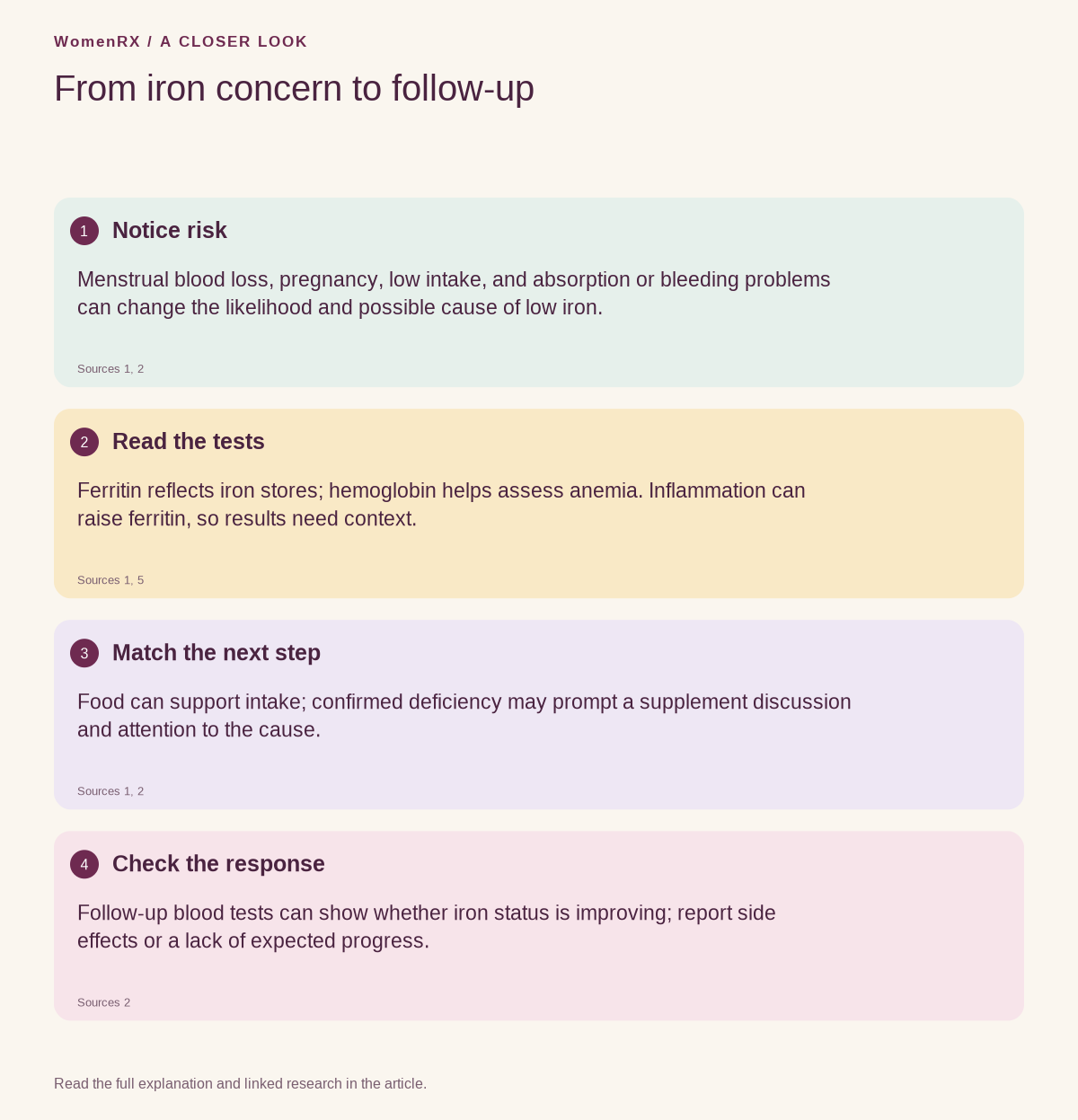
Notice risk: Menstrual blood loss, pregnancy, low intake, and absorption or bleeding problems can change the likelihood and possible cause of low iron.12
Read the tests: Ferritin reflects iron stores; hemoglobin helps assess anemia. Inflammation can raise ferritin, so results need context.15
Match the next step: Food can support intake; confirmed deficiency may prompt a supplement discussion and attention to the cause.12
Check the response: Follow-up blood tests can show whether iron status is improving; report side effects or a lack of expected progress.2
Read the figure as text
A practical path for considering risk, interpreting tests, discussing treatment, and checking progress, with life stage shaping the cause-finding step.- Notice risk: Menstrual blood loss, pregnancy, low intake, and absorption or bleeding problems can change the likelihood and possible cause of low iron.12
- Read the tests: Ferritin reflects iron stores; hemoglobin helps assess anemia. Inflammation can raise ferritin, so results need context.15
- Match the next step: Food can support intake; confirmed deficiency may prompt a supplement discussion and attention to the cause.12
- Check the response: Follow-up blood tests can show whether iron status is improving; report side effects or a lack of expected progress.2
More questions, answered
Can ferritin be misleading?
Yes. Inflammation can raise ferritin, so a result that doesn’t seem to match the rest of your blood tests or health picture may need interpretation alongside other measures and clinical context. 15
Should I start iron because I feel tired?
Tiredness alone doesn’t establish iron deficiency, and iron deficiency can occur without anemia. Testing can help clarify whether iron is low and whether another cause should be considered before you start or change a supplement. 1
Sources you can check
- Iron - Health Professional Fact SheetAccessed 2026-09-25Return to first citation
- Iron deficiency anaemia - NHSAccessed 2026-09-25Return to first citation
- Menstruation | Period | MedlinePlusAccessed 2026-09-25Return to first citation
- Heavy periods - NHSAccessed 2026-09-25Return to first citation
- American Society of Hematology 2026 guidelines for diagnosis of iron deficiency.Powers JM, Lim MY, Achebe MO, Akpan IJ, Auerbach M, Brown MC, Cardenas MP, Cromwell C, DeLoughery TG, Fleming RE, Fraga M, Goshua G, James PD, Lewkowitz AK, May JE, Nnadozie G, Ogu... · Blood advances · 2026Return to first citation