Vitamin C: Food Sources, Supplement Claims, and Safety
For most people, a varied diet can provide enough vitamin C; supplements have narrower, less certain benefits than their marketing may suggest.
Vitamin C helps prevent deficiency, but extra amounts aren’t a guarantee of stronger immunity or better skin. Fruits and vegetables can provide plenty, and an adult woman’s recommended intake is 75 mg daily, rising to 85 mg during pregnancy and 120 mg while breastfeeding. Regular supplements may modestly shorten colds, but evidence doesn’t support promising prevention. High doses can cause digestive upset. 1 2 3
Start with the reason you’re considering it
Vitamin C, also called ascorbic acid, is essential. The useful question is whether you need more than you’re getting from food, and what result a supplement could realistically offer. Preventing or correcting a deficiency is different from taking extra vitamin C in hopes of avoiding colds or changing your skin.
For women age 19 and older, the recommended dietary allowance (RDA) is 75 mg a day. It’s 85 mg during pregnancy and 120 mg while breastfeeding. These are daily intake targets from food and supplements combined, not supplement doses. People who smoke need 35 mg more per day than nonsmokers. 1
Food can cover the daily target
Vitamin C is found in many fruits and vegetables. For example, a medium orange provides about 70 mg, half a cup of raw red pepper about 95 mg, and half a cup of cooked broccoli about 51 mg. A mix of foods makes it possible to meet the target without taking a vitamin C pill. 1
Vitamin C can be lost with prolonged storage and cooking. It dissolves in water and is sensitive to heat, so steaming or microwaving may preserve more than longer cooking methods. That doesn’t mean you need to eat everything raw; it’s simply useful context if you rely on cooked produce for most of your intake. 1
If your diet is very limited, getting enough may be harder. Deficiency is uncommon in the United States, but it can occur when food variety is severely restricted. Very low intake over many weeks can cause scurvy, which may involve fatigue, swollen or bleeding gums, easy bruising, joint pain, or poor wound healing. Those symptoms can have other causes too, so they don’t identify vitamin C deficiency on their own. 1
What supplements may do, by goal
Colds: a possible modest difference in duration
Regular vitamin C supplementation has been associated with colds that are somewhat shorter and less severe in adults. One review cited in a systematic review reported an 8% reduction in cold duration, with a range of 3% to 12%. That’s a modest effect, and it doesn’t mean vitamin C reliably prevents a cold. 3
A five-year trial in older Japanese adults with atrophic gastritis found fewer people in the 500 mg group than the 50 mg group experienced three or more colds. But the study had limitations, including a protocol change, and found no apparent reduction in cold duration or severity. It doesn’t establish what a supplement would do for women generally. 4
Skin: don’t treat food and topical products as the same evidence
Vitamin C has roles in the body that matter to skin, and a recent dermatology review describes potential skin benefits from several vitamin C preparations. But that review covers different routes, including topical and procedural delivery, as well as systemic intake. Its summary does not establish that taking an oral supplement will reliably improve skin for someone who already gets enough vitamin C from food. 5
General health: more isn’t automatically better
Vitamin C is necessary for health, but the fact that it has antioxidant and immune functions doesn’t show that high-dose supplements improve health outcomes for everyone. If you’re eating a varied diet, a supplement may add little. In the NIH fact sheet, standard ascorbic acid supplements have bioavailability comparable to vitamin C in foods; the other forms described haven’t shown a clear, consistent advantage. 1
Pregnancy, breastfeeding, and choosing a product
The recommended intake increases during pregnancy and breastfeeding, but that doesn’t by itself mean you need a separate vitamin C product. Check the amount in any prenatal or other multivitamin you already take before adding another supplement, so you can understand your total intake. 1
If you do choose a supplement, the form isn’t necessarily a reason to pay more: ascorbic acid is the most common form, and NIH notes comparable bioavailability to food-based vitamin C. The evidence described doesn’t establish that specialty forms are better for everyday health. 1
Safety: the dose matters
Large amounts can cause gastrointestinal upset or mild diarrhea. The adult tolerable upper intake level is 2,000 mg a day. That’s a ceiling set for safety, not a target or a recommended amount to take. Consider the vitamin C in all your supplements, rather than looking at a single product in isolation. 2
The practical takeaway: aim to meet your needs through food when you can. Consider a supplement for a specific reason, such as difficulty getting enough, rather than assuming a larger dose will deliver broader protection.
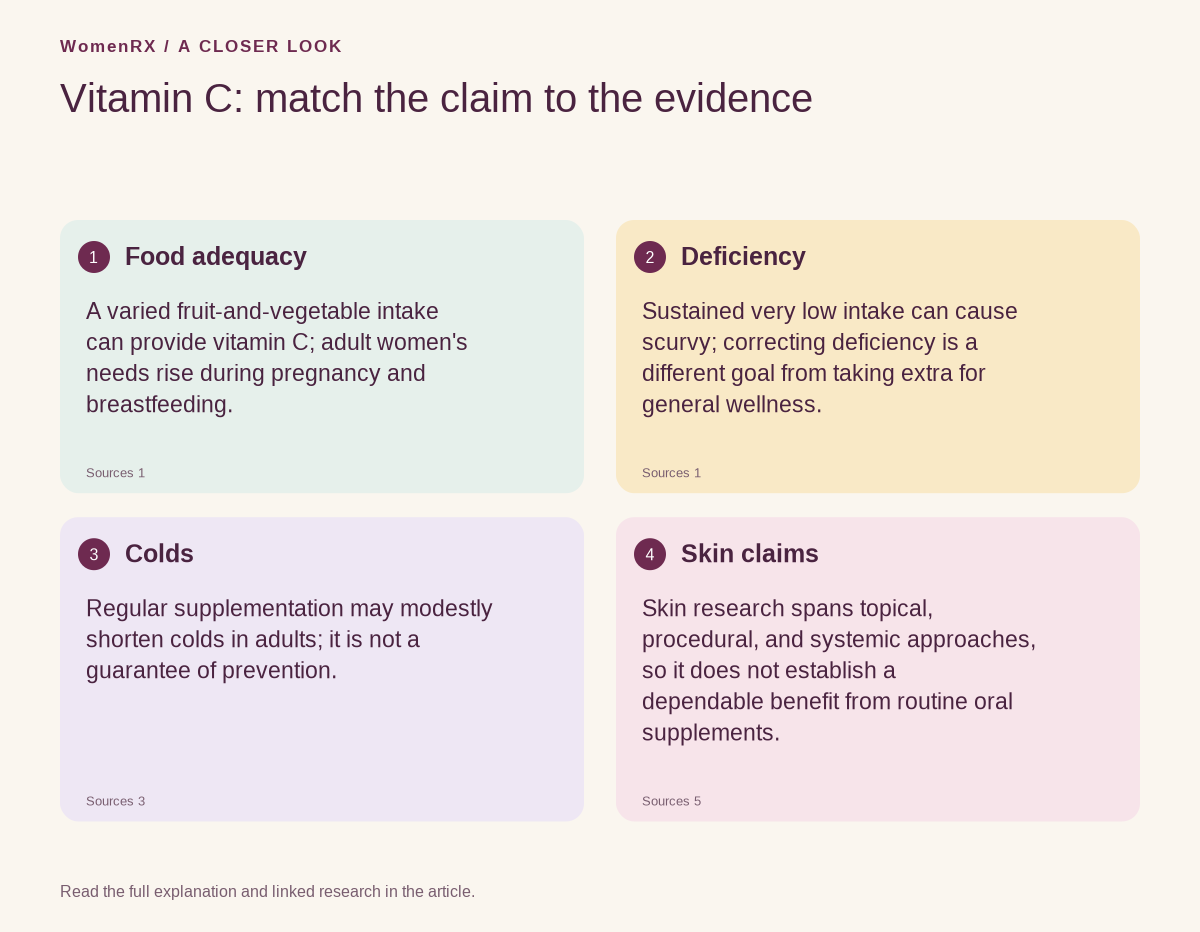
Vitamin C: match the claim to the evidence
Food adequacy: A varied fruit-and-vegetable intake can provide vitamin C; adult women's needs rise during pregnancy and breastfeeding.1
Deficiency: Sustained very low intake can cause scurvy; correcting deficiency is a different goal from taking extra for general wellness.1
Colds: Regular supplementation may modestly shorten colds in adults; it is not a guarantee of prevention.3
Skin claims: Skin research spans topical, procedural, and systemic approaches, so it does not establish a dependable benefit from routine oral supplements.5
Read the figure as text
These distinctions show why meeting a nutrient target is not the same as expecting a supplement to prevent illness or change skin.- Food adequacy: A varied fruit-and-vegetable intake can provide vitamin C; adult women's needs rise during pregnancy and breastfeeding.1
- Deficiency: Sustained very low intake can cause scurvy; correcting deficiency is a different goal from taking extra for general wellness.1
- Colds: Regular supplementation may modestly shorten colds in adults; it is not a guarantee of prevention.3
- Skin claims: Skin research spans topical, procedural, and systemic approaches, so it does not establish a dependable benefit from routine oral supplements.5
More questions, answered
Is a special form of vitamin C more absorbable?
The NIH Office of Dietary Supplements says the ascorbic acid used in supplements has bioavailability comparable to vitamin C in foods. The evidence summarized there doesn’t show a consistent advantage for specialty forms. 1
Does vitamin C prevent colds?
Regular supplementation may modestly shorten colds in adults, but you can’t count on it to prevent them. 3 4
Sources you can check
- Vitamin C - Health Professional Fact SheetAccessed 2026-09-25Return to first citation
- Vitamins E and C are safe across a broad range of intakes.Hathcock JN, Azzi A, Blumberg J, Bray T, Dickinson A, Frei B, Jialal I, Johnston CS, Kelly FJ, Kraemer K, Packer L, Parthasarathy S, Sies H, Traber MG. · The American journal of clinical nutrition · 2005Return to first citation
- Zinc Supplementation Reduces Common Cold Duration among Healthy Adults: A Systematic Review of Randomized Controlled Trials with Micronutrients Supplementation.Wang MX, Win SS, Pang J. · The American journal of tropical medicine and hygiene · 2020Return to first citation
- Effect of vitamin C on common cold: randomized controlled trial.Sasazuki S, Sasaki S, Tsubono Y, Okubo S, Hayashi M, Tsugane S. · European journal of clinical nutrition · 2006Return to first citation
- Clinical Applications of Vitamin C in Dermatology: A Systematic Review.Boghosian T, Mendez H, Boghosian N, Sayegh M, Beer J, Tosti A. · The Journal of clinical and aesthetic dermatology · 2026Return to first citation