Who May Need a Vitamin C Supplement?
Your usual diet and circumstances are better guides than a supplement label.
Most women can meet their vitamin C needs through food. A supplement is worth discussing if your diet has been very limited for a sustained period, you’re concerned about deficiency, or a clinician has recommended one. Pregnancy, breastfeeding, and smoking change recommended intake, but none automatically means you need a separate vitamin C pill. 1 2
Start with your usual food pattern
Vitamin C deficiency is uncommon in developed countries, but it can occur when someone has very little variety in what they eat. Think about a typical stretch of meals, not one unusual day. Do fruits and vegetables show up regularly? Or does a restriction mean you rarely eat them? That distinction is more useful than assuming you need a supplement because you’re a woman. 1
For example, if fruit and vegetables are already regular parts of your meals, start by looking at what food provides. Five varied servings a day can provide more than 200 mg of vitamin C, though the amount depends on the foods and portions. Vitamin C can decrease with prolonged storage and cooking; steaming or microwaving may lessen cooking losses. 1
If your choices have stayed narrow, consider whether adding vitamin C-containing foods is realistic for you. If it isn’t, that’s a concrete reason to discuss whether a supplement would help fill the gap.
Check whether your intake needs have changed
A 2024 narrative review summarizes US recommended daily intakes of 75 mg for adult women, 85 mg during pregnancy, and 115 mg while breastfeeding. It also reports an additional 35 mg per day for people who smoke. These figures refer to total vitamin C intake, not the amount to take in a pill. 2
If you’re pregnant or breastfeeding, look at food alongside any prenatal or other supplement you already use. Vitamin C can be included in combination products, so an additional pill may not be needed. Smoking changes the intake target too, but the question remains the same: what are you getting now, and is there a gap to address? 1 2
When a food review isn’t enough
A severely restricted diet over time deserves more attention than an occasional low-produce day. The NIH Office of Dietary Supplements describes overt vitamin C deficiency symptoms in the context of intake below approximately 10 mg a day for many weeks. That’s a description of prolonged, very low intake, not a number to use for self-diagnosis. 1
If you’re concerned about deficiency, particularly alongside a long-standing restriction, seek a clinical assessment rather than trying to identify the cause from symptoms alone. Be specific about what you’ve been able to eat, for how long, and which supplements you take. If a clinician has already recommended vitamin C, ask what concern the recommendation is meant to address and whether your current food and supplements already contribute toward that goal.
If a supplement has a clear role
You don’t need to assume an elaborate form is better. The NIH reference says the ascorbic acid commonly used in supplements has bioavailability equivalent to ascorbic acid found naturally in foods. It also reports that absorption falls to less than 50% at doses above 1 gram a day. A larger amount on the label doesn’t automatically make a product more useful. 1
The useful next move depends on the reason you’re considering one: review your food intake if produce is already part of your routine, look for a workable way to address a persistent dietary gap, or get an assessment if deficiency is a concern. Let that reason guide the supplement conversation, rather than choosing a dose based on marketing.
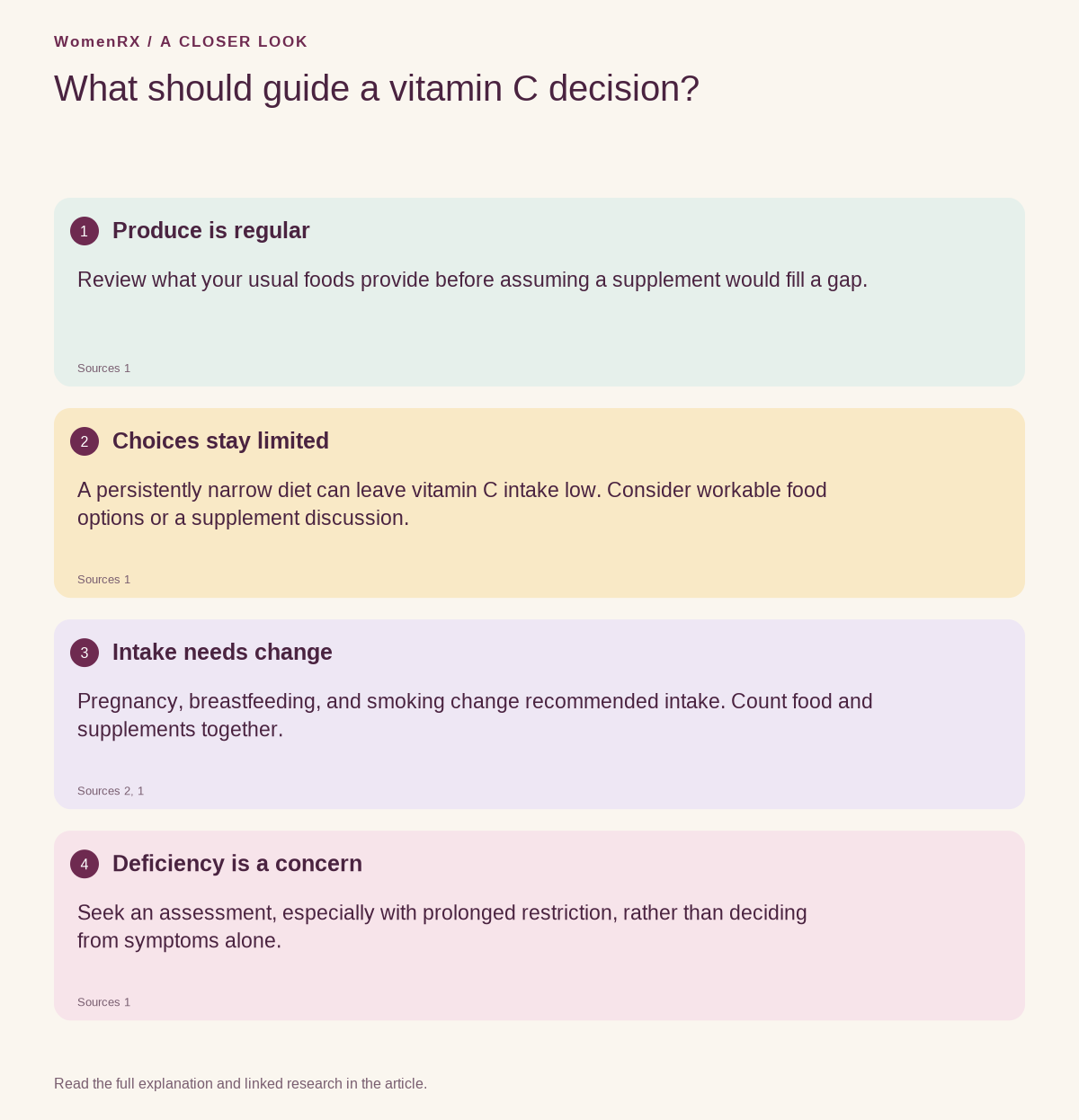
What should guide a vitamin C decision?
Produce is regular: Review what your usual foods provide before assuming a supplement would fill a gap.1
Choices stay limited: A persistently narrow diet can leave vitamin C intake low. Consider workable food options or a supplement discussion.1
Intake needs change: Pregnancy, breastfeeding, and smoking change recommended intake. Count food and supplements together.21
Deficiency is a concern: Seek an assessment, especially with prolonged restriction, rather than deciding from symptoms alone.1
Read the figure as text
Follow your usual food pattern first, then consider changed intake needs or a concern about deficiency.- Produce is regular: Review what your usual foods provide before assuming a supplement would fill a gap.1
- Choices stay limited: A persistently narrow diet can leave vitamin C intake low. Consider workable food options or a supplement discussion.1
- Intake needs change: Pregnancy, breastfeeding, and smoking change recommended intake. Count food and supplements together.21
- Deficiency is a concern: Seek an assessment, especially with prolonged restriction, rather than deciding from symptoms alone.1
Sources you can check
- Vitamin C - Health Professional Fact SheetAccessed 2026-09-25Return to first citation
- Molecular Pharmacology of Vitamin C and Relevance to Health and Obesity-A Narrative Review.Wilson RB, Liang Y, Kaushal D, Carr A. · International journal of molecular sciences · 2024Return to first citation