Vitamin C: Does Timing Matter, and Who May Need More?
For most women, the useful question is whether daily food and supplements together meet the life-stage target, not whether vitamin C is taken at a particular hour.
Vitamin C absorption depends partly on the amount taken, but the guidance doesn’t set a best time of day or require taking it with food. Most women can get enough from fruits and vegetables. A supplement may help fill a dietary gap; pregnancy and breastfeeding raise the recommended daily intake, while high doses can cause digestive upset. 1
The daily total matters more than the clock
Vitamin C is needed every day, but there’s no special morning, evening, or meal-time schedule in the US intake guidance. The body absorbs a higher share of moderate amounts than very large amounts: about 70% to 90% at intakes of 30 to 180 mg per day, compared with less than 50% at doses above 1,000 mg per day. Unused absorbed vitamin C can be excreted in urine. 1
That dose-dependent pattern doesn’t establish that splitting a supplement improves a health outcome. If a large dose bothers your stomach, taking less at a time is a reasonable practical experiment, but it isn’t a proven way to get extra benefit. The available evidence also doesn’t establish that taking vitamin C with food is necessary for absorption. 1
A small crossover study in 12 healthy adults found that vitamin C from a supplement, raw produce, and juice all raised blood vitamin C after a single intake. That short experiment can show that each route is absorbed; it can’t determine which route is best for long-term health or whether a particular daily schedule matters. 2
When food is likely enough
For adult women, the recommended dietary allowance (RDA) is 75 mg per day. One medium orange provides about 70 mg, while half a cup of raw red pepper provides about 95 mg. Strawberries, broccoli, kiwifruit, and Brussels sprouts are other useful sources. Food and supplements both count toward the daily total. 1
Vitamin C is also available in supplements, most often as ascorbic acid. NIH guidance reports that supplemental ascorbic acid has bioavailability equivalent to the ascorbic acid naturally present in foods. So a supplement isn’t automatically better absorbed just because it comes in a tablet or powder. 1
Food is a straightforward fit if you regularly eat vitamin-C-rich produce. If your food choices are limited or inconsistent, or a health condition affects absorption, a supplement may help close the gap. People who smoke have a higher recommended intake: 35 mg per day more than people who don’t smoke. 1
Pregnancy, breastfeeding, and periods
The RDA increases to 85 mg per day for adults during pregnancy and 120 mg per day while breastfeeding. For pregnant or breastfeeding teens ages 14 to 18, the respective RDAs are 80 mg and 115 mg per day. These are daily totals from food and supplements, not automatic supplement doses. 1
The RDA table gives different values by age, sex, and life stage, but it doesn’t list a separate increase for menstruation. Menstruating doesn’t by itself show that you need a vitamin C supplement. Vitamin C does help your body absorb nonheme iron, the kind found in plant foods, but that role doesn’t establish a need for a separate vitamin C pill. 1
What a supplement can and can’t answer
A supplement can help meet an intake target when food alone isn’t covering it. That’s different from preventing a deficiency and different again from taking vitamin C to improve a particular health outcome. Vitamin C has roles in collagen production, iron absorption, and immune function, but those roles don’t mean that a larger supplement dose will prevent or cure an infection. 1
The distinction matters because the body regulates vitamin C concentrations, and absorption becomes less efficient at high doses. The RDA is a target for usual daily intake, not a signal to take a megadose. For adults, including pregnancy and breastfeeding, the tolerable upper intake level is 2,000 mg per day from food and supplements combined. That’s a safety ceiling, not a recommended goal. 1
Use comfort as a practical signal
High supplemental amounts can cause diarrhea, nausea, and abdominal cramps. If a product causes digestive symptoms, a smaller amount or relying more on food may be more comfortable than trying to push through a large dose. 1
If you’re choosing a supplement, check its vitamin C amount and add it to what you already get from food and any multivitamin. For most women, the useful decision is whether the total fits the relevant daily target and whether the supplement serves a real dietary gap. Chasing a particular hour, splitting doses for a promised extra effect, or taking more simply because it’s available isn’t supported by the intake guidance. 1
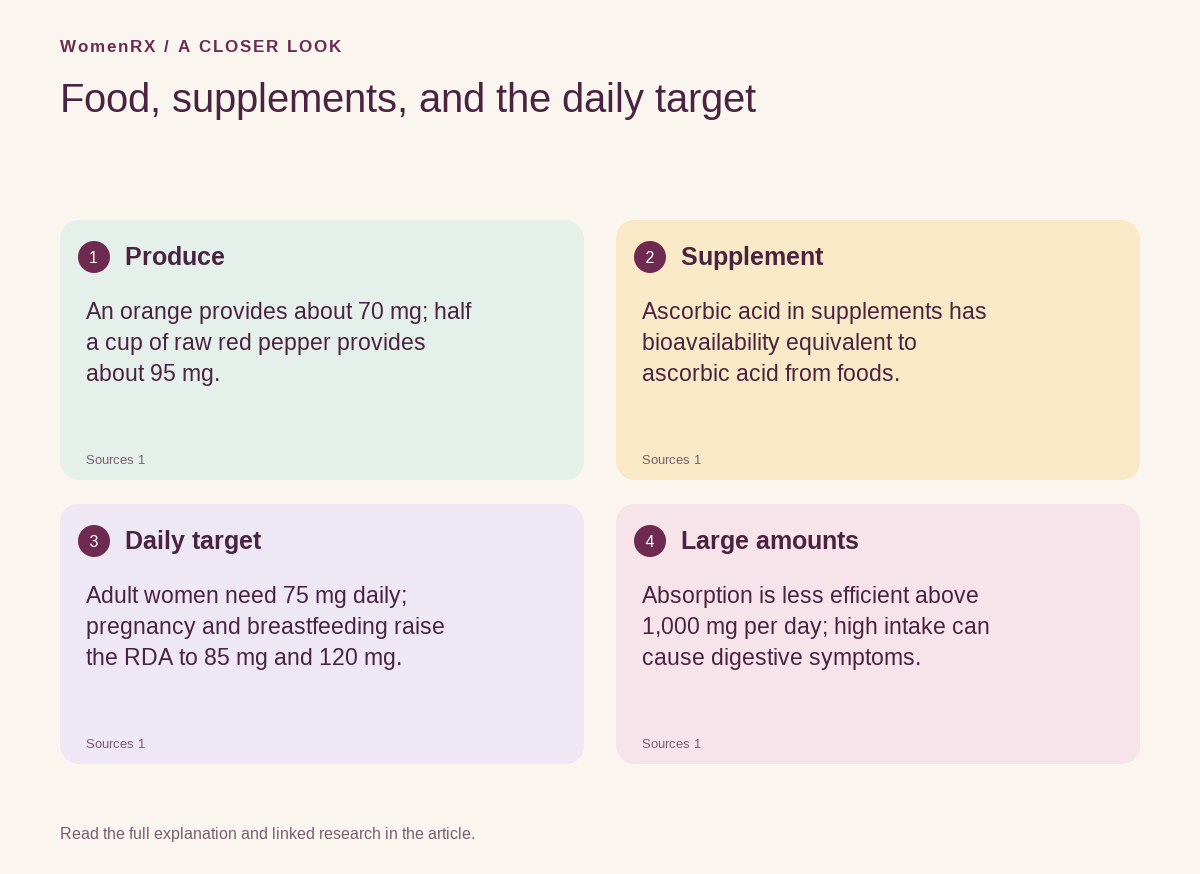
Food, supplements, and the daily target
Produce: An orange provides about 70 mg; half a cup of raw red pepper provides about 95 mg.1
Supplement: Ascorbic acid in supplements has bioavailability equivalent to ascorbic acid from foods.1
Daily target: Adult women need 75 mg daily; pregnancy and breastfeeding raise the RDA to 85 mg and 120 mg.1
Large amounts: Absorption is less efficient above 1,000 mg per day; high intake can cause digestive symptoms.1
Read the figure as text
Compare what each route can help answer, and which practical limits matter when deciding whether to add a supplement.- Produce: An orange provides about 70 mg; half a cup of raw red pepper provides about 95 mg.1
- Supplement: Ascorbic acid in supplements has bioavailability equivalent to ascorbic acid from foods.1
- Daily target: Adult women need 75 mg daily; pregnancy and breastfeeding raise the RDA to 85 mg and 120 mg.1
- Large amounts: Absorption is less efficient above 1,000 mg per day; high intake can cause digestive symptoms.1
More questions, answered
Should I take vitamin C with an iron-rich meal?
Vitamin C helps your body absorb nonheme iron from plant foods. A vitamin-C-rich food alongside beans, lentils, or fortified grains can contribute to that meal, but the guidance doesn’t require a separate supplement or a particular timing routine. 1
Can a high dose make more vitamin C available to my body?
Not in direct proportion to the amount taken. Absorption is less efficient above 1,000 mg per day, and excess absorbed vitamin C is excreted in urine. Large amounts can also cause digestive symptoms. 1
Sources you can check
- Vitamin C - Health Professional Fact SheetAccessed 2026-09-25Return to first citation
- Comparative Bioavailability of Vitamin C After Short-Term Consumption of Raw Fruits and Vegetables and Their Juices: A Randomized Crossover Study.Choi M, Baek J, Yun JM, Hong YS, Park E. · Nutrients · 2025Return to first citation