Collagen Supplements: What the Forms and Studies Show
The evidence applies to specific collagen formulations, not automatically to every product with “collagen” on the label.
Collagen products can contain hydrolyzed collagen peptides, gelatin, undenatured type II collagen, or combinations. These forms are related, but they aren’t interchangeable evidence-wise: a skin trial tested a particular fish-gelatin-derived peptide, while a knee osteoarthritis trial tested a combination that didn’t outperform placebo. These studies don’t answer questions about pregnancy, breastfeeding, or bone benefits. 3 5
Start with the form, then check the study
“Collagen supplement” is a broad label. Products may contain hydrolyzed collagen peptides, gelatin, undenatured type II collagen, or more than one form. A review describes collagen, gelatin, and collagen peptides as distinct but related materials; its abstract doesn’t provide a complete physical or chemical comparison of every form. 4
One practical distinction is clear in a skin study: researchers made low-molecular-weight collagen peptides by enzymatically hydrolyzing fish-skin-derived gelatin. In other words, gelatin was the starting material for that particular peptide product. That doesn’t mean ordinary gelatin has the same evidence, or that another collagen peptide product matches the one tested. 3
Undenatured type II collagen is another form named in a knee osteoarthritis trial. That trial combined it with hydrolyzed collagen, so it can’t show whether either ingredient would have had the same result on its own. The product form and the exact formulation matter when you compare a study with a tub on a shelf. 5
What the human studies actually tested
Skin: A randomized, placebo-controlled study enrolled 114 women ages 20 to 50 with thigh cellulite and self-reported hair thinning. Participants received either a specific low-molecular-weight fish-skin collagen peptide product or placebo for 24 weeks. The study reported greater improvements than placebo in several measured skin outcomes, including cellulite severity, skin roughness, and elasticity; it also reported an increase in hair diameter at week 24. These results apply to that product and those participants. They don’t establish that every collagen supplement improves skin, or that the results apply to all women or skin concerns. 3
The study was women-only, which is useful for understanding who was studied. It still addresses a particular group and set of outcomes, not pregnancy, breastfeeding, or every stage of adulthood. 3
Knee osteoarthritis: In a randomized, double-blind, placebo-controlled trial, 68 patients with knee osteoarthritis received either a combination of hydrolyzed collagen and undenatured type II collagen or placebo. Over 12 weeks, both groups improved, but the study found no significant between-group differences in pain, knee function, rescue medication use, or satisfaction. That means this combination did not show an advantage over placebo in this trial. It doesn’t settle whether a different formulation or population would have a different result. The abstract doesn’t report sex-specific outcomes. 5
No adverse effects were reported in either group during this 12-week trial. That finding is limited to the specific combination and study period; it doesn’t establish the safety of other products or longer-term use. 5
The study authors also describe earlier collagen trials as using different formulations and note that many were industry-sponsored. That variation makes it harder to treat results for one product as proof for another. 5
What about gelatin, pregnancy, or bones?
The fish-skin study shows that a particular gelatin can be processed into collagen peptides, but its results are not evidence that gelatin itself produces the same skin outcomes. The review recognizes gelatin and peptides as different forms, but the study summaries here don’t provide a direct clinical comparison between eating gelatin and taking collagen peptides. 3 4
The human studies described here don’t answer whether collagen supplements are beneficial or safe during pregnancy or breastfeeding. They also don’t provide evidence about bone outcomes. That’s a limit of these studies, not proof that no research exists. If you’re pregnant, breastfeeding, or choosing a supplement for a health condition, don’t assume results from a skin or knee study apply to you.
A practical label check
Before choosing a product, look for the form named on the label, its source (for example, fish), and any other listed ingredients. If you have a food allergy, check ingredients carefully: a food allergy can involve many different foods, and ingredient labels are one practical place to check for the food you need to avoid. 1
For joint symptoms, keep supplements in perspective. Osteoarthritis care includes approaches such as exercise, and the collagen combination in the trial above did not outperform placebo. A supplement shouldn’t stand in for care aimed at persistent pain or stiffness. 2 5
The simplest way to compare products is to ask: Is this the same form, source, combination, and outcome studied? If not, the trial may be interesting background, but it isn’t a direct result for the product you’re considering.
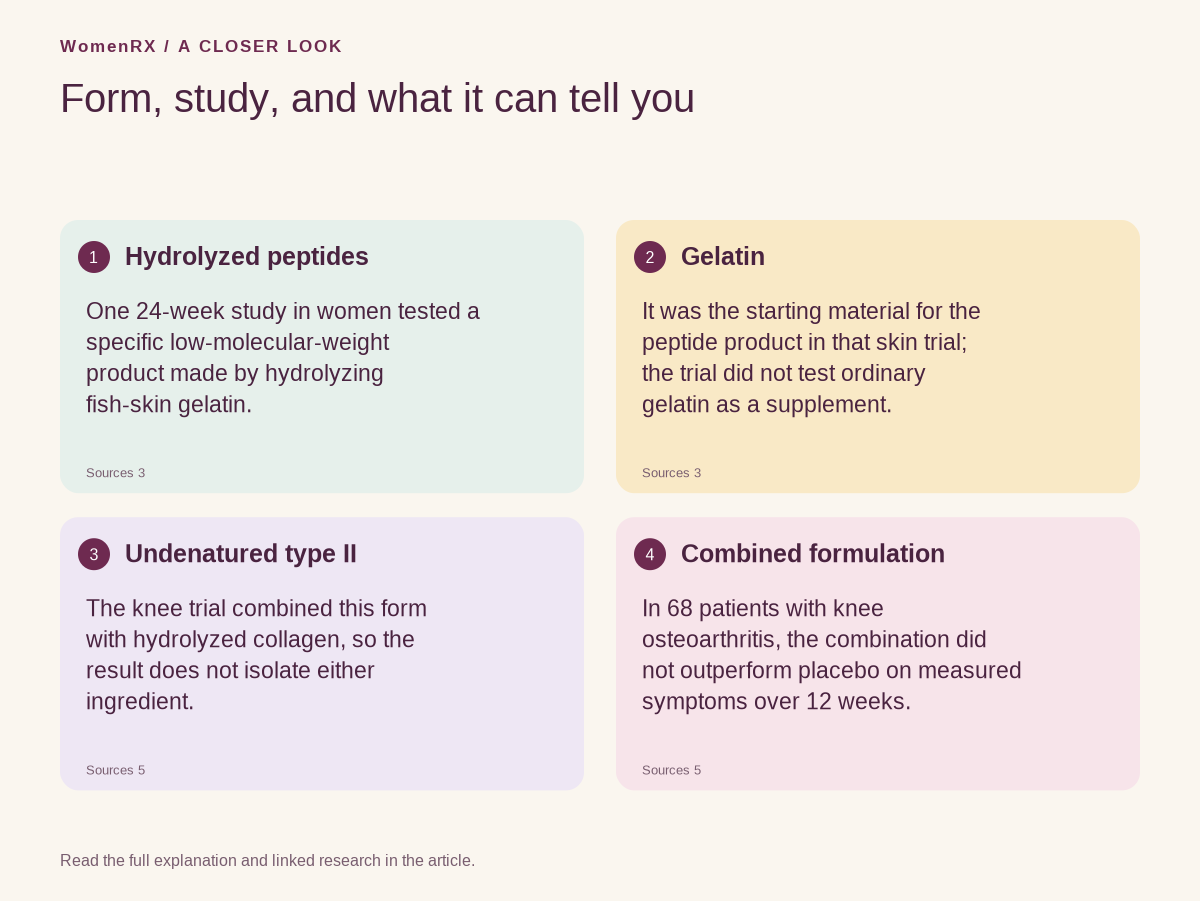
Form, study, and what it can tell you
Hydrolyzed peptides: One 24-week study in women tested a specific low-molecular-weight product made by hydrolyzing fish-skin gelatin.3
Gelatin: It was the starting material for the peptide product in that skin trial; the trial did not test ordinary gelatin as a supplement.3
Undenatured type II: The knee trial combined this form with hydrolyzed collagen, so the result does not isolate either ingredient.5
Combined formulation: In 68 patients with knee osteoarthritis, the combination did not outperform placebo on measured symptoms over 12 weeks.5
Read the figure as text
These are the forms and formulations described in the human studies. Evidence for one should not be assumed to apply to another.- Hydrolyzed peptides: One 24-week study in women tested a specific low-molecular-weight product made by hydrolyzing fish-skin gelatin.3
- Gelatin: It was the starting material for the peptide product in that skin trial; the trial did not test ordinary gelatin as a supplement.3
- Undenatured type II: The knee trial combined this form with hydrolyzed collagen, so the result does not isolate either ingredient.5
- Combined formulation: In 68 patients with knee osteoarthritis, the combination did not outperform placebo on measured symptoms over 12 weeks.5
More questions, answered
Do collagen skin-study results apply during pregnancy or breastfeeding?
The skin trial described here studied women ages 20 to 50 with cellulite and self-reported hair thinning; it doesn’t answer whether the product is beneficial or safe during pregnancy or breastfeeding. 3
Does evidence for collagen peptides apply to gelatin?
Not automatically. In one skin study, researchers enzymatically hydrolyzed fish-skin gelatin to produce a specific collagen peptide product. The study tested that peptide product, not ordinary gelatin as a supplement. 3
Sources you can check
- Food allergy - NHSAccessed 2026-09-25Return to first citation
- Osteoarthritis - Treatment and support - NHSAccessed 2026-09-25Return to first citation
- Low-Molecular-Weight Collagen Peptide Supplementation Improves Cellulite Severity, Skin Elasticity, and Hair Shaft Diameter: A Clinical Study with Pharmacokinetic Evaluation.Hwang S, Won J, Kim S, Kang W, Park M. · Journal of medicinal food · 2026Return to first citation
- Characteristics and food applications of aquatic collagen and its derivatives: A review.Shi H, Jiang M, Zhang X, Xia G, Shen X. · Food research international (Ottawa, Ont.) · 2025Return to first citation
- Efficacy of combined undenatured type II collagen and hydrolysed collagen supplementation in knee osteoarthritis: a randomised controlled trial.Yuenyongviwat V, Anusitviwat C, Tuntarattanapong P, Hongnaparak T, Iamthanaporn K. · Scientific reports · 2025Return to first citation