Collagen for Hair Loss: What the Studies Show
One trial in women found a signal for thicker hair strands, but that’s different from showing collagen regrows hair or treats the cause of thinning.
Collagen may affect some measures of hair thickness or appearance, but it hasn’t been established as a treatment for hair loss. A 24-week trial in women reported increased hair-shaft diameter with one specific collagen peptide; other studies tested products with several ingredients. If you’re shedding or thinning, finding out why matters more than assuming a supplement will address it. 234
A thicker strand isn’t the same as regrowth
A placebo-controlled trial enrolled 114 women ages 20 to 50 who had thigh cellulite and self-reported hair thinning. After 24 weeks, researchers reported increased hair-shaft diameter and a larger proportion of women with measurable thickening in the group taking a specific low-molecular-weight collagen peptide. The study abstract doesn’t give the size of the diameter change or make clear whether its reported statistical significance for that measure was a comparison with placebo. 2
Hair-shaft diameter is the width of an individual strand. It doesn’t tell you whether more hairs grew, shedding stopped, or the reason for thinning changed. The finding is a reason to study that particular peptide further, not a promise that any collagen powder will regrow hair. 2
The trial abstract doesn’t report separate results for postpartum women or women going through menopause. If you first noticed a hair change after giving birth or around menopause, that timing helps describe your situation, but this trial can’t tell you whether its finding applies to it. 2
What the combination studies can and can’t tell us
In a 12-week randomized study, 83 people with androgenetic hair loss or chronic telogen effluvium, including 57 women, were assigned either condition-specific treatment alone or treatment plus a supplement containing hydrolyzed collagen, amino acids, iron, and selenium. The supplement group had better scores on an overall photographic hair assessment. Because everyone receiving the supplement also received treatment, and because the supplement had several ingredients, the study can’t isolate an effect of collagen or show that it could replace treatment. The researchers didn’t report a separate result for women in the abstract. 3
Other findings need the same careful reading. A trial in 40 women tested collagen together with hyaluronic acid, biotin, and vitamins C and E; any hair changes can’t be credited to collagen alone. 7 A trial of collagen with vitamin C reported 27.6% more hairs counted than with placebo after 12 weeks, but that difference was not statistically significant. Its improved clinical rating of healthy-looking hair is an appearance finding, not proof of regrowth. 6
Hair quality is another question
Some studies examine damaged hair rather than hair loss. A placebo-controlled trial in adults with mild to moderate hair damage, but no alopecia, reported improvements in measures including gloss and elasticity with a particular collagen peptide. That may be relevant if your concern is how your strands look or feel. It doesn’t establish a treatment for thinning at the scalp. 5
Overall, a 2026 review found the human evidence on collagen and hair varied across study designs, products, and outcomes. Short studies and multi-ingredient formulas make the size and consistency of any collagen-specific benefit uncertain. 4
Match the next step to the change you’re noticing
For example, more hair coming out when you wash it, a gradually widening part, and strands that break and look damaged are different observations. A supplement claim about shine or strand diameter doesn’t answer every one of those concerns. Hair loss can be temporary, follow an illness, run in families, or sometimes signal a medical condition. 125
If the loss worries you, or you can’t tell what’s behind it, a clinician can examine your hair and help assess the cause. Describe what changed and when you first noticed it, including whether it followed an illness or began around a life-stage change. That gives you a more useful starting point than trying collagen as if all hair changes were the same problem. 1
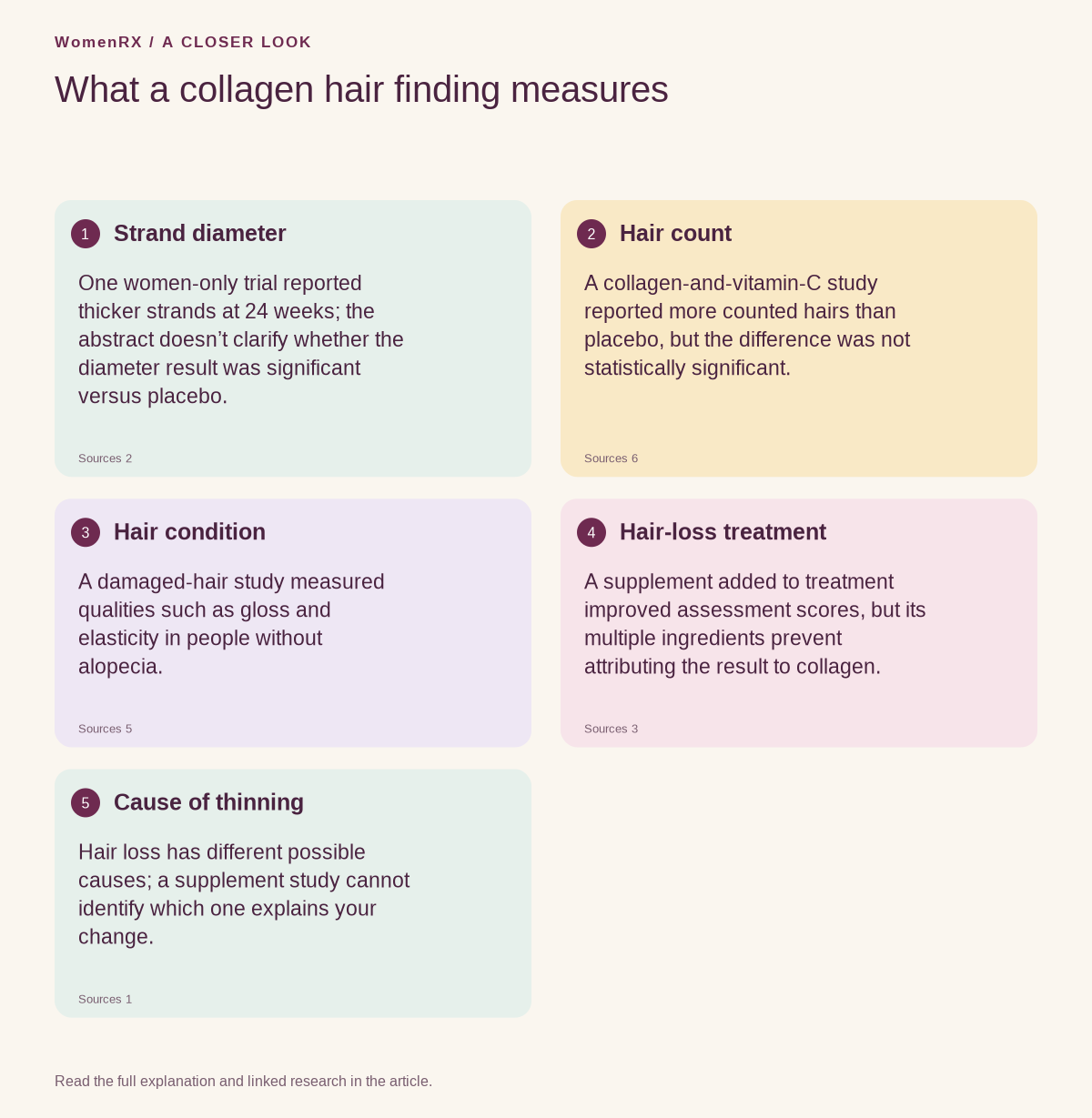
What a collagen hair finding measures
Strand diameter: One women-only trial reported thicker strands at 24 weeks; the abstract doesn’t clarify whether the diameter result was significant versus placebo.2
Hair count: A collagen-and-vitamin-C study reported more counted hairs than placebo, but the difference was not statistically significant.6
Hair condition: A damaged-hair study measured qualities such as gloss and elasticity in people without alopecia.5
Hair-loss treatment: A supplement added to treatment improved assessment scores, but its multiple ingredients prevent attributing the result to collagen.3
Cause of thinning: Hair loss has different possible causes; a supplement study cannot identify which one explains your change.1
Read the figure as text
These findings answer different questions. A change in how a strand looks or measures is not necessarily a change in hair loss.- Strand diameter: One women-only trial reported thicker strands at 24 weeks; the abstract doesn’t clarify whether the diameter result was significant versus placebo.2
- Hair count: A collagen-and-vitamin-C study reported more counted hairs than placebo, but the difference was not statistically significant.6
- Hair condition: A damaged-hair study measured qualities such as gloss and elasticity in people without alopecia.5
- Hair-loss treatment: A supplement added to treatment improved assessment scores, but its multiple ingredients prevent attributing the result to collagen.3
- Cause of thinning: Hair loss has different possible causes; a supplement study cannot identify which one explains your change.1
More questions, answered
Is marine collagen better for hair than other types?
That hasn’t been established. Marine-derived peptides appear more often in clinical research, but a review cautions that this may reflect which products have been studied rather than a true advantage over other collagen sources. 4
Sources you can check
- Hair loss - NHSAccessed 2026-09-25Return to first citation
- Low-Molecular-Weight Collagen Peptide Supplementation Improves Cellulite Severity, Skin Elasticity, and Hair Shaft Diameter: A Clinical Study with Pharmacokinetic Evaluation.Hwang S, Won J, Kim S, Kang W, Park M. · Journal of medicinal food · 2026Return to first citation
- Efficacy and tolerability of an oral supplement containing amino acids, iron, selenium, and marine hydrolyzed collagen in subjects with hair loss (androgenetic alopecia, AGA or FAGA or telogen effluvium). A prospective, randomized, 3-month, controlled, assessor-blinded study.Milani M, Colombo F, GFM‐O‐Trial Investigators Group. · Skin research and technology : official journal of International Society for Bioengineering and the Skin (ISBS) [and] International Society for Digital Imaging of Skin (ISDIS) [and] International Society for Skin Imaging (ISSI) · 2023Return to first citation
- Dietary Collagen Supplementation as a Strategy for Skin Health: A Narrative Review of Clinical Effects on Skin, Hair, Nails, and Wound Healing.Biełach-Bazyluk A, Jurga M, Flisiak I, Zbroch E. · Nutrients · 2026Return to first citation
- Efficacy and Safety of Low-Molecular-Weight Collagen Peptide GT for Improving Hair Condition in Individuals with Damaged Hair: A Randomized, Double-Blind, Placebo-Controlled Trial.Kim TK, Oh J, Ha YS, Son HJ, Yang JS, Kim K, Her Y, Kim SK, Hwang S, Yang SR, Choi J, Kim SJ. · International journal of stem cells · 2026Return to first citation
- A Clinical Trial Shows Improvement in Skin Collagen, Hydration, Elasticity, Wrinkles, Scalp, and Hair Condition following 12-Week Oral Intake of a Supplement Containing Hydrolysed Collagen.Reilly DM, Kynaston L, Naseem S, Proudman E, Laceby D. · Dermatology research and practice · 2024Return to first citation
- Efficacy and Safety of Skin Radiance Collagen on Skin and Hair Matrix: A Placebo-Controlled Clinical Trial in Healthy Human Subjects.Trehan A, Anand R, Chaudhary G, Garg H, Verma MK. · Clinical, cosmetic and investigational dermatology · 2024Return to first citation