Collagen, Hair, and Skin Changes on GLP-1s
Collagen trials suggest possible changes in some skin measurements, but they don’t show that collagen prevents GLP-1-related hair shedding or facial changes.
Collagen isn’t a proven fix for hair or skin changes during GLP-1-associated weight loss. Some small trials found improvements in measured skin hydration, elasticity, or wrinkles, and one trial in women with self-reported thinning found thicker hair shafts. Those results don’t show that collagen stops shedding, treats a deficiency, or prevents changes related to weight loss or GLP-1 medicines. 2 3 4
What collagen has been tested for
The most useful distinction is between a measurement that changed in a study and a concern you might notice in the mirror. Several collagen trials measured skin features such as hydration, elasticity, wrinkles, or dermal density. For example, a randomized trial in 77 healthy women reported improvements in some skin measurements after 12 weeks of a collagen-peptide supplement. Another trial in healthy adults reported improvements in skin measurements after eight weeks. These results suggest possible effects on selected skin outcomes, not a general treatment for skin changes during weight loss. 2 4
They also don’t answer whether collagen can restore facial fullness or prevent changes in facial appearance as weight changes. The studies measured skin properties, not whether collagen offsets changes associated with losing body fat.
Hair evidence is narrower. A randomized trial enrolled 114 women ages 20 to 50 who had thigh cellulite and self-reported hair thinning. After 24 weeks, hair diameter increased in the collagen-peptide group. That finding is not the same as showing fewer hairs shed, more hair regrowth, or benefit for hair changes during GLP-1 treatment. 3
What those studies can’t tell you about GLP-1s
The collagen trials described here weren’t tests of collagen for hair loss or skin changes in people taking GLP-1 medicines. They therefore can’t establish that collagen prevents or reverses a medication-related effect, or that it corrects a nutritional deficiency. A supplement’s marketing claims aren’t a way to diagnose a deficiency or identify why your hair or skin has changed.
If you’re considering collagen, look at the exact outcome you hope to change. A study reporting better skin hydration doesn’t establish a benefit for hair shedding; a study reporting thicker hair shafts doesn’t establish that shedding stops. And results from a particular peptide product don’t automatically apply to every collagen product. 2 3 4
Look for the pattern, not just the supplement
Some daily hair shedding is normal. Hair loss can also be temporary after an illness, while some thinning patterns run in families. A change in your hair deserves a closer look if it’s worrying you, especially if the timing or pattern is new. 1
When you discuss a change with a clinician, useful context includes when it began relative to weight loss or starting a medication, whether you’re seeing more shedding or gradual thinning, and whether you’ve recently been ill. Mention other changes too, including menstrual changes, pregnancy or breastfeeding, the postpartum period, or perimenopause or menopause. Ask whether iron deficiency or another cause should be considered rather than assuming collagen is the answer. These details help frame the discussion; they don’t establish what’s causing your symptoms.
Collagen studies described here don’t establish safety during pregnancy or breastfeeding. If either applies to you, don’t assume a supplement studied in other adults is suitable; review the specific product with your care team.
Separate hair shedding from skin hydration
If your main concern is hair shedding, collagen has not been shown in these trials to stop it. If your concern is skin dryness or elasticity, some studies offer a limited signal for measured skin outcomes, but they don’t test GLP-1-associated changes. In either case, first clarify what changed and whether another explanation needs attention. That gives you a more useful next step than choosing a product based on a broad “hair, skin, and nails” promise.
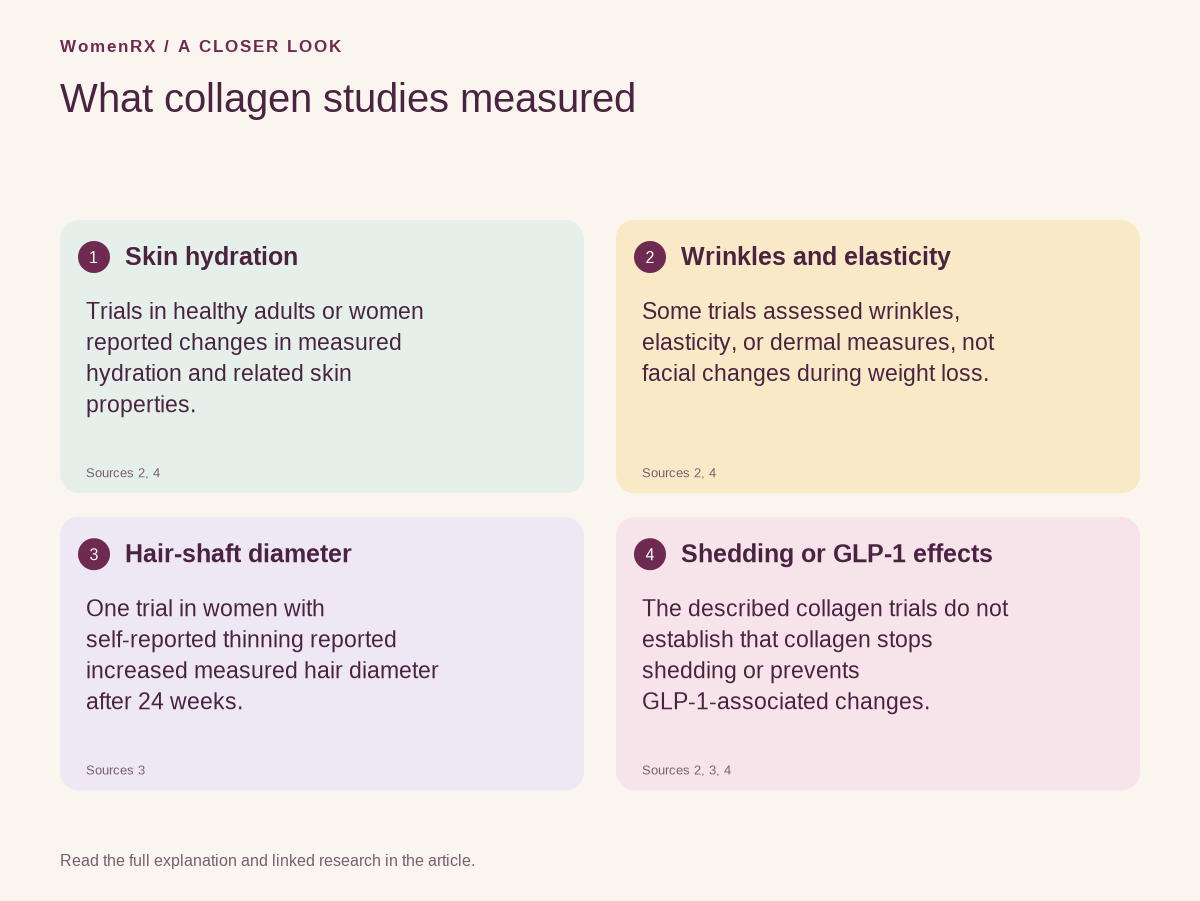
What collagen studies measured
Skin hydration: Trials in healthy adults or women reported changes in measured hydration and related skin properties.24
Wrinkles and elasticity: Some trials assessed wrinkles, elasticity, or dermal measures, not facial changes during weight loss.24
Hair-shaft diameter: One trial in women with self-reported thinning reported increased measured hair diameter after 24 weeks.3
Shedding or GLP-1 effects: The described collagen trials do not establish that collagen stops shedding or prevents GLP-1-associated changes.234
Read the figure as text
These studies measured particular skin or hair features. The measures are not interchangeable with preventing shedding or treating GLP-1-associated changes.- Skin hydration: Trials in healthy adults or women reported changes in measured hydration and related skin properties.24
- Wrinkles and elasticity: Some trials assessed wrinkles, elasticity, or dermal measures, not facial changes during weight loss.24
- Hair-shaft diameter: One trial in women with self-reported thinning reported increased measured hair diameter after 24 weeks.3
- Shedding or GLP-1 effects: The described collagen trials do not establish that collagen stops shedding or prevents GLP-1-associated changes.234
More questions, answered
Does thicker hair in a study mean less hair shedding?
No. The trial in women with self-reported thinning measured hair-shaft diameter. That result doesn’t establish that participants shed fewer hairs or that collagen treats the cause of thinning. 3
Do collagen skin results apply to every supplement?
Not automatically. The trials tested particular collagen products, and one specifically described a low-molecular-weight peptide product. Their findings don’t prove that products with different ingredients or formulations produce the same results. 2 4
Sources you can check
- Hair loss - NHSAccessed 2026-09-25Return to first citation
- Skin Anti-Aging and Moisturizing Effects of Low-Molecular-Weight Collagen Peptide Supplementation in Healthy Adults: A Randomized, Double-Blind, Placebo-Controlled Clinical Trial.Lee E, Ahn DK, Kim JH, Lee S, Kim HJ, Lee HK, Shin JH. · Journal of microbiology and biotechnology · 2025Return to first citation
- Low-Molecular-Weight Collagen Peptide Supplementation Improves Cellulite Severity, Skin Elasticity, and Hair Shaft Diameter: A Clinical Study with Pharmacokinetic Evaluation.Hwang S, Won J, Kim S, Kang W, Park M. · Journal of medicinal food · 2026Return to first citation
- The Sustained Effects of Bioactive Collagen Peptides on Skin Health: A Randomized, Double-Blind, Placebo-Controlled Clinical Study.Wang Y, Zhu W, Luo W, Ma Y, Zhou Y. · Journal of cosmetic dermatology · 2025Return to first citation