Creatine and GLP-1s: What We Know About Muscle
Creatine may support strength in some exercise settings, but research hasn’t established that it preserves muscle during GLP-1 treatment.
Research hasn’t established that adding creatine to a GLP-1 medicine prevents muscle loss or improves strength during weight loss. A 2026 review describes creatine as an adjunct supported mainly by indirect evidence. Studies of creatine with exercise, including a small study in women after bariatric surgery, can’t show what happens with GLP-1 treatment. 1 5
Creatine is sometimes suggested as a way to protect muscle while taking a GLP-1 medicine for weight loss. The practical answer is that the combination’s muscle benefits haven’t been established. Research on creatine alone, or alongside exercise in other settings, can inform questions to ask, but it can’t prove that creatine prevents muscle loss during GLP-1 treatment. 1
“Lean mass” doesn’t automatically mean muscle loss
During weight loss, body-composition tests can show a decrease in lean mass. That category includes more than skeletal muscle, and a change in lean mass doesn’t by itself tell you whether strength or everyday function has declined. A 2026 review of GLP-1-based treatment emphasizes that DXA-measured lean mass and bioelectrical-impedance estimates of fat-free mass aren’t the same as a direct measure of muscle or its performance. 1
A separate meta-analysis pooled 20 randomized trials with 15,782 adults. It estimated that lean mass accounted for 35.2% of weight lost with semaglutide, 25.4% with tirzepatide, and 26.8% with liraglutide. The corresponding estimate for lifestyle interventions was 26.2%; lifestyle plus resistance training had the lowest estimate, 17.5%. These are pooled body-composition findings, not proof that every person loses the same amount of muscle, and they don’t show that creatine changes the result. The figures presented here aren’t broken down for women. 3
So a scan or scale reading is only one part of the picture. Strength, physical function, eating enough, and whether resistance exercise is part of the plan help make the change more meaningful. 1
What creatine studies can, and can’t, tell you
Some research in older adults has tested creatine alongside resistance training. One small randomized study included 45 older adults, both women and men, divided among resistance training with creatine, resistance training with placebo, and a control group. Strength improved in the training groups, with larger gains reported in the creatine group. Because training was part of the intervention, and the study wasn’t conducted during GLP-1 treatment, it can’t tell us whether creatine protects muscle during medication-related weight loss. 6
A small pilot study offers a more women-specific comparison, but it still wasn’t a GLP-1 study. Fifteen women recovering from bariatric surgery did strength training for eight weeks and received either creatine or placebo before exercise. The researchers found no significant between-group difference in muscle-mass loss. Surgery, recovery, and medication-assisted weight loss aren’t interchangeable settings, so this result doesn’t settle the question for women taking a GLP-1 medicine. 5
There’s also a study of creatine combined with HMB, a different supplement, and a structured exercise program in 30 physically active older adults, including 10 women. It reported improvements in several strength measures, but the combination makes it impossible to attribute the effect to creatine alone. The study also wasn’t about GLP-1 treatment or weight-loss-related muscle outcomes. 4
The findings reported for the two older-adult studies combine women and men, so they don’t show whether older women benefited differently. Neither those findings nor the women-only surgery pilot establishes an effect specifically for postmenopausal women taking a GLP-1 medicine. 4 5 6
Taken together, these studies make creatine a question worth discussing if strength training is part of your plan. They don’t make it a proven safeguard or a necessary addition for everyone. A review of GLP-1-based obesity treatment describes creatine as an adjunct supported mainly by indirect or specific-population evidence, while emphasizing nutrition and structured resistance exercise as more central parts of supportive care. 1
If you’re considering it, focus on the goal and the test
It helps to be specific about what you want creatine to do. Are you trying to build strength in a resistance-training program, address a change in physical function, or respond to a body-composition result? Those are different questions, and the available research doesn’t show that creatine reliably changes GLP-1-related muscle outcomes.
Kidney testing is another useful conversation. In the small older-adult exercise study, serum creatinine increased in the group taking creatine with training. That finding doesn’t establish kidney injury, but it’s worth telling the clinician ordering your tests that you take creatine. 6 In an analysis of adults with type 2 diabetes taking tirzepatide, kidney-function estimates based on creatinine and cystatin C showed similar patterns over a year. Cystatin C is not dependent on muscle mass, which can make it a useful part of interpreting kidney estimates when body composition is changing. 2
Before adding creatine, you could ask:
- What outcome are we trying to improve: strength, function, or a body-composition measurement?
- Would resistance training or addressing low food intake be a better first step for that goal?
- Could creatine affect how my kidney test results are interpreted, and would cystatin C add useful context?
- Do my kidney health, other medicines, or health conditions change the decision?
The studies summarized here don’t establish a specific medication interaction, dose, or safety plan for using creatine with GLP-1 treatment. They also don’t establish safety or benefit during pregnancy or breastfeeding. If either applies to you, get advice specific to that stage before using a supplement.
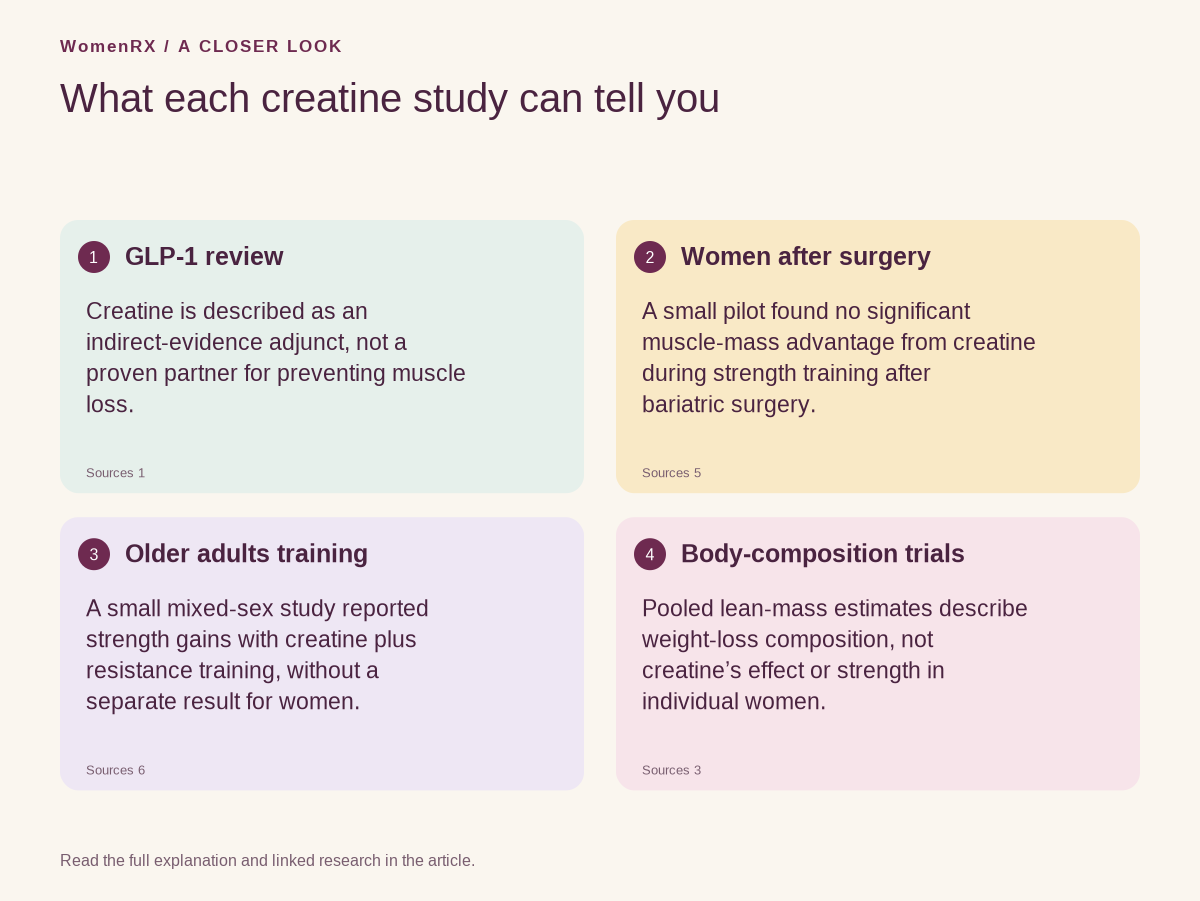
What each creatine study can tell you
GLP-1 review: Creatine is described as an indirect-evidence adjunct, not a proven partner for preventing muscle loss.1
Women after surgery: A small pilot found no significant muscle-mass advantage from creatine during strength training after bariatric surgery.5
Older adults training: A small mixed-sex study reported strength gains with creatine plus resistance training, without a separate result for women.6
Body-composition trials: Pooled lean-mass estimates describe weight-loss composition, not creatine’s effect or strength in individual women.3
Read the figure as text
These studies address different populations and outcomes; none establishes that creatine preserves muscle during GLP-1 treatment.- GLP-1 review: Creatine is described as an indirect-evidence adjunct, not a proven partner for preventing muscle loss.1
- Women after surgery: A small pilot found no significant muscle-mass advantage from creatine during strength training after bariatric surgery.5
- Older adults training: A small mixed-sex study reported strength gains with creatine plus resistance training, without a separate result for women.6
- Body-composition trials: Pooled lean-mass estimates describe weight-loss composition, not creatine’s effect or strength in individual women.3
Sources you can check
- Lean Mass and Musculoskeletal Preservation in GLP-1-Based Obesity Treatment: Nutrition, Exercise, Supplementation, and Monitoring Strategies.Šantić R, Martinović L, Pavlović N, Rušić D, Kumrić M, Martinović D, Tičinović Kurir T, Božić J. · Metabolites · 2026Return to first citation
- Effects of Tirzepatide Versus Insulin Glargine on Cystatin C-Based Kidney Function: A SURPASS-4 Post Hoc Analysis.Heerspink HJL, Sattar N, Pavo I, Haupt A, Duffin KL, Yang Z, Wiese RJ, Wilson JM, Hemmingway A, Cherney DZI, Tuttle KR. · Diabetes care · 2023Return to first citation
- Lean Mass Changes With Incretin Therapy Versus Lifestyle Intervention: A Systematic Review and Meta-Analysis of Randomised Controlled Trials.Eisa N, Barood O. · Diabetes, obesity & metabolism · 2026Return to first citation
- Combined creatine and HMB co-supplementation improves functional strength independent of muscle mass in physically active older adults: a randomized crossover trial.Ramos-Hernández R, Miguel-Ortega Á, Martínez-Ferrán M, Fernández-Lázaro D, Busto N, Mielgo-Ayuso J. · GeroScience · 2026Return to first citation
- Creatine Supplementation Prior to Strength Exercise Training Is Not Superior in Preventing Muscle Mass Loss Compared with Standard Nutritional Recommendations in Females After Bariatric Surgery: A Pilot Study.Diaz-Pizarro M, Pino-Zúñiga J, Gálvez MO, Vesga CR, Tello RL, Seguro JCD, Cancino-Lopez J. · Obesity surgery · 2024Return to first citation
- The role of resistance training and creatine supplementation on oxidative stress, antioxidant defense, muscle strength, and quality of life in older adults.Amiri E, Sheikholeslami-Vatani D. · Frontiers in public health · 2023Return to first citation