Compounded Tirzepatide: What to Check Before You Decide
A compounded offer may look like an easy substitute for Zepbound or Mounjaro, but the product and the safeguards behind it can differ.
Compounded tirzepatide is not an FDA-approved drug. A compounded drug may be appropriate when an approved drug cannot meet a particular medical need or is not commercially available, but it does not receive FDA review for safety, effectiveness, and quality before marketing. Before proceeding, establish why this preparation is being proposed, how it qualifies under current compounding rules, who will make it, what it contains, and who will manage your care. 73
Start with the reason for compounding
The first question isn’t whether the offer says “tirzepatide.” It’s why a compounded preparation is being proposed for you. FDA-approved products and compounded preparations are not interchangeable simply because they name the same active ingredient. The FDA says compounding may be appropriate when an approved drug cannot meet a patient’s medical need or is not commercially available. It also says compounded drugs do not undergo its premarketing review for safety, effectiveness, and quality. 7
There’s a current-rules question, too. A 2026 review describes the post-shortage constraint this way: after shortages of approved semaglutide and tirzepatide products resolved, compounding pharmacies could legally sell only unique products. The review describes offerings that differed in strength, route, or formulation, but a difference in an advertisement does not, by itself, establish that a particular offer complies with the rules. 3
Ask the prescriber: “What need does this specific preparation meet that an approved option doesn’t?” If the answer is only that it’s described as a generic Zepbound or Mounjaro, pause. That description obscures the distinction you need to make a decision. Also ask: “What makes this preparation distinct, and how have you checked that it qualifies under current compounding rules?” A general claim about GLP-1 shortages doesn’t establish that a specific offer is appropriate for you. 37
Find out what would actually arrive
An offer labeled “compounded tirzepatide” doesn’t tell you the full formulation. In a 2026 review of online offerings for compounded semaglutide and tirzepatide, researchers reported differences in strengths, routes, and added ingredients across the products surveyed. Some combined either drug with other ingredients, including a form of vitamin B12. The review does not establish which of those variations applied to tirzepatide alone, or whether the advertised products work as well as approved medicines. 3
Get the proposed formulation in writing: Is it an injection or another form? What else is in it? What is its concentration, and how will the amount prescribed be measured? Is it supplied in a vial containing multiple doses? These aren’t fussy details. The FDA has reported adverse events potentially associated with compounded semaglutide and tirzepatide given in amounts or schedules beyond those in approved-drug labeling. It also warns that multi-dose vials raise practical questions about use after opening and contamination. 7
An added ingredient deserves its own explanation, not a vague claim of personalization. Researchers testing samples of compounded tirzepatide combined with certain B12 analogs found an impurity formed by a chemical reaction. The clinical effects of that impurity are unknown, and the finding does not establish that every compounded tirzepatide product contains it. It does give you a concrete question: “Why is this ingredient included, and what is known about the quality of this exact formulation?” 4
Check who is making it, not just who is selling it
Ask for the name and location of the pharmacy that will make your prescription, whether that pharmacy will make the product you’re being offered, and how you can confirm that the pharmacy is real and actually made the product. Don’t treat a polished website or a pharmacy name printed on a label as confirmation. The FDA has identified fraudulent compounded tirzepatide and semaglutide products whose labels named nonexistent pharmacies or pharmacies that had not made the products. 7
This is also the moment to ask who answers questions about a multi-dose vial, including how long it can be used after opening. The FDA warns that contamination risk increases after 28 days of use. If the seller cannot clearly connect the prescription, the pharmacy, and the product that will reach you, pause before paying. 7
Make the care plan part of the offer
The product is only one part of treatment. Ask the prescriber how they’ll decide whether tirzepatide suits you, what they’ll review if you take other medicines, and who will respond if you have troublesome symptoms or a question about the amount you’ve been given. FDA reports involving compounded semaglutide and tirzepatide include nausea, vomiting, diarrhea, abdominal pain, and constipation; some people sought medical attention. A clear route back to the prescribing team matters more than a promise of easy refills. 7
Mention pregnancy plans before starting, even if conception isn’t imminent. A review for obstetrician-gynecologists identifies contraception and preconception planning as specific considerations with tirzepatide and related medicines. It notes manufacturer guidance about backup contraception after starting tirzepatide or increasing its dose. Research on inadvertent early pregnancy exposure remains limited, so it cannot establish that exposure is safe. Compounding does not remove these questions or create evidence of a different effect in women. 2
The approved Zepbound labeling also identifies a clear reason it must not be used: a personal or family history of medullary thyroid carcinoma, or multiple endocrine neoplasia syndrome type 2. Its thyroid tumor warning is based on findings in rats; whether those findings apply to humans is unknown. Bring up either history during the suitability discussion rather than assuming an offer has already screened for it. 1
Finally, compare the whole offer, not two headline prices. For example, one seller’s September 2026 listing put a starting compounded-tirzepatide medication price at $90 per month, with a separate $79 one-month membership; its medication price varied by prescribed dose and pharmacy. An approved Zepbound self-pay vial listing started at $299 for a specified 28-day supply, with conditions and other potential costs. Those listings do not compare identical products or establish your total cost. Ask what the quoted price includes, what product and quantity you’ll receive, and what happens if your treatment plan changes. 56
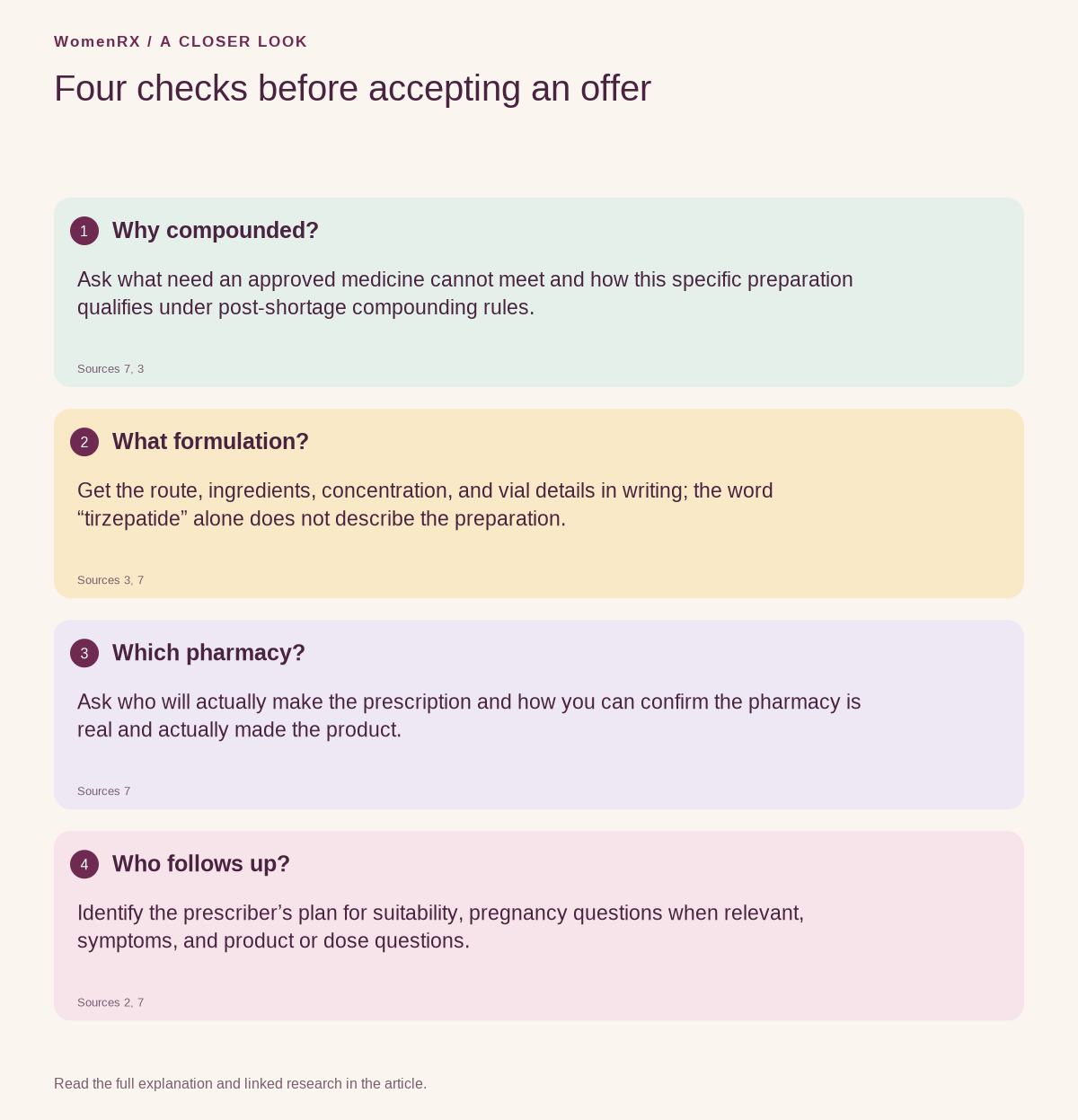
Four checks before accepting an offer
Why compounded?: Ask what need an approved medicine cannot meet and how this specific preparation qualifies under post-shortage compounding rules.73
What formulation?: Get the route, ingredients, concentration, and vial details in writing; the word “tirzepatide” alone does not describe the preparation.37
Which pharmacy?: Ask who will actually make the prescription and how you can confirm the pharmacy is real and actually made the product.7
Who follows up?: Identify the prescriber’s plan for suitability, pregnancy questions when relevant, symptoms, and product or dose questions.27
Read the figure as text
Move through these questions in order. If an answer stays unclear, pause rather than treating the advertised price as the whole decision.- Why compounded?: Ask what need an approved medicine cannot meet and how this specific preparation qualifies under post-shortage compounding rules.73
- What formulation?: Get the route, ingredients, concentration, and vial details in writing; the word “tirzepatide” alone does not describe the preparation.37
- Which pharmacy?: Ask who will actually make the prescription and how you can confirm the pharmacy is real and actually made the product.7
- Who follows up?: Identify the prescriber’s plan for suitability, pregnancy questions when relevant, symptoms, and product or dose questions.27
More questions, answered
Does having a prescription mean the compounded product is FDA approved?
No. A prescription identifies what has been ordered for you; it does not turn a compounded preparation into an FDA-approved drug. Compounded drugs do not receive FDA review for safety, effectiveness, and quality before marketing. 7
Sources you can check
- ZEPBOUND (TIRZEPATIDE) INJECTION, SOLUTION ZEPBOUND (TIRZEPATIDE) INJECTION, SOLUTION ZEPBOUND KWIKPEN (TIRZEPATIDE) INJECTION, SOLUTION [ELI LILLY AND COMPANY] | US prescribing information and patient instructionsAccessed 2026-09-25Return to first citation
- What obgyns need to know about GLP-1 receptor agonists.Chauhan I. · Current opinion in obstetrics & gynecology · 2026Return to first citation
- Compounded Semaglutide and Tirzepatide Products Use Unique Formulations but Efficacy and Safety Largely Unknown.Belcourt J, Sapowadia A, White CM. · The Annals of pharmacotherapy · 2026Return to first citation
- A novel, widespread impurity in mass-compounded tirzepatide/B12 products: potential patient safety implications.Jordan B, Arbogast L, Clemens M, Huang L, Snyder M. · Expert opinion on drug safety · 2026Return to first citation
- Mochi: monthly membership and dose-dependent compounded medication pricesAccessed 2026-09-25Return to first citation
- LillyDirect: Zepbound self-pay product pricesAccessed 2026-09-25Return to first citation
- FDA’s Concerns with Unapproved GLP-1 Drugs Used for Weight Loss | FDAAccessed 2026-09-25Return to first citation