Higher-dose semaglutide: what the evidence can tell you
A 7.2 mg dose appears in obesity research, but a studied dose, a product’s US label, and a dose that fits your care are different things.
A network meta-analysis found that semaglutide 7.2 mg ranked above 2.4 mg for weight-related outcomes, but a statistically significant advantage in percentage weight change appeared only in the diabetes subgroup. That finding alone does not establish US approval, availability, or whether the dose suits you. Check the current label for the exact product and discuss any proposed change with your prescriber. 31
What the higher-dose finding actually says
The 7.2 mg figure comes from a 2026 network meta-analysis of phase 3 trials in adults with a BMI of at least 25 kg/m². The review included 24 trials, with 23 in its network analysis, and compared weight-management medicines against placebo or one another over at least 52 weeks. Semaglutide 7.2 mg ranked above 2.4 mg across the analysis’s weight-related outcomes. But rankings are not the same as a direct trial showing that one dose is better for every person. The reported statistically significant advantage in percentage body-weight change appeared only in the diabetes subgroup. The authors described the average incremental benefit as roughly 2-3 percentage points and called for more head-to-head and real-world research. 3
That is a signal of possible added benefit, not a promise. The analysis also found substantial variation across efficacy results. Its published abstract does not report results by sex or life stage, so it cannot tell us whether the comparison differs for women, or for people who are pregnant, postpartum, perimenopausal, or postmenopausal. There’s no basis here for assuming women need a different dose. 3
Research dose is not the same as US labeling
A trial or meta-analysis can show that a dose was studied. It cannot, by itself, establish what is approved in the United States, currently available, or appropriate for an individual prescription. US Wegovy prescribing information describes weight-management studies in which participants were titrated to 2.4 mg by injection. To check the status of a proposed 7.2 mg regimen, look at the current US labeling for the exact product rather than treating the research finding as an approval notice. 13
Product and route matter, too. Wegovy prescribing information gives a starting dose for its tablets and describes gradual dose escalation to reduce gastrointestinal reactions. That is one reason not to treat milligram numbers from different formulations or products as interchangeable. Ask the clinician managing your prescription to verify the proposed product, route, regimen, and local availability before any dose change. 1
A useful distinction: semaglutide doses studied for type 2 diabetes are not automatically evidence for a higher obesity-treatment dose. For example, a small retrospective real-world study of adults with type 2 diabetes examined escalation from 0.5 mg to 1.0 mg. Without a group that stayed at 0.5 mg, it could not establish that the dose increase caused the observed changes, and it does not answer whether 7.2 mg is appropriate for obesity treatment. 2
Weigh possible benefit against tolerability
More medicine does not guarantee a better personal tradeoff. In the 7.2 mg network analysis, the serious-adverse-event comparison did not show significant differences between treatments, but that does not prove the doses have identical safety or tolerability. The authors note that dose selection should be considered alongside tolerability and patient preferences. 3
For context, adult Wegovy injection weight-reduction trials reported gastrointestinal reactions in 73% of participants receiving Wegovy and 47% receiving placebo. Severe gastrointestinal reactions were reported in 4.1% and 0.9%, respectively. These figures are not a comparison of 7.2 mg with 2.4 mg. Gastrointestinal reactions in those trials were most frequently reported during dose escalation, which helps explain why changing a regimen calls for prescriber oversight rather than an adjustment on your own. 1
When checking a higher-dose claim, ask what outcome was measured, in whom, and over what period; whether the comparison was direct or based on a network of trials; and whether the result applies to the product and route you use. Then check the exact current US labeling and local availability rather than relying on a dose mentioned in a headline or study summary.
Women, breastfeeding, and pregnancy questions
The 7.2 mg analysis does not establish a women-specific dose difference or provide pregnancy outcomes. If you are pregnant or considering pregnancy, a weight-loss result from adults in these trials is not pregnancy-safety evidence. Ask your prescriber to check pregnancy guidance for the exact semaglutide product as part of any treatment decision. 3
There is a separate, formulation-specific breastfeeding precaution in Wegovy prescribing information: breastfeeding is not recommended during treatment with Wegovy tablets because SNAC, an ingredient in that formulation, or its metabolites are present in human milk and the potential effects on a breastfed infant are uncertain. That tablet-specific statement should not be generalized to every semaglutide product or route. 1
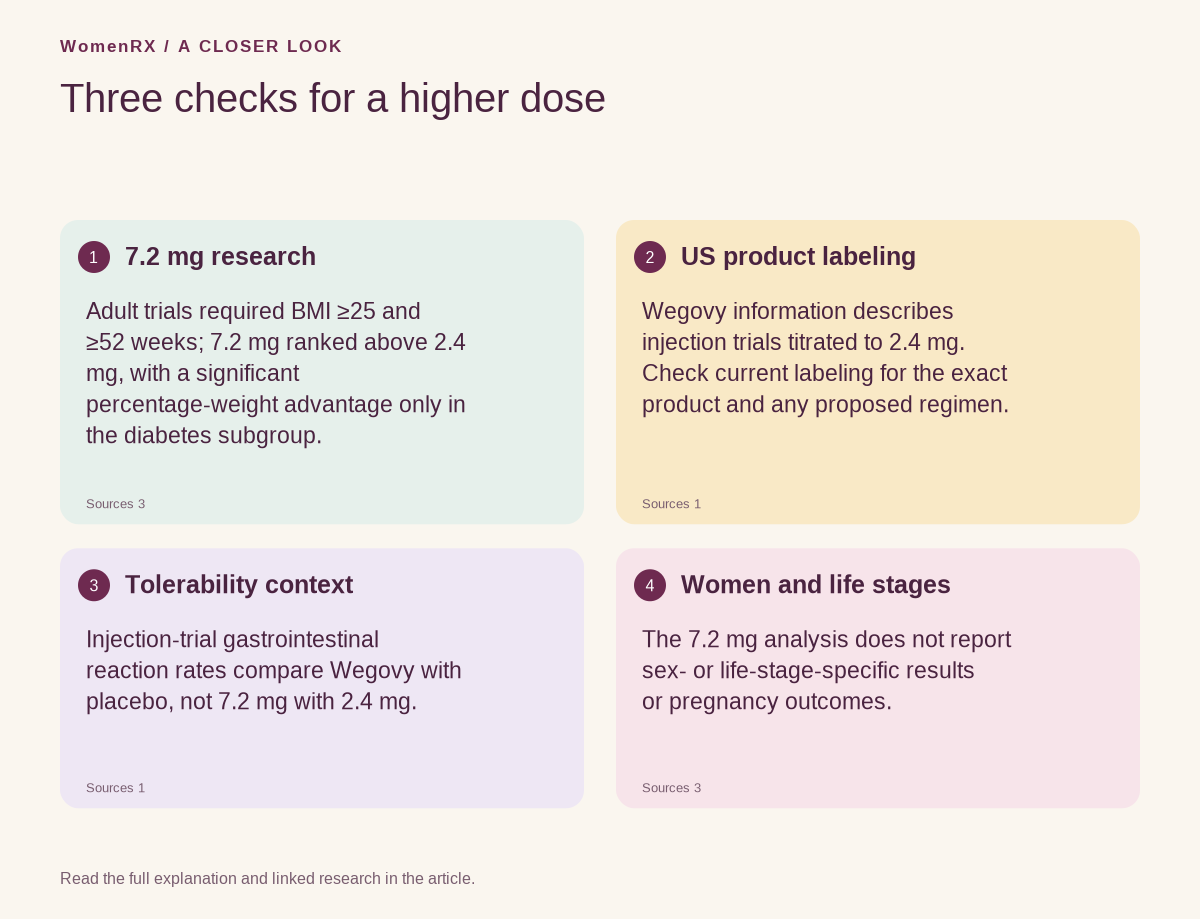
Three checks for a higher dose
7.2 mg research: Adult trials required BMI ≥25 and ≥52 weeks; 7.2 mg ranked above 2.4 mg, with a significant percentage-weight advantage only in the diabetes subgroup.3
US product labeling: Wegovy information describes injection trials titrated to 2.4 mg. Check current labeling for the exact product and any proposed regimen.1
Tolerability context: Injection-trial gastrointestinal reaction rates compare Wegovy with placebo, not 7.2 mg with 2.4 mg.1
Women and life stages: The 7.2 mg analysis does not report sex- or life-stage-specific results or pregnancy outcomes.3
Read the figure as text
Separate what the research reports from what a product label establishes and what is known about different patient groups.- 7.2 mg research: Adult trials required BMI ≥25 and ≥52 weeks; 7.2 mg ranked above 2.4 mg, with a significant percentage-weight advantage only in the diabetes subgroup.3
- US product labeling: Wegovy information describes injection trials titrated to 2.4 mg. Check current labeling for the exact product and any proposed regimen.1
- Tolerability context: Injection-trial gastrointestinal reaction rates compare Wegovy with placebo, not 7.2 mg with 2.4 mg.1
- Women and life stages: The 7.2 mg analysis does not report sex- or life-stage-specific results or pregnancy outcomes.3
More questions, answered
Does the 7.2 mg research mean that dose is US-approved?
No. A research finding does not establish US approval or local availability. Check current US labeling for the exact product and route, and confirm the proposed regimen with your prescriber. 31
Does the evidence show that women need a different dose?
No women-specific dose difference is established by the 7.2 mg analysis; it does not report results by sex or life stage. 3
Sources you can check
- WEGOVY (SEMAGLUTIDE) INJECTION, SOLUTION WEGOVY (SEMAGLUTIDE) TABLET [NOVO NORDISK PHARMACEUTICAL INDUSTRIES, LP] | US prescribing information and patient instructionsAccessed 2026-09-25Return to first citation
- Real-World Effectiveness and Safety of Escalating Once-Weekly Semaglutide from 0.5 to 1.0 mg in Type 2 Diabetes.Sato G, Uchino H, Takuma K, Saito M, Fuchigami A, Iwata Y, Yoshikawa F, Hirose T. · Diabetes therapy : research, treatment and education of diabetes and related disorders · 2026Return to first citation
- Analysis of the efficacy and safety of liraglutide, semaglutide, and tirzepatide for the treatment of overweight and obesity: a systematic review and network meta-analysis.Pałka W, Moćko P, Śladowska K, Holko P, Kawalec P. · Journal of endocrinological investigation · 2026Return to first citation