Semaglutide Long Term: What the Evidence Can Tell You
Some semaglutide trials followed people for about three to four years, but their findings apply to specific products, populations, and outcomes.
Long-term semaglutide use doesn’t have one safety verdict. Trials provide several years of information for specific products and groups, and side effects led some participants to stop treatment. Review your ongoing benefit and tolerability in light of your exact product and reason for taking it. Pregnancy plans matter, as do product-specific contraindications, including a personal or family history of medullary thyroid carcinoma or MEN2. 1256
Start with the product and reason you take it
“Semaglutide” can refer to different products and formulations used for different reasons. Wegovy injection is labeled for long-term weight reduction and maintenance in adults with obesity, or overweight with at least one weight-related condition. A trial of Wegovy injection also measured cardiovascular outcomes. Other semaglutide trials studied people with type 2 diabetes, using different formulations and measuring different outcomes. Their results shouldn’t be treated as interchangeable. 12
That distinction matters when you ask whether it’s safe to continue. Evidence about cardiovascular events in people with diabetes, for example, doesn’t automatically answer how well a weight-management treatment works or is tolerated in someone without diabetes.
Some safety questions are product-specific, too. Wegovy and Ozempic both list a personal or family history of medullary thyroid carcinoma, a particular type of thyroid cancer, or multiple endocrine neoplasia syndrome type 2 (MEN2) as contraindications. Wegovy also lists known hypersensitivity to semaglutide or its ingredients; Ozempic specifies a serious hypersensitivity reaction. These are not warnings against use for every thyroid condition or every type of thyroid cancer. 56
What several years of follow-up show
In a cardiovascular-outcomes trial of Wegovy injection, participants received study treatment for a median of 37.3 months in the semaglutide group and 38.6 months in the placebo group. The label reports that adverse events led to stopping study treatment in 16% of the semaglutide group and 8% of the placebo group. That’s a comparison from this particular trial, not a prediction of what will happen to you. Safety collection in the trial was limited to serious adverse events, events leading to discontinuation, and events of special interest. 1
A separate cardiovascular-outcomes trial followed adults with type 2 diabetes taking semaglutide tablets or placebo for a median of about four years. Adverse events led to permanent discontinuation in 15.5% of the semaglutide group and 11.6% of the placebo group. In that trial, gallstones were reported in 1.1% of people taking the 14 mg tablets and 0.9% taking placebo; gallbladder inflammation was reported in 1.1% and 0.7%, respectively. Those results belong to that tablet trial and population. They don’t establish the same rates for Wegovy injection or every person taking semaglutide. 2
For weight management in adults with overweight or obesity without diabetes, reviews of randomized trials found greater weight loss with subcutaneous semaglutide than placebo, and nausea, vomiting, diarrhea, and constipation were among the most commonly reported gastrointestinal effects. One review reported higher discontinuation due to adverse events with semaglutide; another found no statistically significant difference in serious adverse events. These summaries don’t provide a separate long-term safety estimate for women. 34
Make the review about your actual benefit and burden
A useful follow-up conversation is more specific than “Is this still safe?” Consider:
- What is the treatment for? Weight management, blood sugar control, and cardiovascular risk reduction are different goals, supported by different evidence.
- What benefit are you still getting? Discuss the treatment target that matters for your indication and whether it remains meaningful to you.
- What is difficult to live with? Nausea, vomiting, diarrhea, and constipation were common gastrointestinal effects in trials of semaglutide for weight reduction. Tell your clinician what you’re experiencing and how it affects eating, drinking, or daily life. 3
- Has anything changed? New or ongoing symptoms, other medicines, and changes in your health may affect whether the balance still suits you. In interaction studies cited in the Wegovy information, levothyroxine exposure increased with the semaglutide tablet, while semaglutide 1 mg weekly injection did not affect absorption of oral medicines. Those findings shouldn’t be assumed to apply identically across formulations. 1
- What are your plans around pregnancy or breastfeeding? Pregnancy deserves a product- and indication-specific discussion. Wegovy labeling advises stopping at least two months before a planned pregnancy because of potential fetal risk and semaglutide’s long half-life. Semaglutide tablet labeling also advises stopping at least two months before planned pregnancy, while noting that diabetes care in pregnancy involves separate considerations. Breastfeeding is a separate question, and pregnancy guidance alone doesn’t answer it. 12
These are prompts for a shared review, not a checklist that proves treatment is safe or unsafe. If the benefit remains worthwhile but side effects or a life change have shifted the balance, that’s a reason to revisit the plan rather than assume the answer is automatically to continue or stop.
What the evidence can’t settle
Several years of trial follow-up are useful, but they don’t establish lifelong safety. The longer trials cited here differed in product, formulation, and participant health. Both limited safety collection to serious adverse events, events leading to discontinuation, and events of special interest. 12 Evidence about long-term use in women specifically isn’t reported separately in the weight-management review summaries. A balanced decision therefore combines the relevant trial evidence with your treatment goal, experience, and individual circumstances, without treating results from another product or population as a guarantee.
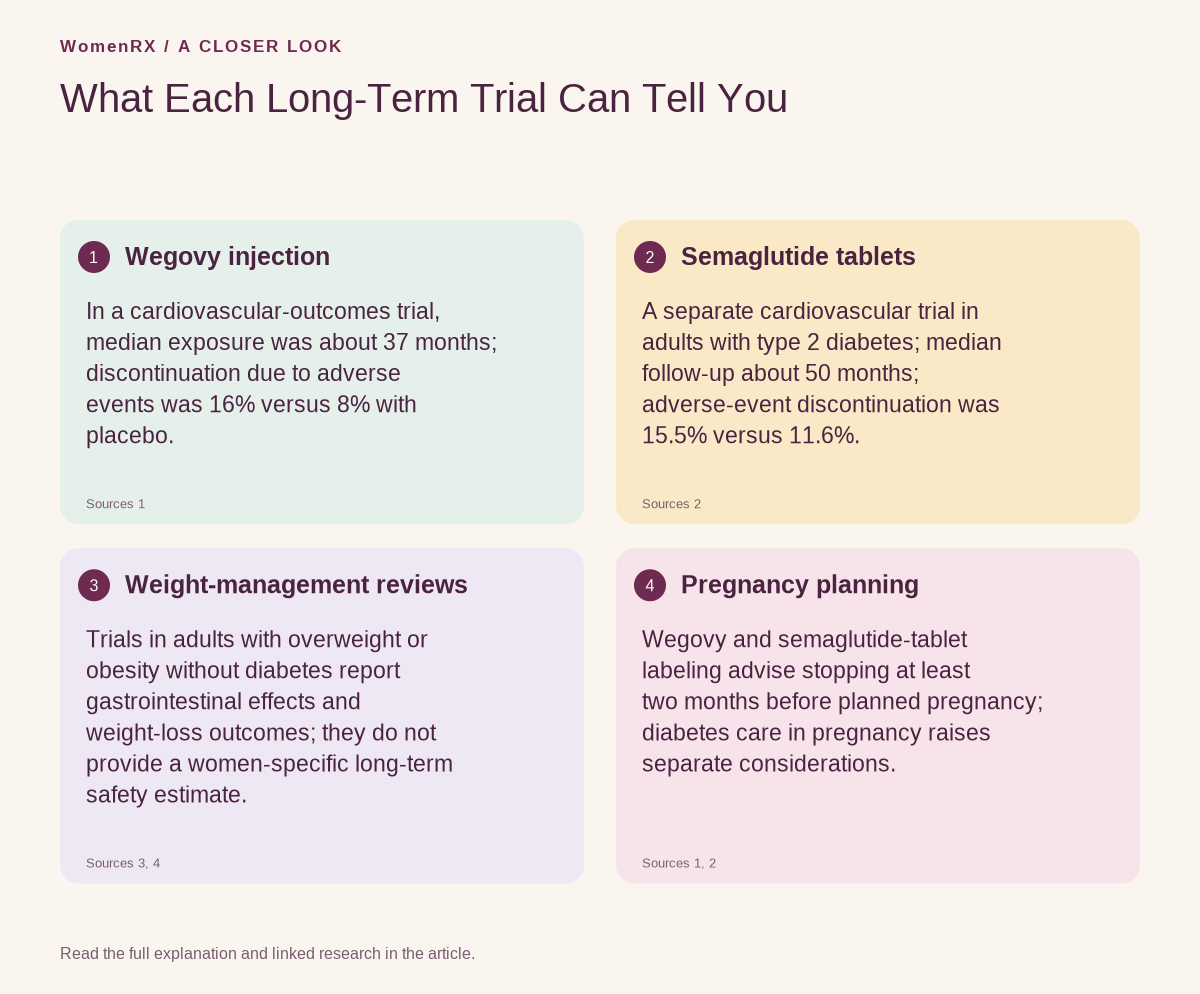
What Each Long-Term Trial Can Tell You
Wegovy injection: In a cardiovascular-outcomes trial, median exposure was about 37 months; discontinuation due to adverse events was 16% versus 8% with placebo.1
Semaglutide tablets: A separate cardiovascular trial in adults with type 2 diabetes; median follow-up about 50 months; adverse-event discontinuation was 15.5% versus 11.6%.2
Weight-management reviews: Trials in adults with overweight or obesity without diabetes report gastrointestinal effects and weight-loss outcomes; they do not provide a women-specific long-term safety estimate.34
Pregnancy planning: Wegovy and semaglutide-tablet labeling advise stopping at least two months before planned pregnancy; diabetes care in pregnancy raises separate considerations.12
Read the figure as text
These findings come from different formulations, populations, and follow-up periods, so compare like with like.- Wegovy injection: In a cardiovascular-outcomes trial, median exposure was about 37 months; discontinuation due to adverse events was 16% versus 8% with placebo.1
- Semaglutide tablets: A separate cardiovascular trial in adults with type 2 diabetes; median follow-up about 50 months; adverse-event discontinuation was 15.5% versus 11.6%.2
- Weight-management reviews: Trials in adults with overweight or obesity without diabetes report gastrointestinal effects and weight-loss outcomes; they do not provide a women-specific long-term safety estimate.34
- Pregnancy planning: Wegovy and semaglutide-tablet labeling advise stopping at least two months before planned pregnancy; diabetes care in pregnancy raises separate considerations.12
More questions, answered
Does long-term evidence for Wegovy apply to Ozempic?
Not automatically. Products and formulations may have different indications, and trials can enroll different populations and measure different outcomes. Ask which evidence matches your exact product, formulation, and reason for taking it. 12
How long have semaglutide safety trials followed participants?
The examples here include a Wegovy injection cardiovascular-outcomes trial with a median of about 37 months of exposure and a separate semaglutide-tablet cardiovascular trial with a median follow-up of about 50 months. These durations don’t establish lifelong safety. 12
Sources you can check
- WEGOVY (SEMAGLUTIDE) INJECTION, SOLUTION WEGOVY (SEMAGLUTIDE) TABLET [NOVO NORDISK PHARMACEUTICAL INDUSTRIES, LP] | US prescribing information and patient instructionsAccessed 2026-09-25Return to first citation
- OZEMPIC (ORAL SEMAGLUTIDE) TABLET RYBELSUS (ORAL SEMAGLUTIDE) TABLET [NOVO NORDISK PHARMACEUTICAL INDUSTRIES, LP] | US prescribing information and patient instructionsAccessed 2026-09-25Return to first citation
- Effectiveness & safety of semaglutide in weight reduction in obese nondiabetic patients: A systematic review and meta-analysis.Naz F, Qaiser F, Mumtaz A, Din SU, Mustafa A, Ullah A, Perveen A, Malik J. · Medicine · 2026Return to first citation
- Effects of subcutaneous semaglutide on weight loss and inflammatory markers in adults with overweight or obesity without diabetes: a systematic review and meta-analysis.Milluzzo A, Oteri V, Manuella L, Pulvirenti A, Frittitta L. · International journal of obesity (2005) · 2026Return to first citation
- Wegovy current US prescribing informationAccessed 2026-09-25Return to first citation
- Ozempic current US prescribing informationAccessed 2026-09-25Return to first citation