Can You Take Quercetin Long Term?
Human studies offer a few months of limited reassurance, but they don’t establish that quercetin supplements are safe for years.
There’s no strong basis to call long-term quercetin use safe or unsafe. Small human studies report tolerability over 30 to 90 days, and one study in people with Fanconi anemia followed treatment for four or six months. But the products, doses, and participants differ, and these studies don’t settle safety for years of use, pregnancy, breastfeeding, or people taking many medicines. 2 3 4
What the human studies can tell you
The most useful distinction is between “tolerated during a study” and “known to be safe for long-term use.” The human evidence described here reaches months, not years, and comes from quite different settings.
One real-world study analyzed three groups of adults that included participants who took a quercetin phytosome product for 90 days. The product provided 400 mg of quercetin daily, and the study reported that it was well tolerated, with minimal, temporary side effects. Not everyone in the three groups took quercetin: comparison participants received a probiotic in one group and a different supplement combination in another. Because the analysis used clinical records rather than a randomized comparison across all groups, and studied a particular formulation, it can’t establish long-term safety for other products or for everyone who takes quercetin. 3
A phase 1 study involved children and young adults with Fanconi anemia. Twelve participants received quercetin for four months, and a separate expansion group of 18 received it for six months. Researchers reported no severe adverse events attributed to quercetin. They also recorded possible or probable related events, including weight gain, constipation, diarrhea, and reflux. This is a longer follow-up than the adult studies, but the participants had a rare illness and were receiving monitored study treatment. It isn’t a general safety guarantee for healthy adults. 2
In another small study, 15 adults with long COVID took quercetin alongside curcumin for eight weeks. No serious adverse events were reported, but the study was open-label, had no comparison group, and could not separate the effects of quercetin from curcumin. 1
A study in 16 healthy adults assessed a combination of quercetin, chrysin, and rutin; clinical biochemistry was assessed in 15 participants during 30 days of daily use. Mild stomach discomfort and a rash were reported. The combination makes it impossible to identify which ingredient, if any, caused them. Thirty days also says little about continuing for months or years. 4
Taken together, these findings offer limited information about tolerability over weeks or months. They don’t show that risk stays the same with longer use, higher amounts, or a different formulation.
Medicines and health changes deserve a fresh look
These studies don’t establish a reliable list of quercetin-medicine interactions. That means you shouldn’t assume either that an interaction exists or that there are none. In one eight-week study, people taking anticoagulants were excluded; this is a limit on who was studied, not proof that quercetin interacts with those medicines. 1
If you’re considering continuing quercetin, check the exact product and amount on its label against your current medicines and supplements with a pharmacist or prescriber. Revisit the question if a medicine is started, stopped, or changed, or if your health changes. This is especially relevant if you have a severe or uncontrolled chronic illness: one study excluded people with conditions such as severe liver disease, kidney disease requiring dialysis, and advanced heart failure, so it cannot answer safety for those groups. 1
If you develop a new symptom after starting or increasing a supplement, ask whether it could be related before deciding whether to continue. Studies reported symptoms such as stomach discomfort and rash, but they don’t provide a complete list of possible reactions or establish that quercetin caused every event. 2 4
Pregnancy and breastfeeding are separate questions
A small study of quercetin combined with curcumin excluded people who were pregnant or breastfeeding. That leaves those situations unanswered; it doesn’t establish that quercetin is safe or harmful during either one. If you’re pregnant, planning a pregnancy, or breastfeeding, don’t use short-term findings in other adults as a safety answer for you. 1
A practical way to decide whether to continue
Before deciding, write down the product name, formulation, amount, how long you’ve taken it, why you started, and every medicine and supplement you use. Then ask whether there’s a clear reason to keep taking it and whether the evidence applies to your situation. A 90-day result for a specific phytosome product, for example, doesn’t automatically apply to a different quercetin capsule. 3
studies provide some short-term and several-month observations, but not a dependable answer about years of routine use. Continuing is a more informed choice when you’ve reviewed the exact product, your reason for taking it, your medicines, and any new health circumstances, rather than treating “no serious event in a small study” as proof of lasting safety.
How long the human evidence follows people
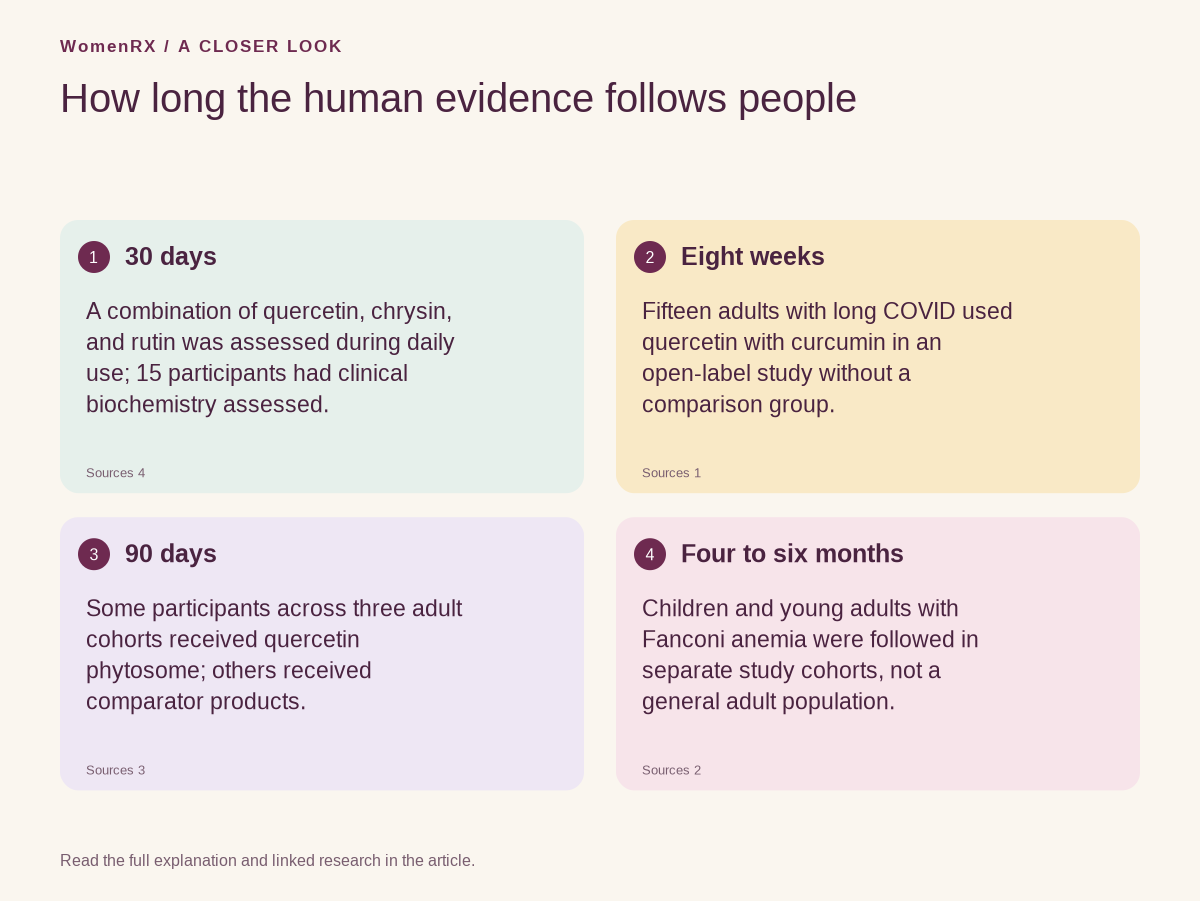
30 days: A combination of quercetin, chrysin, and rutin was assessed during daily use; 15 participants had clinical biochemistry assessed.4
Eight weeks: Fifteen adults with long COVID used quercetin with curcumin in an open-label study without a comparison group.1
90 days: Some participants across three adult cohorts received quercetin phytosome; others received comparator products.3
Four to six months: Children and young adults with Fanconi anemia were followed in separate study cohorts, not a general adult population.2
Read the figure as text
These studies differ in duration, product, and participants. A longer follow-up in one specific group does not automatically answer the safety question for everyone.- 30 days: A combination of quercetin, chrysin, and rutin was assessed during daily use; 15 participants had clinical biochemistry assessed.4
- Eight weeks: Fifteen adults with long COVID used quercetin with curcumin in an open-label study without a comparison group.1
- 90 days: Some participants across three adult cohorts received quercetin phytosome; others received comparator products.3
- Four to six months: Children and young adults with Fanconi anemia were followed in separate study cohorts, not a general adult population.2
More questions, answered
Does a study lasting several months mean quercetin is safe for years?
No. The Fanconi anemia study followed participants for four or six months, and quercetin-treated participants in the adult real-world study were followed for 90 days. Those results describe the participants and periods studied; they don’t establish safety over years or for people in different circumstances. 2 3
Do these studies prove quercetin interacts with blood thinners?
No. One small study excluded people taking anticoagulants, so it cannot answer whether an interaction occurs. This evidence doesn’t verify a specific interaction or establish that combining them is safe. 1
Sources you can check
- Potential Adjunctive Effects of Quercetin-Curcumin Co-Supplementation in Adults with Mild-to-Moderate Long COVID: Results from a Pragmatic Exploratory Real-World Clinical Study.Khan A, Rabbani F, Mumtaz SU, Javed R, Ujjan I, Kanwal A, Conti G. · Pharmaceuticals (Basel, Switzerland) · 2026Return to first citation
- Phase 1 study of quercetin, a natural antioxidant for children and young adults with Fanconi anemia.Mehta PA, Nelson A, Loveless S, Lane A, Fukuda T, Teusink-Cross A, Elder D, Lagory D, Miller E, Cancelas JA, Howell J, Zhao J, Mizuno K, Myers KC, Lake K, McIntosh K, Setchell KDR,... · Blood advances · 2025Return to first citation
- Potential pharmacological effect of Quercetin Phytosome™ in the management of hyperuricemia: results from real-life clinical studies.Di Pierro F, Rabbani F, Tareen M, Nigar R, Khan A, Zerbinati N, Tanda ML, Cazzaniga M, Bertuccioli A, Falasca P, Damiani G, Villanova N. · Frontiers in nutrition · 2025Return to first citation
- Comparative Pharmacokinetics and Safety of a Micellar Chrysin-Quercetin-Rutin Formulation: A Randomized Crossover Trial.Ibi A, Chang C, Kuo YC, Zhang Y, Do P, Du M, Roh YS, Gahler R, Hardy M, Solnier J. · Antioxidants (Basel, Switzerland) · 2025Return to first citation