Can You Take Myo-Inositol Long Term?
A 24-week PCOS trial found a benefit from adding myo-inositol to metformin, but it doesn’t tell us what happens with years of use.
Whether to keep taking myo-inositol depends on what you hope it will do. In a 24-week PCOS trial, adding it to metformin improved some metabolic and menstrual measures compared with metformin alone. That supports a benefit for the tested combination, not myo-inositol by itself or indefinite use. Fertility and pregnancy raise different questions. 2
Match the evidence to your goal
If you’re taking myo-inositol for PCOS, “Is it safe long term?” is only part of the decision. The other part is whether continuing is likely to help with the result you want, such as more regular periods or support during fertility treatment. A study measuring one result may not answer the other.
The clearest way to assess continued use is to check three things: what treatment was tested, what changed, and how long people were followed. That matters especially if you take myo-inositol on its own, because a study of myo-inositol added to another treatment answers a different question.
What the 24-week PCOS trial can tell you
A randomized trial enrolled 196 people with PCOS. For 24 weeks, one group received metformin plus myo-inositol and the other received metformin alone. The combination group had greater improvement in insulin resistance and some measures of menstrual irregularity. Because the groups differed by the addition of myo-inositol, the comparison provides evidence about adding it to metformin. It does not establish that myo-inositol taken alone would produce the same results. 2
The tested combination contained 600 mg of myo-inositol and 500 mg of metformin twice daily. Those amounts describe the study treatment, not a recommended regimen for you or a studied dose of myo-inositol alone. Mild adverse events were reported at low, comparable rates in the two groups, and the trial reported no severe adverse events. That is useful safety information for the treatment period studied, not proof of safety over years. 2
If you’re considering continuing because your periods seem more predictable, this trial offers a reason to discuss that result when you’re also taking metformin. If you take myo-inositol without metformin, the trial is a less direct guide to what the supplement may be doing for you.
Fertility treatment asks a different question
In assisted reproduction, getting more eggs and becoming pregnant are different outcomes. A systematic review of eight randomized trials, including 820 participants, found a small increase in the overall number of oocytes retrieved with inositol compared with control. It did not find a statistically significant improvement in clinical pregnancy rates. The review also called for more research on effectiveness and safety. 1
So if fertility is your reason for taking myo-inositol, ask which outcome you expect it to improve. The assisted-reproduction results don’t establish a better chance of pregnancy, and they don’t answer whether taking it for longer would change that result. They also shouldn’t be treated as evidence for every person trying to conceive outside assisted reproduction. 1
Pregnancy and breastfeeding need their own decisions
A review that considered myo-inositol in pregnancy describes a favorable maternal and fetal safety profile across pregnancy-related research. That offers some reassurance, but it doesn’t show that continuing indefinitely is beneficial or safe in every pregnancy. Its reported findings also don’t settle the separate question of use while breastfeeding. 3
If you become pregnant while taking myo-inositol, the goal that led you to start it may no longer be the goal that matters now. That’s a sensible point to review the product and your reason for using it with the clinician managing your pregnancy or PCOS care, rather than carrying on automatically.
Decide what would make continuing worthwhile
There isn’t a universal duration established by these studies. The PCOS trial followed a specific combination for 24 weeks; the assisted-reproduction review assessed fertility-treatment outcomes, not indefinite use. 1 2
Before making myo-inositol a standing part of your routine, name the result you’re hoping for and whether you’ve seen it. Then compare your situation with the research: Are you taking it alone or with metformin? Are you hoping for a change in periods, a metabolic measure, or a fertility outcome? If the goal has changed, particularly with fertility treatment or pregnancy, ask what result would justify continuing and when to reassess. That keeps the decision tied to a purpose instead of assuming that longer use must bring more benefit.
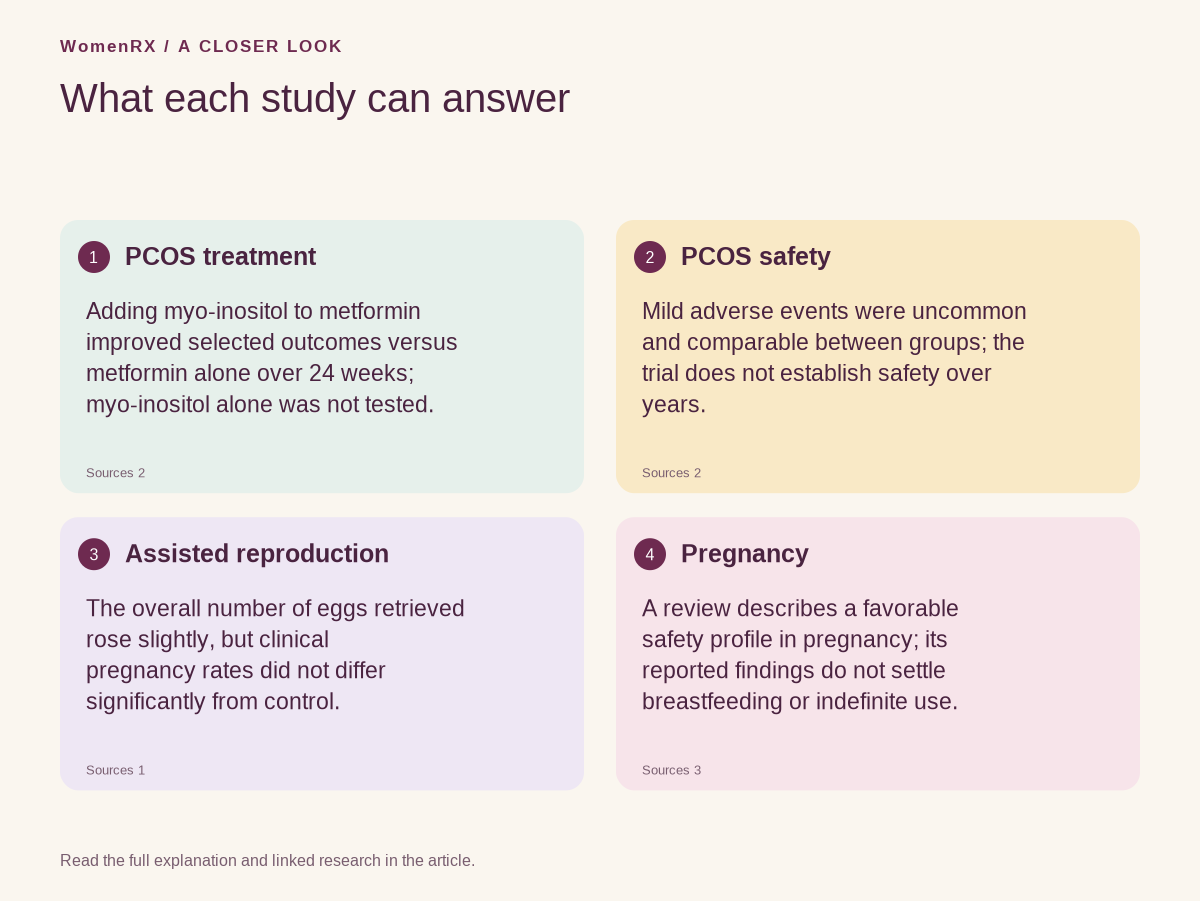
What each study can answer
PCOS treatment: Adding myo-inositol to metformin improved selected outcomes versus metformin alone over 24 weeks; myo-inositol alone was not tested.2
PCOS safety: Mild adverse events were uncommon and comparable between groups; the trial does not establish safety over years.2
Assisted reproduction: The overall number of eggs retrieved rose slightly, but clinical pregnancy rates did not differ significantly from control.1
Pregnancy: A review describes a favorable safety profile in pregnancy; its reported findings do not settle breastfeeding or indefinite use.3
Read the figure as text
Compare the treatment and outcome studied before applying a finding to your reason for continuing myo-inositol.- PCOS treatment: Adding myo-inositol to metformin improved selected outcomes versus metformin alone over 24 weeks; myo-inositol alone was not tested.2
- PCOS safety: Mild adverse events were uncommon and comparable between groups; the trial does not establish safety over years.2
- Assisted reproduction: The overall number of eggs retrieved rose slightly, but clinical pregnancy rates did not differ significantly from control.1
- Pregnancy: A review describes a favorable safety profile in pregnancy; its reported findings do not settle breastfeeding or indefinite use.3
More questions, answered
Does the PCOS trial show myo-inositol works on its own?
No. It found that adding myo-inositol to metformin improved some outcomes compared with metformin alone over 24 weeks. That comparison can assess the added benefit in the tested combination, but it cannot establish the effect of myo-inositol used by itself. 2
Does a change in eggs retrieved mean a better chance of pregnancy?
Not necessarily. In a review of randomized assisted-reproduction trials, the overall number of eggs retrieved was slightly higher with inositol, but clinical pregnancy rates did not differ significantly from control. 1
Sources you can check
- Effectiveness of Myo-Inositol on Oocyte and Embryo Quality in Assisted Reproduction: Systematic Review and Meta-Analysis of Randomized Clinical Trials.Pivazyan L, Krylova E, Obosyan L, Seregina V, Shapovalenko R, Ayryan E. · Gynecologic and obstetric investigation · 2025Return to first citation
- A Phase III, Double-Blind, Randomized, Multicenter, Clinical Trial to Evaluate the Efficacy and Safety of a Fixed-Dose Combination of Metformin Hydrochloride and Myo-Inositol Compared to Metformin in Patients With Polycystic Ovary Syndrome.Kriplani A, Tank P, Singh P, Maini N, Kaitala S, Kantha G L, Paul J, Shah S, Bhatara U, Sinha A, Singh T, Srivastava S, Malvi A. · Cureus · 2024Return to first citation
- Myo-Inositol in Pregnancy: Implications for Acne Management.Baboun D, Yaghi M, Keelin J, Hernandez-Bueso DM, Fernandez Fernandez V, Keri J. · Journal of drugs in dermatology : JDD · 2026Return to first citation