Myo-Inositol in Women: What Has Actually Been Studied?
Studies discussed here include several PCOS trials and two distinct pregnancy investigations whose findings don’t point to a settled answer.
Myo-inositol has been studied in women with polycystic ovary syndrome (PCOS) for menstrual patterns, insulin-related measures, and fertility-treatment outcomes. Two pregnancy investigations have also examined glucose-related outcomes, with findings that don’t point to a settled answer. Some PCOS trials test myo-inositol alongside another treatment or with D-chiro-inositol, so they can’t show what myo-inositol alone does. 1 2 3 4 5
PCOS studies examine cycles, metabolism, and fertility
Studies in women with PCOS have looked at menstrual regularity, insulin resistance, hormone measures, and fertility-treatment outcomes. Results in women diagnosed with PCOS don’t establish the same effects in women without PCOS, or for every life stage.
Even within PCOS research, the supplement being studied isn’t always myo-inositol by itself. Some trials pair it with D-chiro-inositol; others add it to metformin. Those designs can tell us about the combination, but not cleanly separate myo-inositol’s contribution. 1 5
Menstrual cycles and insulin-related measures
A 12-week trial in 60 women with PCOS compared a myo-inositol plus D-chiro-inositol combination with metformin. Both groups showed improvements in measures including insulin sensitivity and menstrual regularity. Because the trial was small and tested a combination rather than myo-inositol alone, it offers a limited comparison, not proof that myo-inositol alone produces those changes. 1
A larger, 24-week trial compared metformin plus myo-inositol with metformin alone in 196 patients with PCOS. The combination group had a greater reported improvement in insulin resistance and menstrual irregularities. This supports further study of adding myo-inositol to metformin, but it doesn’t establish the effect of taking myo-inositol on its own. 5
Fertility treatment: some encouraging outcomes, but not a guarantee
A 2025 systematic review and meta-analysis included 17 intervention studies evaluating myo-inositol and D-chiro-inositol in women with PCOS undergoing assisted reproductive technology (ART). Its pooled estimate showed a higher clinical pregnancy rate compared with the studies’ control groups. The review also found more top-grade embryos, but results for that outcome varied considerably between studies. These findings apply to a specific group in fertility treatment; they don’t show that myo-inositol alone increases the chance of a baby being born. 4
The review also reported lower average antral follicle counts and anti-Müllerian hormone levels in the inositol intervention groups. These are ovarian measurements, not pregnancy or live-birth outcomes. A change in a measurement shouldn’t be treated as proof of a benefit or harm to fertility on its own. 4
Pregnancy: results aren’t settled
One open-label randomized trial enrolled 200 pregnant women and compared myo-inositol plus folic acid with folic acid alone. The abstract reports gestational diabetes rates of 14.9% in the myo-inositol group and 28.5% in the control group, alongside better glucose measures in the myo-inositol group. However, its wording about which group had the higher rate conflicts with those reported percentages. That inconsistency, along with the single-center, open-label design, makes the result hard to interpret as a firm answer. 3
A separate analysis of 585 generally healthy women in the NiPPeR trial found that the myo-inositol-containing supplement started before conception did not lower gestational glycemia. In the analysis, higher myo-inositol levels early in pregnancy were associated with higher later post-meal glucose readings, but not with gestational diabetes risk or birthweight. Because this was an analysis of associations with measured blood levels, it does not show that taking myo-inositol caused the glucose differences. 2
Taken together, these pregnancy studies don’t establish a reliable effect across pregnant women. They also don’t justify treating a result in women with PCOS as a result for all pregnancies.
A practical way to read the evidence
Ask three questions when you see a claim about a “benefit”:
- Who was studied? Women with PCOS, women in fertility treatment, and generally healthy pregnant women are different study populations.
- What was actually taken? Myo-inositol alone, a myo-inositol/D-chiro-inositol combination, and a combination with metformin are not interchangeable.
- What outcome changed? A menstrual pattern, an insulin marker, an embryo grade, a clinical pregnancy, and a live birth are different outcomes.
These studies don’t establish whether myo-inositol improves fertility outcomes outside ART or in women without PCOS. They also leave its effects in nonpregnant women without PCOS unclear.
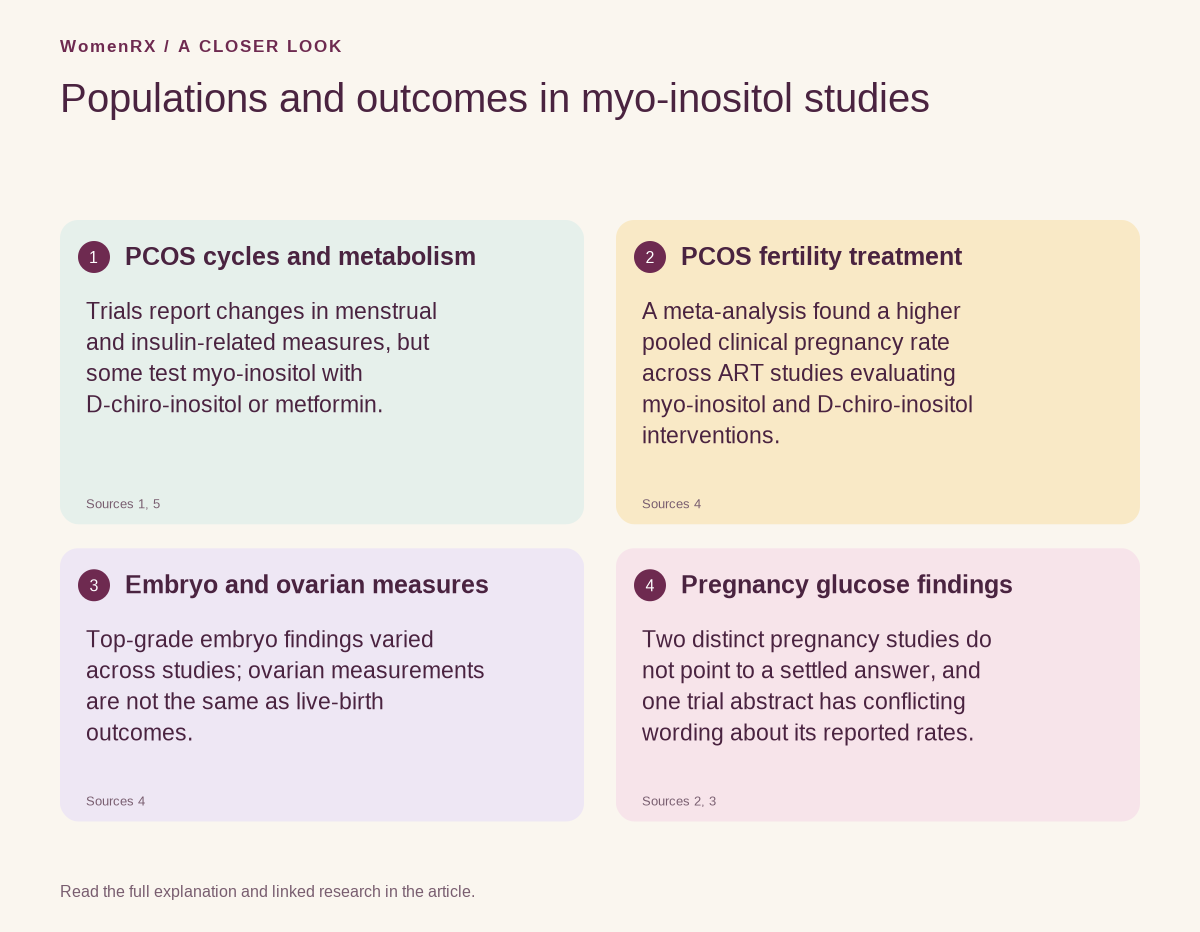
Populations and outcomes in myo-inositol studies
PCOS cycles and metabolism: Trials report changes in menstrual and insulin-related measures, but some test myo-inositol with D-chiro-inositol or metformin.15
PCOS fertility treatment: A meta-analysis found a higher pooled clinical pregnancy rate across ART studies evaluating myo-inositol and D-chiro-inositol interventions.4
Embryo and ovarian measures: Top-grade embryo findings varied across studies; ovarian measurements are not the same as live-birth outcomes.4
Pregnancy glucose findings: Two distinct pregnancy studies do not point to a settled answer, and one trial abstract has conflicting wording about its reported rates.23
Read the figure as text
These examples show why the population and the measured outcome matter: findings from PCOS treatment studies can’t automatically be carried over to pregnancy or to women without PCOS.- PCOS cycles and metabolism: Trials report changes in menstrual and insulin-related measures, but some test myo-inositol with D-chiro-inositol or metformin.15
- PCOS fertility treatment: A meta-analysis found a higher pooled clinical pregnancy rate across ART studies evaluating myo-inositol and D-chiro-inositol interventions.4
- Embryo and ovarian measures: Top-grade embryo findings varied across studies; ovarian measurements are not the same as live-birth outcomes.4
- Pregnancy glucose findings: Two distinct pregnancy studies do not point to a settled answer, and one trial abstract has conflicting wording about its reported rates.23
More questions, answered
Does research show that myo-inositol improves fertility for all women?
No. The fertility-treatment meta-analysis focused on women with PCOS undergoing ART and included studies evaluating myo-inositol and D-chiro-inositol interventions. It does not establish an effect of myo-inositol alone, an effect for women without PCOS or outside ART, or a benefit for live birth. 4
Are the pregnancy findings consistent?
No. One open-label trial reported lower gestational diabetes rates with myo-inositol plus folic acid, but its abstract contains a wording conflict about which group had the higher rate. A separate analysis in generally healthy women found no lower gestational glycemia from a myo-inositol-containing supplement started before conception. 2 3
Sources you can check
- Comparative efficacy of combined myo-inositol and D-chiro inositol versus metformin across PCOS Phenotypes: enhancing ovarian function, ovulation, and stress response in a prospective clinical trial.Gul M, Khan H, Rauf B, Bukhari SMS, Ehtesham E, Malik MO, Shah FA, Alanazi FE, Shah M. · Naunyn-Schmiedeberg's archives of pharmacology · 2025Return to first citation
- Higher early pregnancy plasma myo-inositol associates with increased postprandial glycaemia later in pregnancy: Secondary analyses of the NiPPeR randomized controlled trial.Chan SY, Zhang H, Wong JT, Chang HF, Chen LW, Barton SJ, Nield H, El-Heis S, Kenealy T, Lavalle L, Ramos-Nieves JM, Godin JP, Silva-Zolezzi I, Cutfield WS, Godfrey KM, NiPPeR Study... · Diabetes, obesity & metabolism · 2024Return to first citation
- Effect of dietary myo-inositol supplementation on the insulin resistance and the prevention of gestational diabetes mellitus: an open-label, randomized controlled trial.Asimakopoulos G, Pergialiotis V, Antsaklis P, Theodora M, Loutradis D, Daskalakis G. · Archives of gynecology and obstetrics · 2024Return to first citation
- The effect of myo-inositol on assisted reproductive technology outcomes in women with polycystic ovarian syndrome: A systematic review and meta-analysis of randomized clinical trial studies.Sene AA, Saeedzarandi M, Yazdizadeh M, Ghaffari SR, Amjadi F, Zandieh Z, Moradi Y. · International journal of reproductive biomedicine · 2025Return to first citation
- A Phase III, Double-Blind, Randomized, Multicenter, Clinical Trial to Evaluate the Efficacy and Safety of a Fixed-Dose Combination of Metformin Hydrochloride and Myo-Inositol Compared to Metformin in Patients With Polycystic Ovary Syndrome.Kriplani A, Tank P, Singh P, Maini N, Kaitala S, Kantha G L, Paul J, Shah S, Bhatara U, Sinha A, Singh T, Srivastava S, Malvi A. · Cureus · 2024Return to first citation