Semaglutide for PCOS: What Has Actually Been Studied?
The clearest PCOS-specific evidence is about weight; findings on periods and fertility are promising but much less settled.
In women with PCOS, studies have reported lower weight and some improved metabolic measures with semaglutide, but the evidence varies by outcome. A small trial found better menstrual-cycle recovery when semaglutide was added to metformin; it does not show that semaglutide alone treats irregular periods or improves fertility. Acne, excess hair, and pregnancy outcomes need separate, careful interpretation. If pregnancy is a goal, discuss timing before starting or continuing treatment. 2 3 4
The answer depends on which PCOS outcome you mean
PCOS can involve irregular or absent periods, higher androgen levels, and metabolic concerns, but not every woman has the same combination. So a change in weight is not the same thing as proof that every PCOS symptom has improved. 1
The most useful way to read the semaglutide research is by outcome. Weight has the most direct PCOS-specific study data. Metabolic results are also reported, though less consistently. Menstrual and fertility findings are early and harder to attribute to semaglutide alone. The available studies don’t establish that it improves acne or unwanted hair.
Weight and metabolic markers: the strongest direct findings
A 2025 meta-analysis reported eight randomized trials involving 526 people with PCOS. Across those trials, semaglutide was associated with a greater reduction in BMI and in total cholesterol, triglycerides, and LDL cholesterol compared with placebo or conventional treatment. It did not find a significant improvement in HDL cholesterol. The authors rated the overall evidence moderate to low, so these pooled results are useful signals, not a guarantee of an individual response. 3
A separate 16-week randomized trial enrolled 100 women with PCOS who had overweight or obesity. It compared metformin alone with metformin plus semaglutide; 80 participants completed the study. The combination group had a greater average weight reduction over 16 weeks, and the study also reported improvements in some metabolic and hormone measures. Because both groups received metformin, this trial does not tell us how semaglutide would compare with no medication or what it would do on its own. 2
That distinction matters in practice: a clinician discussing treatment may be weighing a person’s weight and metabolic goals separately from goals such as more predictable cycles or relief from acne.
Periods: an encouraging result, not a settled effect
In the same trial, menstrual-cycle recovery was reported more often with metformin plus semaglutide than with metformin alone. That’s relevant, but it is one small study, and it tested a combination rather than semaglutide by itself. It does not show that every woman who loses weight on semaglutide will have regular periods. 2
A 2026 scoping review also found reports of improved menstrual regularity, but said much of this evidence came from small pilot studies or conference abstracts. The review described the overall semaglutide evidence in PCOS as heterogeneous and predominantly low quality. 4
Fertility and pregnancy planning are different questions
The 16-week randomized trial reported natural pregnancy rates of 35% in the combination group and 15% in the metformin group during weeks 16 to 40. But after the initial comparison period, participants in both groups received metformin alone. The finding therefore can’t establish that semaglutide itself caused the difference, or predict an individual woman’s chance of pregnancy. 2
A separate prospective pilot followed 20 women with PCOS, obesity, and prediabetes who took metformin with semaglutide. It reported that 60% became pregnant during follow-up. Because the study was small and had no comparison group, it can’t separate the effect of the medicines from other factors or be generalized to all women with PCOS. 5
If pregnancy is a current or future goal, raise that before treatment decisions. The scoping review advises stopping semaglutide before planned conception, but it doesn’t give an exact stopping interval. Ask the prescriber how treatment and contraception fit your plans, including if you’re not trying to conceive now but would welcome a pregnancy. 4
Acne and excess hair: don’t assume weight change treats them
The studies summarized above focus on weight, metabolic measures, hormones, menstrual patterns, and reproductive outcomes. They don’t establish semaglutide as a treatment for acne or excess facial or body hair. These are distinct PCOS concerns, and a change in the scale or cycle shouldn’t be taken as proof they will improve too. 1 2 3 4
When weighing options, it can help to name the outcome you care about most: weight, a metabolic measure, cycle regularity, pregnancy planning, or skin and hair symptoms. Then ask which evidence applies to that specific goal, and whether it comes from semaglutide alone or from a combination treatment. That comparison is more informative than asking simply whether semaglutide “helps PCOS.”
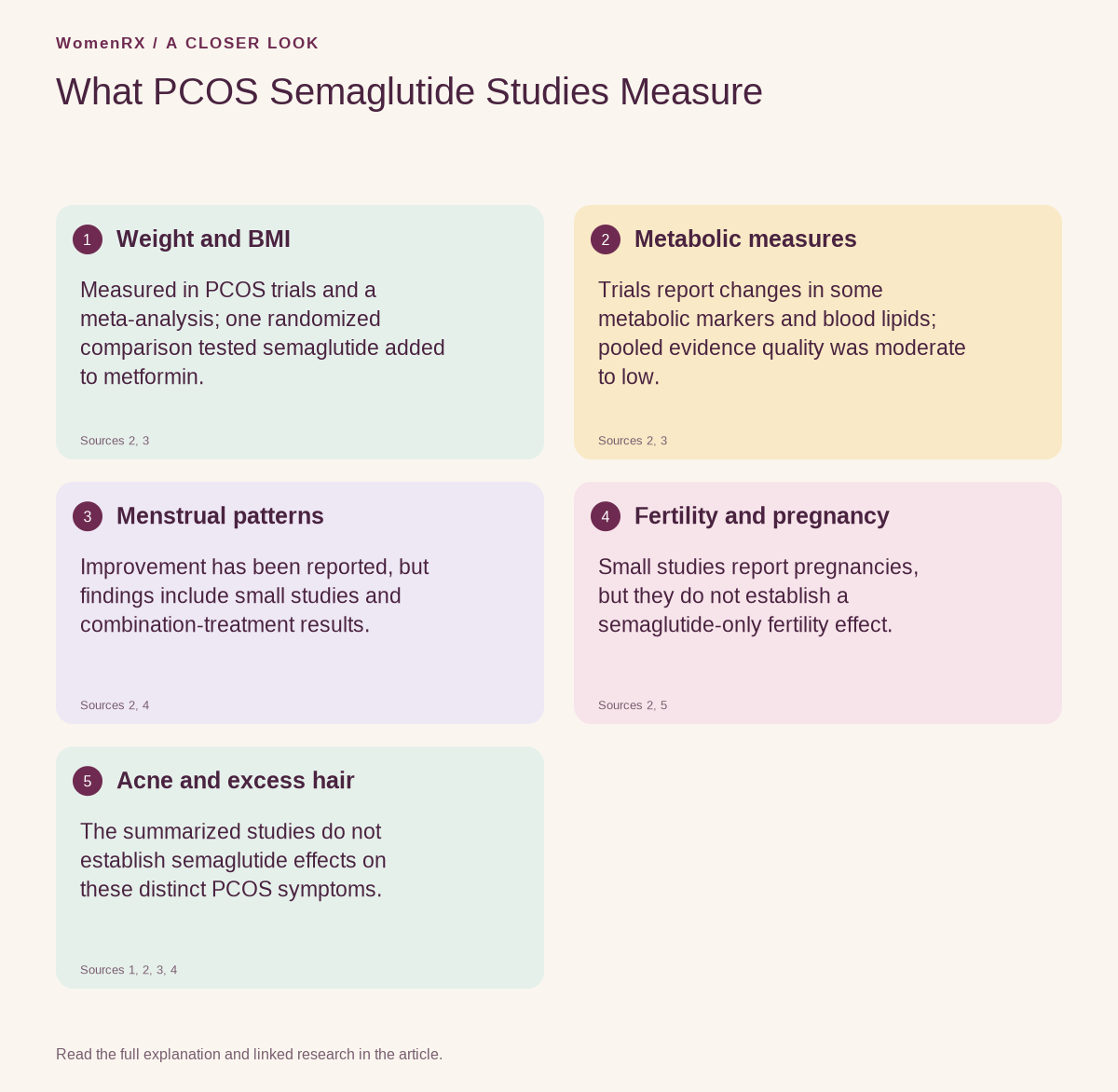
What PCOS Semaglutide Studies Measure
Weight and BMI: Measured in PCOS trials and a meta-analysis; one randomized comparison tested semaglutide added to metformin.23
Metabolic measures: Trials report changes in some metabolic markers and blood lipids; pooled evidence quality was moderate to low.23
Menstrual patterns: Improvement has been reported, but findings include small studies and combination-treatment results.24
Fertility and pregnancy: Small studies report pregnancies, but they do not establish a semaglutide-only fertility effect.25
Acne and excess hair: The summarized studies do not establish semaglutide effects on these distinct PCOS symptoms.1234
Read the figure as text
The evidence differs by outcome: weight and some metabolic measures have more direct study data than periods, fertility, or skin and hair symptoms.- Weight and BMI: Measured in PCOS trials and a meta-analysis; one randomized comparison tested semaglutide added to metformin.23
- Metabolic measures: Trials report changes in some metabolic markers and blood lipids; pooled evidence quality was moderate to low.23
- Menstrual patterns: Improvement has been reported, but findings include small studies and combination-treatment results.24
- Fertility and pregnancy: Small studies report pregnancies, but they do not establish a semaglutide-only fertility effect.25
- Acne and excess hair: The summarized studies do not establish semaglutide effects on these distinct PCOS symptoms.1234
More questions, answered
Does semaglutide improve fertility in PCOS?
Small studies have reported pregnancies, and one randomized trial reported higher natural pregnancy rates with semaglutide plus metformin than with metformin alone. But the follow-up treatment and study designs make it difficult to attribute those pregnancies to semaglutide. These findings don’t establish a fertility benefit for semaglutide alone. 2 5
What should I ask if I might want to become pregnant?
Ask how treatment fits your pregnancy timeline, what to do if you might conceive while taking it, and how contraception should fit your plans. A review advises stopping semaglutide before planned conception, but it doesn’t specify an exact interval. 4
Sources you can check
- PCOS | Polycystic Ovary Syndrome | MedlinePlusAccessed 2026-09-25Return to first citation
- Effects of combined metformin and semaglutide therapy on body weight, metabolic parameters, and reproductive outcomes in overweight/obese women with polycystic ovary syndrome: a prospective, randomized, controlled, open-label clinical trial.Chen H, Lei X, Yang Z, Xu Y, Liu D, Wang C, Du H. · Reproductive biology and endocrinology : RB&E · 2025Return to first citation
- Meta-analysis of the effects of semaglutide on body mass index (BMI) and blood lipid levels in polycystic ovary syndrome patients.Chen W, Xu D, Shao X, Song Q, Chen R. · Gynecological endocrinology : the official journal of the International Society of Gynecological Endocrinology · 2025Return to first citation
- Efficacy and Safety of Semaglutide in Patients with Polycystic Ovary Syndrome: A Scoping Review.La Vignera S, Condorelli RA. · Biomedicines · 2026Return to first citation
- Effect of semaglutide with metformin for weight loss and fertility in polycystic ovary syndrome (PCOS) patients with obesity: A pilot prospective study.Bolek T, Turňová P, Janošova S, Péč MJ, Ságová I, Nagy N, Jurica J, Mokáň M, Samoš M. · Clinical nutrition ESPEN · 2026Return to first citation