Magnesium L-Threonate: What Dose Has Actually Been Studied?
Human trials have used 1 or 2 grams of magnesium L-threonate daily, but those amounts don’t tell you how much elemental magnesium a product supplies.
For sleep, one trial studied 1 gram of magnesium L-threonate daily for 21 days; a trial measuring cognition and sleep studied 2 grams daily for six weeks. Neither amount is an established recommended dose. Those figures describe the weight of the compound, not elemental magnesium. To assess a product, read its Supplement Facts panel for the elemental-magnesium amount per serving. For example, if a panel lists “Magnesium 100 mg (as magnesium L-threonate)” for a two-capsule serving, those two capsules supply 100 mg of elemental magnesium. That is a hypothetical label example, not a verified amount for a product or either trial. 123
First, separate two numbers on the label
A bottle may feature “magnesium L-threonate” on the front, while its Supplement Facts panel lists “magnesium” followed by a milligram amount and the form it comes from. These aren’t interchangeable numbers. The compound includes magnesium and L-threonate; the magnesium amount declared on the Supplement Facts panel is elemental magnesium, not the weight of the whole compound. 1
For example, if a product advertises 2 grams of magnesium L-threonate, don’t count that as 2,000 milligrams of magnesium. Check the panel for the amount of magnesium in the stated serving, then check how many capsules make up that serving. For a worked example, if a hypothetical panel lists “Magnesium 100 mg (as magnesium L-threonate)” and a serving size of two capsules, that serving supplies 100 mg of elemental magnesium. Two such servings would supply 200 mg of elemental magnesium. Neither figure is a verified amount for a product or either trial. Without a particular product’s panel, there’s no verified elemental-magnesium amount to assign to it. That distinction matters if you’re comparing products or adding up magnesium from more than one supplement. 1
What the human trials actually tested
In a 2025 randomized, placebo-controlled trial, 100 adults ages 18 to 45 who were dissatisfied with their sleep received 2 grams daily of a branded magnesium L-threonate preparation or placebo for six weeks. The supplement group improved more on an overall cognitive test score and a reaction-time test. It did not outperform placebo on a separate reasoning test. The researchers also reported an improvement in a measure they called estimated “cognitive age.” That’s a test-derived estimate, not evidence that taking the supplement makes a brain biologically younger. 2
Sleep results in that trial were narrower than a general claim that it improves sleep. Participants reported less sleep-related impairment, but the groups did not differ on several other self-reported sleep measures or on sleep outcomes recorded by a wearable ring. 2
A separate 2024 randomized, placebo-controlled trial studied 1 gram daily for 21 days in 80 adults ages 35 to 55 with self-assessed sleep problems. It reported better results than placebo on selected wearable sleep measures and on some self-reported measures of waking and daytime functioning. The supplement group maintained sleep quality and daytime functioning while the placebo group declined, a distinction worth keeping in mind when reading “improved” in a product claim. 3
The two trials tested different amounts, for different lengths of time, in different groups of adults. Their sleep findings aren’t identical. They can tell you what was tested, but they don’t establish that 2 grams works better than 1 gram, or that either is the right daily amount for you. 23
What about a benefit specifically for women?
The cognition and sleep results above are reported for adult study groups, not as separate results for women. They don’t establish a women-specific benefit, and they don’t answer whether the effects differ during pregnancy, lactation, perimenopause or postmenopause. 23
There is also a trial in 109 people after breast cancer surgery that measured cognition and sleep alongside pain. After 12 weeks of magnesium L-threonate or placebo, it found no between-group improvement in cognition or sleep. That’s a different clinical situation from taking a supplement for everyday sleep concerns, but it’s a useful reminder that positive findings in one group need not carry over to another. 4
How to make a label comparison that helps
Start with the reason you’re considering it. If it’s cognition, the most directly relevant trial here used 2 grams of the compound daily for six weeks and found improvement on some tests, not all. If it’s sleep, trials used both 1 gram and 2 grams daily and produced mixed results across sleep measures. Neither trial amount is a proven target to match. 23
Then look at the elemental magnesium on the Supplement Facts panel, using the serving size printed beside it. This is the number to compare with magnesium from any other supplements or medicines you take. For adults, the NIH Office of Dietary Supplements lists 350 milligrams a day as the upper intake level for magnesium from supplements and medications; that limit does not include magnesium naturally present in food. It isn’t a suggested dose or a target for magnesium L-threonate. 1
The practical takeaway: a front-label compound weight can help you recognize an amount used in research, but the Supplement Facts panel tells you how much magnesium that particular serving adds. Neither number, by itself, promises a cognition or sleep benefit. 123
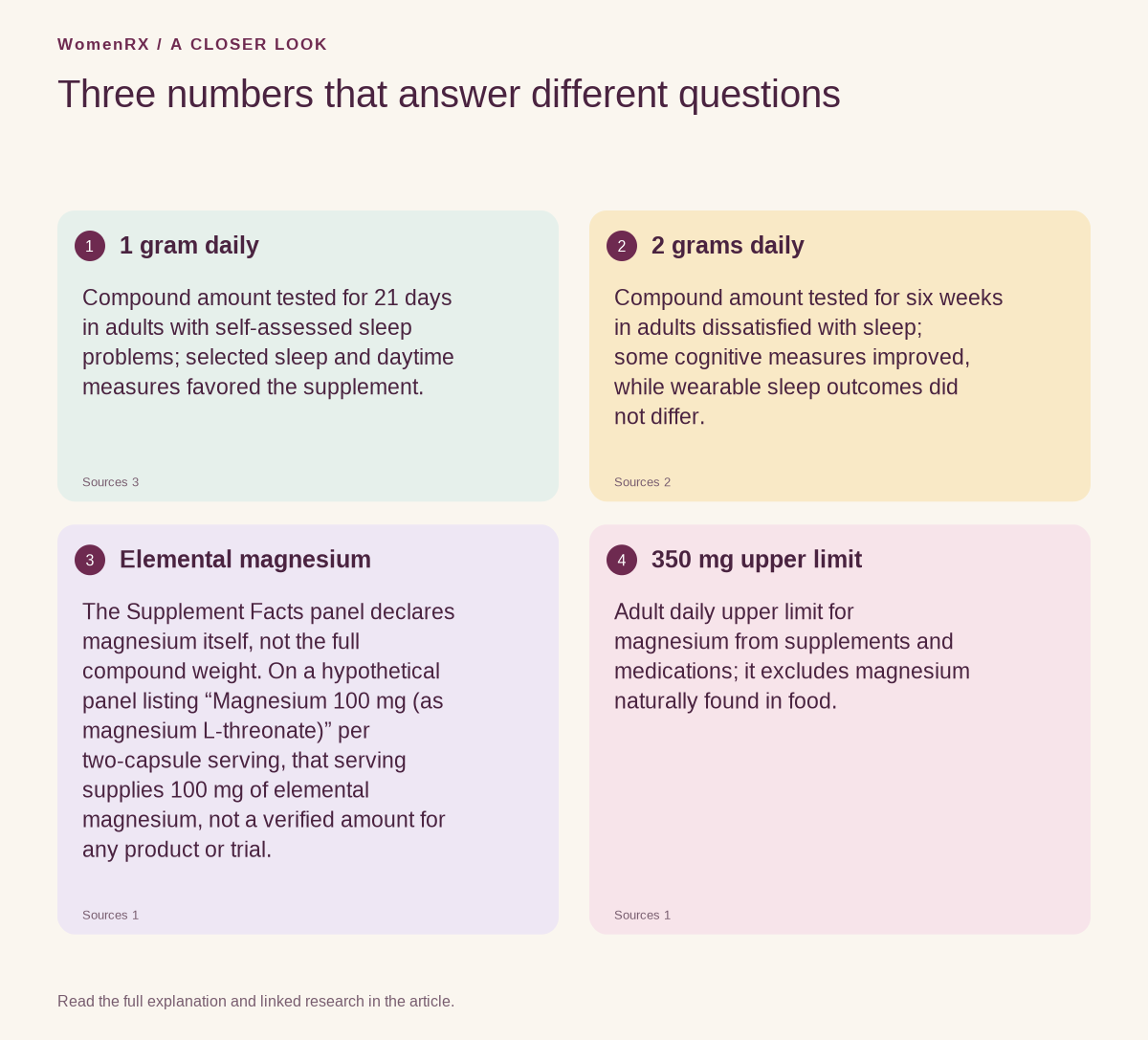
Three numbers that answer different questions
1 gram daily: Compound amount tested for 21 days in adults with self-assessed sleep problems; selected sleep and daytime measures favored the supplement.3
2 grams daily: Compound amount tested for six weeks in adults dissatisfied with sleep; some cognitive measures improved, while wearable sleep outcomes did not differ.2
Elemental magnesium: The Supplement Facts panel declares magnesium itself, not the full compound weight. On a hypothetical panel listing “Magnesium 100 mg (as magnesium L-threonate)” per two-capsule serving, that serving supplies 100 mg of elemental magnesium, not a verified amount for any product or trial.1
350 mg upper limit: Adult daily upper limit for magnesium from supplements and medications; it excludes magnesium naturally found in food.1
Read the figure as text
Use the studied compound amounts to understand the research, and the product panel to understand your magnesium intake.- 1 gram daily: Compound amount tested for 21 days in adults with self-assessed sleep problems; selected sleep and daytime measures favored the supplement.3
- 2 grams daily: Compound amount tested for six weeks in adults dissatisfied with sleep; some cognitive measures improved, while wearable sleep outcomes did not differ.2
- Elemental magnesium: The Supplement Facts panel declares magnesium itself, not the full compound weight. On a hypothetical panel listing “Magnesium 100 mg (as magnesium L-threonate)” per two-capsule serving, that serving supplies 100 mg of elemental magnesium, not a verified amount for any product or trial.1
- 350 mg upper limit: Adult daily upper limit for magnesium from supplements and medications; it excludes magnesium naturally found in food.1
More questions, answered
Is the magnesium Daily Value the same as the supplement upper limit?
No. The magnesium Daily Value is 420 milligrams for adults and children age 4 and older and helps compare labels in the context of a total diet. The adult upper limit of 350 milligrams applies to magnesium from supplements and medications, not magnesium naturally present in food. They answer different questions. 1
Sources you can check
- Magnesium - Health Professional Fact SheetAccessed 2026-09-25Return to first citation
- The effects of magnesium L-threonate (Magtein®) on cognitive performance and sleep quality in adults: a randomised, double-blind, placebo-controlled trial.Lopresti AL, Smith SJ. · Frontiers in nutrition · 2025Return to first citation
- Magnesium-L-threonate improves sleep quality and daytime functioning in adults with self-reported sleep problems: A randomized controlled trial.Hausenblas HA, Lynch T, Hooper S, Shrestha A, Rosendale D, Gu J. · Sleep medicine: X · 2024Return to first citation
- A Randomized, Double-Blind, Placebo-Controlled Trial to Evaluate the Therapeutic Effect of Magnesium-L-Threonate Supplementation for Persistent Pain After Breast Cancer Surgery.Ni Y, Deng F, Yu S, Zhang J, Zhang X, Huang D, Zhou H. · Breast cancer (Dove Medical Press) · 2023Return to first citation