Magnesium L-Threonate: Read the Label, Weigh the Evidence
Magnesium L-threonate has some early human research, but the amount of the compound on a label is not the same as its elemental magnesium.
Magnesium L-threonate is magnesium combined with L-threonate. Human cognition research includes short trials in adults with sleep concerns, plus earlier cognition trials in adults ages 18 to 70 that are described in a later paper. The evidence is still limited, and the reports described don’t provide sex-specific results. Compare products by elemental magnesium on the Supplement Facts panel, not just compound weight. 124
Start with the amount that counts on the label
Magnesium L-threonate is a form of magnesium: the mineral is combined with L-threonate. The two amounts you may see discussed are different. The weight of magnesium L-threonate includes the whole compound; elemental magnesium is the amount of the mineral itself. The Supplement Facts panel lists elemental magnesium, not the weight of the entire magnesium-containing compound. 1
That difference can be substantial. In a European food-safety assessment, 3,000 mg of magnesium L-threonate corresponded to about 250 mg of magnesium. That’s an example from the assessed ingredient, not a universal conversion for every product. 3
When comparing labels, check the serving size, the amount of elemental magnesium per serving, and whether the serving is one or several capsules. Don’t compare a product’s compound weight with another product’s elemental-magnesium amount as if they were equivalent. A label’s quantity also doesn’t show that the product will deliver a particular cognitive or sleep benefit.
What human studies have found
A six-week randomized, placebo-controlled trial studied 100 adults ages 18 to 45 who reported dissatisfied sleep. The group assigned magnesium L-threonate had a greater improvement than placebo on one overall cognition measure, along with some differences in memory and reaction-time measures. Results weren’t positive across every test: for example, the groups didn’t differ on Raven’s test, and wearable sleep measures didn’t show group differences. 2
Cognition research also includes two earlier trials cited in the discussion of that study: one lasting 12 weeks in adults ages 50 to 70, and another lasting 30 days in adults ages 18 to 65. The discussion reports cognitive improvements in those trials, but doesn’t provide enough detail to assess their methods and results as fully as the six-week trial. 2
A separate randomized trial studied 80 adults ages 35 to 55 with self-reported sleep problems for 21 days. It reported improvements in some sleep, mood, and activity measures compared with placebo. Taken together, these are early findings, not proof that magnesium L-threonate prevents cognitive decline, treats a disease, or improves cognition or sleep for everyone. The studies were short, and two of the trials described here specifically recruited adults with sleep concerns. 24
The abstracts for the two sleep-focused trials don’t specify participants’ sex composition or report outcomes separately by sex. The brief descriptions of the earlier cognition trials also don’t say whether women were enrolled or report sex-specific outcomes. So these findings can’t tell us whether results differ for women. 24
How it compares with other magnesium forms
Magnesium forms can differ in how readily they dissolve and are absorbed. NIH guidance says magnesium aspartate, citrate, lactate, and chloride have tended to be more bioavailable than oxide and sulfate in small studies. NIH’s comparisons cover those forms, while the European Food Safety Authority’s assessment establishes that magnesium is bioavailable from L-threonate, not that it has a special advantage in absorption or everyday cognitive outcomes. 13
So the useful comparison depends on your reason for considering magnesium. If you’re comparing products to increase magnesium intake, compare elemental amounts and consider the form and tolerability. If you’re considering L-threonate specifically for memory or sleep, remember that a few short trials are not the same as established treatment evidence.
Safety and life-stage questions
Magnesium from supplements and medicines can cause diarrhea, nausea, or abdominal cramping. The NIH upper limit for adults is 350 mg per day from supplements and medications combined; magnesium naturally present in food doesn’t count toward that limit. This is a safety ceiling for those sources, not a recommended supplement target. 1
The body relies on the kidneys to remove excess magnesium, so the risk of harmful buildup is greater when kidney function is impaired. Magnesium can also interfere with absorption of oral bisphosphonates and some antibiotics, including tetracyclines such as doxycycline and quinolones such as ciprofloxacin. If you take one of these medicines, ask a pharmacist or prescriber how to space it from a magnesium product. Long-term proton pump inhibitor use can affect magnesium status, and loop or thiazide diuretics can increase magnesium loss. 1
Pregnancy and breastfeeding deserve separate consideration. NIH recommended total magnesium intake is 350-360 mg per day during pregnancy and 310-320 mg during lactation, depending on age. Those figures include magnesium from all sources and aren’t a supplement dose. The published trial abstracts don’t report pregnancy- or breastfeeding-specific results, and the European assessment’s proposed conditions of use excluded these groups. Don’t use results from other adults as evidence that this specific product is appropriate during pregnancy or breastfeeding; get advice tailored to your situation. 1234
For a product decision, keep the question narrow: what does the label provide as elemental magnesium, what evidence matches the outcome you care about, and could your medicines or health circumstances change the safety picture?
Four things a magnesium label can mean
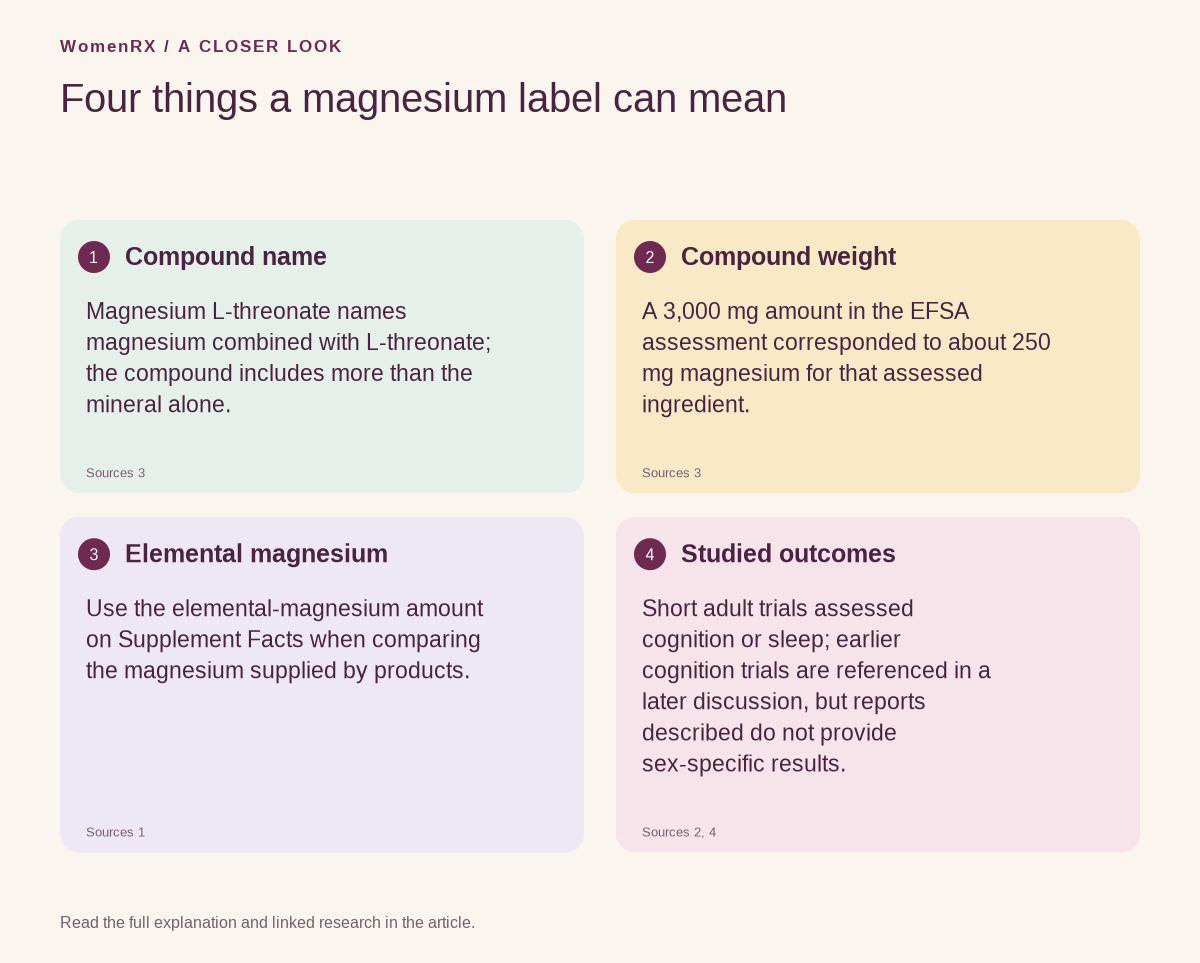
Compound name: Magnesium L-threonate names magnesium combined with L-threonate; the compound includes more than the mineral alone.3
Compound weight: A 3,000 mg amount in the EFSA assessment corresponded to about 250 mg magnesium for that assessed ingredient.3
Elemental magnesium: Use the elemental-magnesium amount on Supplement Facts when comparing the magnesium supplied by products.1
Studied outcomes: Short adult trials assessed cognition or sleep; earlier cognition trials are referenced in a later discussion, but reports described do not provide sex-specific results.24
Read the figure as text
Separate the ingredient’s compound weight from elemental magnesium, then distinguish a label amount from the outcomes tested in human research.- Compound name: Magnesium L-threonate names magnesium combined with L-threonate; the compound includes more than the mineral alone.3
- Compound weight: A 3,000 mg amount in the EFSA assessment corresponded to about 250 mg magnesium for that assessed ingredient.3
- Elemental magnesium: Use the elemental-magnesium amount on Supplement Facts when comparing the magnesium supplied by products.1
- Studied outcomes: Short adult trials assessed cognition or sleep; earlier cognition trials are referenced in a later discussion, but reports described do not provide sex-specific results.24
More questions, answered
Does a larger magnesium L-threonate number mean more magnesium?
Not necessarily. The compound’s total weight includes L-threonate as well as magnesium. Use the elemental-magnesium amount on the Supplement Facts panel to compare magnesium quantities across products. 1
Have studies shown a benefit specifically for women?
The abstracts for the sleep-focused trials don’t specify participants’ sex composition or report outcomes by sex. Brief descriptions of earlier cognition trials also don’t provide sex-specific results. These reports therefore can’t tell us whether the effects differ for women. 24
Sources you can check
- Magnesium - Health Professional Fact SheetAccessed 2026-09-25Return to first citation
- The effects of magnesium L-threonate (Magtein®) on cognitive performance and sleep quality in adults: a randomised, double-blind, placebo-controlled trial.Lopresti AL, Smith SJ. · Frontiers in nutrition · 2025Return to first citation
- Safety of magnesium l-threonate as a novel food pursuant to regulation (EU) 2015/2283 and bioavailability of magnesium from this source in the context of Directive 2002/46/EC.EFSA Panel on Nutrition, Novel Foods and Food Allergens (NDA), Turck D, Bohn T, Castenmiller J, De Henauw S, Hirsch-Ernst KI, Maciuk A, Mangelsdorf I, McArdle HJ, Naska A, Pentieva... · EFSA journal. European Food Safety Authority · 2024Return to first citation
- Magnesium-L-threonate improves sleep quality and daytime functioning in adults with self-reported sleep problems: A randomized controlled trial.Hausenblas HA, Lynch T, Hooper S, Shrestha A, Rosendale D, Gu J. · Sleep medicine: X · 2024Return to first citation