Magnesium L-Threonate for Memory: Evidence and Label Checks
Human trials offer some encouraging cognitive results, but a product label needs a closer look before those results mean much for you.
Magnesium L-threonate has been studied for cognition in people. Short randomized trials report improvements on some cognitive measures, though their results vary by test, population, and formulation. None of the reported findings establishes a benefit specific to women or menopause. If you’re comparing products, check the full ingredient list and distinguish the weight of magnesium L-threonate from the amount of elemental magnesium. 2 3 5
What the human studies show
A six-week randomized trial tested magnesium L-threonate against placebo in 100 adults ages 18 to 45 who were dissatisfied with their sleep. The supplement group improved more on the NIH Toolbox Total Cognition Composite, with reported differences in working and episodic memory. But the groups did not differ on Raven’s Progressive Matrices, a separate cognitive test. That’s a promising result on one set of measures, not a finding that everyone will feel more focused in daily life. 2
There is also an older, 12-week randomized trial of magnesium L-threonate in adults ages 50 to 70. Later publications report that its supplement group improved more than placebo on a composite cognitive score. That result belongs in the picture, although these later accounts alone don’t provide enough detail to assess every outcome or how well it applies to someone with your particular memory concern. 2 3
A third randomized trial found better memory-test scores after 30 days in 109 healthy Chinese adults ages 18 to 65. Its product, however, combined magnesium L-threonate with phosphatidylserine and vitamins C and D. The trial tested the combination, so it cannot tell you whether L-threonate alone caused the difference. 3
These are not interchangeable studies. They used different products, enrolled different adults, and measured cognition in different ways. The reported results do not separate outcomes for women or by menopause status. If you’re considering L-threonate because focus feels different during perimenopause, for example, these trials don’t establish how well it works for that situation. 2 3
Why the brain-delivery claim needs a second question
You may see a claim that L-threonate gets magnesium into the brain. Animal and laboratory findings help explain why researchers are interested in that possibility. For instance, one study examined cells and zebrafish after a low-oxygen injury. It did not test whether a person taking a supplement remembers names more easily or concentrates better at work. 4 7
The useful follow-up is: What happened on a human cognitive test, and what exactly did participants take? That question keeps a proposed mechanism separate from a measured benefit. It also catches the difference between a single-ingredient trial and a trial of a blend.
Read two magnesium numbers, not one
The milligrams of magnesium L-threonate describe the weight of the whole compound. Elemental magnesium is the magnesium portion of that compound. They are not the same number. As an illustration, a sleep trial described 1 gram of magnesium L-threonate as providing about 75 mg of elemental magnesium. That figure describes its study product, not a target amount for you or a guarantee about another product. 5 6
When you look at a product label, start with the serving size. Then find the amount listed for magnesium and check whether the label also gives a separate amount for magnesium L-threonate. If a prominent milligram number refers only to the compound, don’t read it as the elemental magnesium amount. If the distinction is unclear, ask the manufacturer what its stated amount represents.
Finally, read the complete ingredient list. A product containing phosphatidylserine and added vitamins is closer in concept to the combination studied in the 30-day trial than a product containing L-threonate alone, but the shared ingredients still don’t prove that a store-bought product will reproduce that trial’s result. 3
Keep a memory change separate from a supplement claim
The six-week cognition trial reported no significant adverse reactions, and a separate 21-day sleep trial described magnesium L-threonate as well tolerated. Those short periods cannot settle long-term safety. A European safety assessment also excluded pregnant and breastfeeding women from its proposed conditions of use; its conclusion should not be stretched to cover those stages. 2 6 5
An occasional forgotten name is different from increasing trouble with a familiar task or finding your way home. If your memory change looks like the latter, give the change attention in its own right rather than using a supplement purchase as the only next step. 1
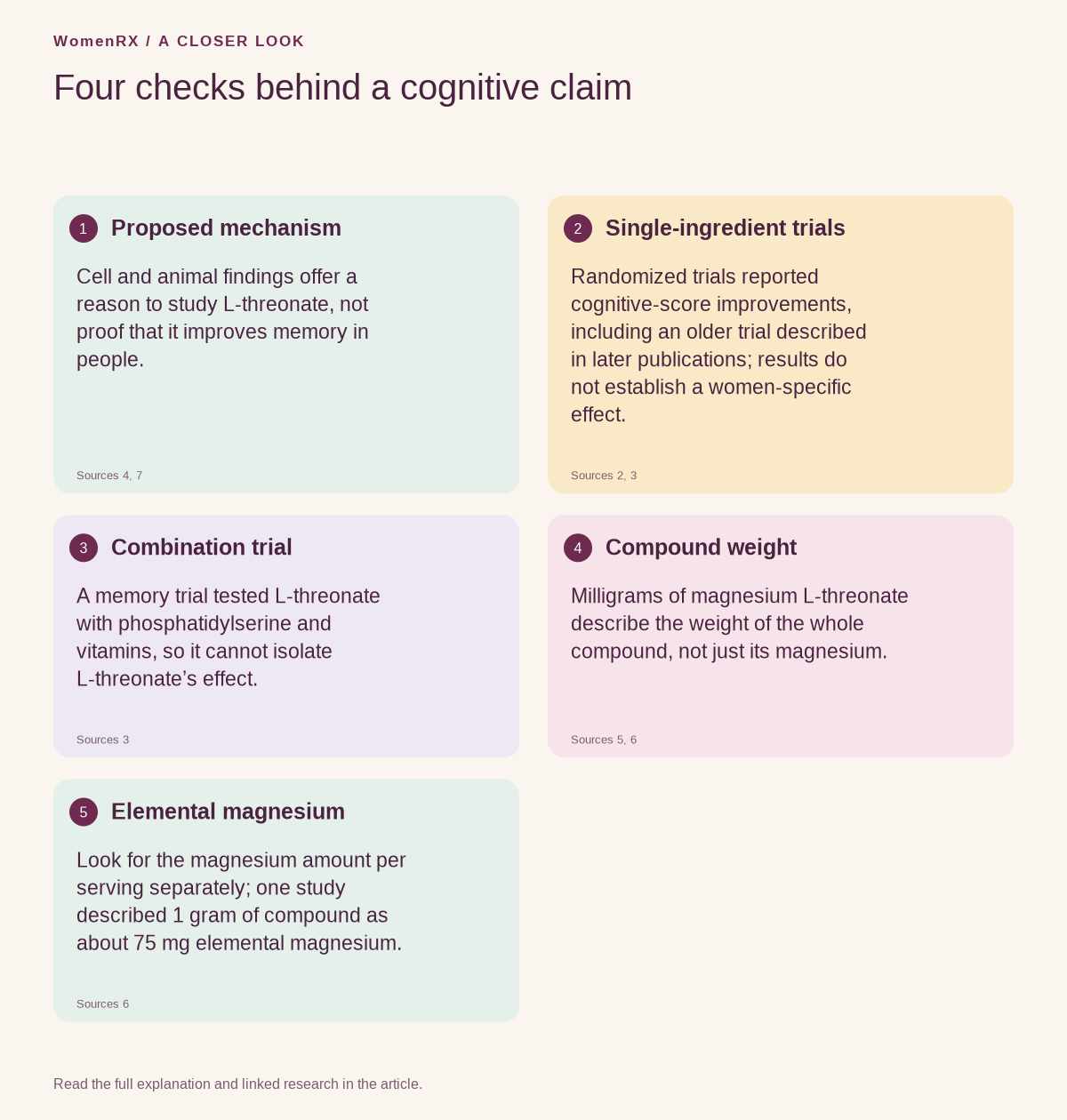
Four checks behind a cognitive claim
Proposed mechanism: Cell and animal findings offer a reason to study L-threonate, not proof that it improves memory in people.47
Single-ingredient trials: Randomized trials reported cognitive-score improvements, including an older trial described in later publications; results do not establish a women-specific effect.23
Combination trial: A memory trial tested L-threonate with phosphatidylserine and vitamins, so it cannot isolate L-threonate’s effect.3
Compound weight: Milligrams of magnesium L-threonate describe the weight of the whole compound, not just its magnesium.56
Elemental magnesium: Look for the magnesium amount per serving separately; one study described 1 gram of compound as about 75 mg elemental magnesium.6
Read the figure as text
These distinctions show what each kind of finding can answer and what to look for on a product label.- Proposed mechanism: Cell and animal findings offer a reason to study L-threonate, not proof that it improves memory in people.47
- Single-ingredient trials: Randomized trials reported cognitive-score improvements, including an older trial described in later publications; results do not establish a women-specific effect.23
- Combination trial: A memory trial tested L-threonate with phosphatidylserine and vitamins, so it cannot isolate L-threonate’s effect.3
- Compound weight: Milligrams of magnesium L-threonate describe the weight of the whole compound, not just its magnesium.56
- Elemental magnesium: Look for the magnesium amount per serving separately; one study described 1 gram of compound as about 75 mg elemental magnesium.6
More questions, answered
Do the studies show a benefit during perimenopause?
The reported cognitive results are not broken out by menopause status. They therefore cannot tell you whether perimenopause changes the effect of magnesium L-threonate. 2 3
Sources you can check
- Memory | MedlinePlusAccessed 2026-09-25Return to first citation
- The effects of magnesium L-threonate (Magtein®) on cognitive performance and sleep quality in adults: a randomised, double-blind, placebo-controlled trial.Lopresti AL, Smith SJ. · Frontiers in nutrition · 2025Return to first citation
- A Magtein®, Magnesium L-Threonate, -Based Formula Improves Brain Cognitive Functions in Healthy Chinese Adults.Zhang C, Hu Q, Li S, Dai F, Qian W, Hewlings S, Yan T, Wang Y. · Nutrients · 2022Return to first citation
- Neuroprotective effects of magnesium L-threonate in a hypoxic zebrafish model.Kim YS, Won YJ, Lim BG, Min TJ, Kim YH, Lee IO. · BMC neuroscience · 2020Return to first citation
- Safety of magnesium l-threonate as a novel food pursuant to regulation (EU) 2015/2283 and bioavailability of magnesium from this source in the context of Directive 2002/46/EC.EFSA Panel on Nutrition, Novel Foods and Food Allergens (NDA), Turck D, Bohn T, Castenmiller J, De Henauw S, Hirsch-Ernst KI, Maciuk A, Mangelsdorf I, McArdle HJ, Naska A, Pentieva... · EFSA journal. European Food Safety Authority · 2024Return to first citation
- Magnesium-L-threonate improves sleep quality and daytime functioning in adults with self-reported sleep problems: A randomized controlled trial.Hausenblas HA, Lynch T, Hooper S, Shrestha A, Rosendale D, Gu J. · Sleep medicine: X · 2024Return to first citation
- A Mini Review on the Various Facets Effecting Brain Delivery of Magnesium and Its Role in Neurological Disorders.Mathew AA, Panonnummal R. · Biological trace element research · 2023Return to first citation