Magnesium L-Threonate for Memory: What Human Studies Show
Several human reports describe cognitive improvements, but they involve different populations and formulations, and don’t establish a reliable or lasting memory benefit.
Human findings on magnesium L-threonate include two placebo-controlled trials described in detail, plus a 2022 paper’s brief summaries of an earlier study in older adults and a study in people with dementia. The results are worth investigating, but the studies differ in participants and formulations, and don’t establish lasting benefit, prevention of cognitive decline, or a specific benefit for women. 2 3
The short answer: promising, not established
Magnesium L-threonate is marketed on the idea that it can raise magnesium in the brain and, in turn, improve memory. Several human reports describe cognitive improvements, but they tested different products and groups of people. The findings remain preliminary: they don’t establish that the supplement reliably improves everyday memory or prevents cognitive decline. 2 3
That distinction matters. A change on a cognitive test can be an interesting research finding without showing that a supplement will make a noticeable or durable difference in daily life.
What the human research has tested
A 2022 randomized, double-blind, placebo-controlled trial included 109 healthy Chinese adults ages 18 to 65. For 30 days, participants took 2 grams per day of a formula containing magnesium L-threonate plus phosphatidylserine and vitamins C and D, or a starch placebo. The formula group improved more than the placebo group on the study’s overall memory score and five test subcategories. The 2-gram figure is the weight of the multi-ingredient formula, not 2 grams of elemental magnesium. Because the product contained several ingredients, the trial can’t show that magnesium L-threonate alone caused the results. The report doesn’t establish whether the score changes mattered in everyday life or lasted after the trial. It also reported greater improvement among older than younger participants, but that age pattern does not show a menopause-related effect or a benefit specific to women. 2
A separate randomized, double-blind, placebo-controlled trial enrolled 100 adults ages 18 to 45 who reported dissatisfied sleep. Participants took 2 grams per day of Magtein or placebo for six weeks. This is the amount of the magnesium L-threonate product, not 2 grams of elemental magnesium. The magnesium L-threonate group had a greater improvement than placebo on the NIH Toolbox total cognition score, with larger effects reported for working and episodic memory. But the groups did not differ on Raven’s Progressive Matrices, another cognitive measure included in the trial. The mixed findings and short timeframe call for replication, rather than a broad promise of better memory. 3
The 2022 paper also summarizes a 2016 placebo-controlled study in American adults ages 50 to 70, reporting improved overall cognitive scores for the magnesium L-threonate group. Its brief account doesn’t provide enough detail about the study’s size, measures, or formulation to weigh this finding closely against the two trials described above. It also mentions a study in people with mild to moderate dementia that used magnesium L-threonate with vitamins C and D and reported cognitive improvements. That combination result can’t establish an effect from L-threonate alone, and the brief account doesn’t give enough detail to assess the finding as a treatment result. 2
Taken together, the human findings justify further study. They don’t yet show that a particular product is a dependable focus or memory supplement.
Brain access is a proposed mechanism, not the outcome
The “brain-penetrating magnesium” claim draws substantially on preclinical work. The 2022 trial paper describes rat studies in which magnesium L-threonate raised magnesium in cerebrospinal fluid and improved memory-related outcomes. Those animal findings help explain why researchers chose to test the compound, but they can’t demonstrate that the same mechanism produces a useful memory improvement in people. 2
In people, the key question is what happens on meaningful cognitive outcomes, not just whether a compound is proposed to reach the brain. The human reports summarized here describe cognitive tests, but don’t establish dementia prevention or lasting protection against age-related decline. 2 3
Is it better than other magnesium forms?
The cognitive studies described here compared their products with placebo, not with citrate, glycinate, oxide, or another magnesium form. So they can’t establish that L-threonate improves cognition more than those alternatives. The NIH Office of Dietary Supplements notes that magnesium forms vary in absorption and that some forms have higher bioavailability than oxide or sulfate; that general information does not establish a cognitive advantage for L-threonate. 1 2 3
The products also weren’t identical: one trial tested L-threonate with other ingredients, while the six-week trial tested Magtein. Results from one formulation shouldn’t automatically be treated as evidence for every product marketed as magnesium threonate. 2 3
What this means if you’re considering it
If your goal is memory or focus, the fair takeaway is that human studies have reported some improvements on cognitive tests, but the evidence isn’t strong enough to promise a noticeable or lasting benefit. The findings come from different populations and formulations, and there’s no direct comparison in these trials showing that L-threonate is a better choice than another magnesium form.
The 2022 trial reported more improvement among older participants, but that was an age-related result, not evidence of a menopause-specific effect. The reported findings don’t establish whether results differ by sex or menopause stage, or whether the supplement protects against memory and concentration changes around menopause. 2 3
If you’re checking a supplement label for general magnesium intake, look for the amount of elemental magnesium: supplement labels list elemental magnesium, not the total weight of the magnesium compound. High supplemental magnesium can cause diarrhea, nausea, or abdominal cramping, and the risk of toxicity is higher with impaired kidney function. 1
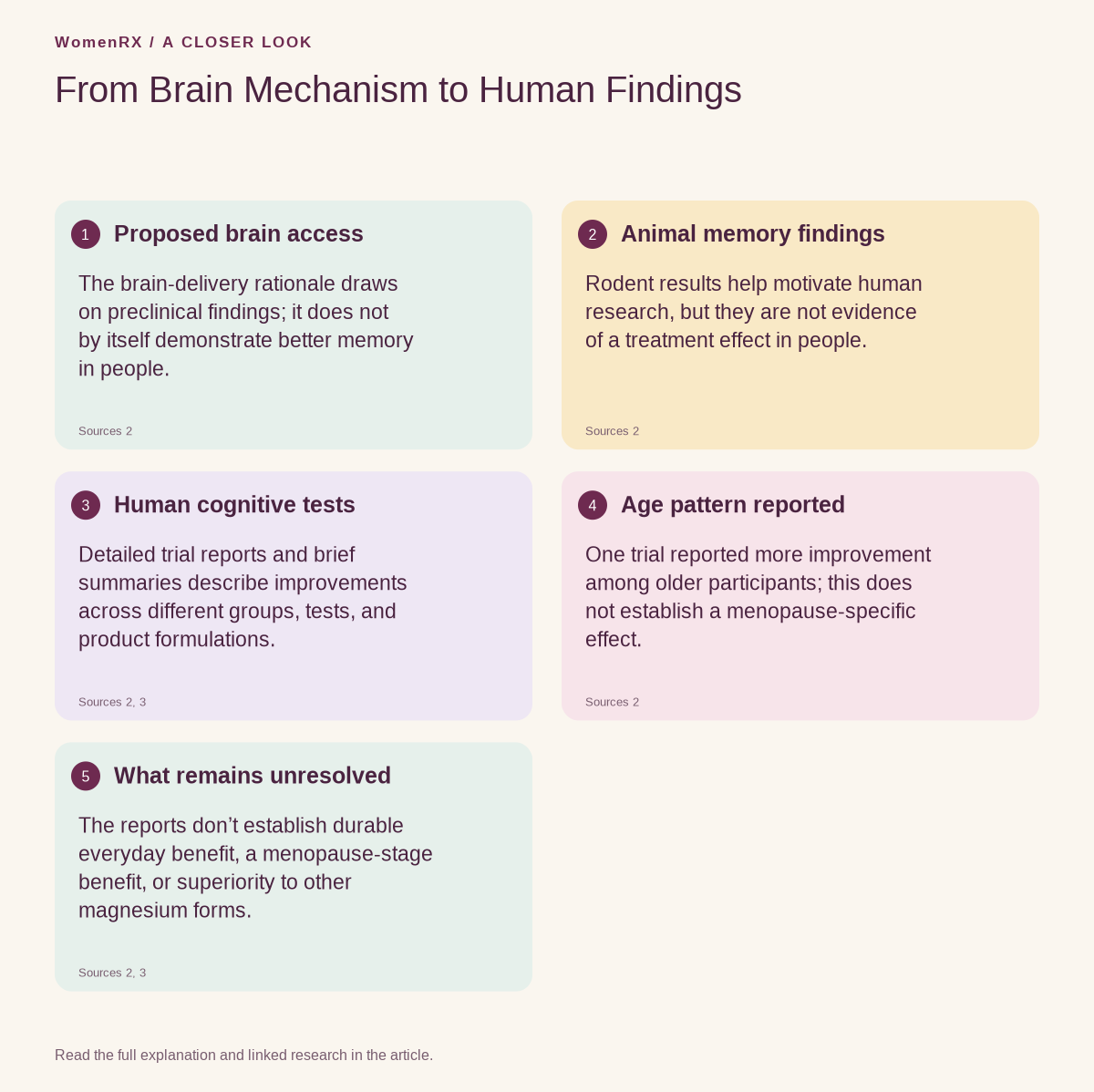
From Brain Mechanism to Human Findings
Proposed brain access: The brain-delivery rationale draws on preclinical findings; it does not by itself demonstrate better memory in people.2
Animal memory findings: Rodent results help motivate human research, but they are not evidence of a treatment effect in people.2
Human cognitive tests: Detailed trial reports and brief summaries describe improvements across different groups, tests, and product formulations.23
Age pattern reported: One trial reported more improvement among older participants; this does not establish a menopause-specific effect.2
What remains unresolved: The reports don’t establish durable everyday benefit, a menopause-stage benefit, or superiority to other magnesium forms.23
Read the figure as text
Brain-delivery hypotheses, animal findings, and human cognitive tests answer different questions. This map shows what the reported evidence can and can’t establish.- Proposed brain access: The brain-delivery rationale draws on preclinical findings; it does not by itself demonstrate better memory in people.2
- Animal memory findings: Rodent results help motivate human research, but they are not evidence of a treatment effect in people.2
- Human cognitive tests: Detailed trial reports and brief summaries describe improvements across different groups, tests, and product formulations.23
- Age pattern reported: One trial reported more improvement among older participants; this does not establish a menopause-specific effect.2
- What remains unresolved: The reports don’t establish durable everyday benefit, a menopause-stage benefit, or superiority to other magnesium forms.23
More questions, answered
Does magnesium L-threonate prevent dementia or cognitive decline?
The human reports described here don’t establish dementia prevention or lasting protection from cognitive decline. One brief summary describes a study in people with mild to moderate dementia using a multi-ingredient formula, but that isn’t enough to show that L-threonate alone treats dementia. 2
Do the findings show it helps during perimenopause or after menopause?
The reported findings don’t establish a menopause-stage benefit. The greater improvement reported among older participants in one trial is an age pattern, not evidence about menopause or a specific benefit for women. 2 3
Sources you can check
- Magnesium - Health Professional Fact SheetAccessed 2026-09-25Return to first citation
- A Magtein®, Magnesium L-Threonate, -Based Formula Improves Brain Cognitive Functions in Healthy Chinese Adults.Zhang C, Hu Q, Li S, Dai F, Qian W, Hewlings S, Yan T, Wang Y. · Nutrients · 2022Return to first citation
- The effects of magnesium L-threonate (Magtein®) on cognitive performance and sleep quality in adults: a randomised, double-blind, placebo-controlled trial.Lopresti AL, Smith SJ. · Frontiers in nutrition · 2025Return to first citation