Magnesium L-Threonate After 40: Is There a Reason to Choose It?
Turning 40 doesn’t create a special need for magnesium L-threonate, and evidence for cognition or menopause symptoms remains limited.
There’s no established reason to choose magnesium L-threonate just because you’re over 40 or going through menopause. Small human trials have reported some cognitive or sleep improvements, but they studied different adult groups and don’t show that L-threonate is better than other forms or helps menopause symptoms. If you’re concerned about magnesium, first consider your food intake and any health factors that could affect it. 234
Age alone isn’t a reason to switch forms
For women, the recommended magnesium intake is 320 mg a day from all sources at ages 31-50, and it remains 320 mg at age 51 and older. Those recommendations don’t single out L-threonate, perimenopause, or menopause. The useful question is whether you’re getting enough magnesium overall, not whether you’ve crossed 40. 1
Magnesium is found in foods such as pumpkin seeds, almonds, spinach, beans, and whole grains. As an example, a meal with beans or whole grains plus nuts or leafy greens can contribute magnesium without requiring a specialty supplement. The amount in a food pattern varies, so these examples aren’t a calculation of your personal intake. 1
What the L-threonate studies can, and can’t, tell you
There are a few human trials, but they don’t answer the specific question of whether L-threonate helps women through perimenopause or menopause.
One placebo-controlled study tested a combination containing L-threonate, phosphatidylserine, and vitamins C and D in 109 healthy Chinese adults ages 18-65. Memory-test scores improved more in the combination group over 30 days, but because the product contained several ingredients, the study can’t show that L-threonate alone caused the result. The study description also doesn’t report whether participants were perimenopausal or postmenopausal, or give a menopause-specific result. 2
A separate six-week placebo-controlled trial studied 100 adults ages 18-45 who reported dissatisfied sleep. It found a difference between groups on one overall cognitive measure, but not on another reasoning test; several sleep outcomes also showed no group difference. This trial doesn’t establish a benefit for women over 45 or for menopause-related brain fog or sleep changes. 3
A 21-day trial included 80 adults ages 35-55 who reported sleep problems and reported improvements in some sleep and daytime measures. Its summary doesn’t provide a menopause-specific analysis. A short study in adults with self-reported sleep problems also can’t establish that L-threonate treats menopausal insomnia. 4
Taken together, these trials are early signals, not proof that L-threonate is the best form for memory, sleep, or menopause symptoms. They also don’t compare it directly with food-based magnesium intake or establish that it outperforms other supplement forms for these concerns. 234
Choose based on the need, not the age label
If your concern is low intake, start by looking at your usual foods. The NIH Office of Dietary Supplements lists nuts, seeds, legumes, leafy greens, and whole grains as good sources. If you’re considering a supplement, the Supplement Facts panel lists elemental magnesium, not the total weight of the magnesium compound. That’s the number to use when understanding how much magnesium the product supplies. 1
Different forms aren’t interchangeable in how they dissolve and are absorbed. The NIH fact sheet notes that magnesium citrate, chloride, lactate, and aspartate tend to be more bioavailable than oxide and sulfate. That doesn’t establish that L-threonate is the right choice for you, or that any form has proven menopause-specific benefits. 1
If a clinician has identified a reason to assess your magnesium intake or status, that’s more relevant than age alone. Magnesium status can be difficult to assess: serum magnesium is commonly measured, but it doesn’t accurately reflect total body magnesium or levels in specific tissues. Intake and clinical assessment may both matter. 1
Keep the safety tradeoff in view
Magnesium from food generally doesn’t pose a health risk for healthy people, but high amounts from supplements or magnesium-containing medicines can cause diarrhea, nausea, or abdominal cramping. The adult upper limit of 350 mg a day applies to magnesium from supplements and medications, not magnesium naturally present in food; it is not a target intake. Kidney problems can raise the risk of magnesium building up because the kidneys help remove excess magnesium. 1
So, for a woman over 40, L-threonate may be a formulation to discuss if there’s a specific reason to consider it, but age or menopause by itself isn’t an evidence-based reason to choose it. The more grounded first step is to consider overall magnesium intake and the particular concern you want to address.
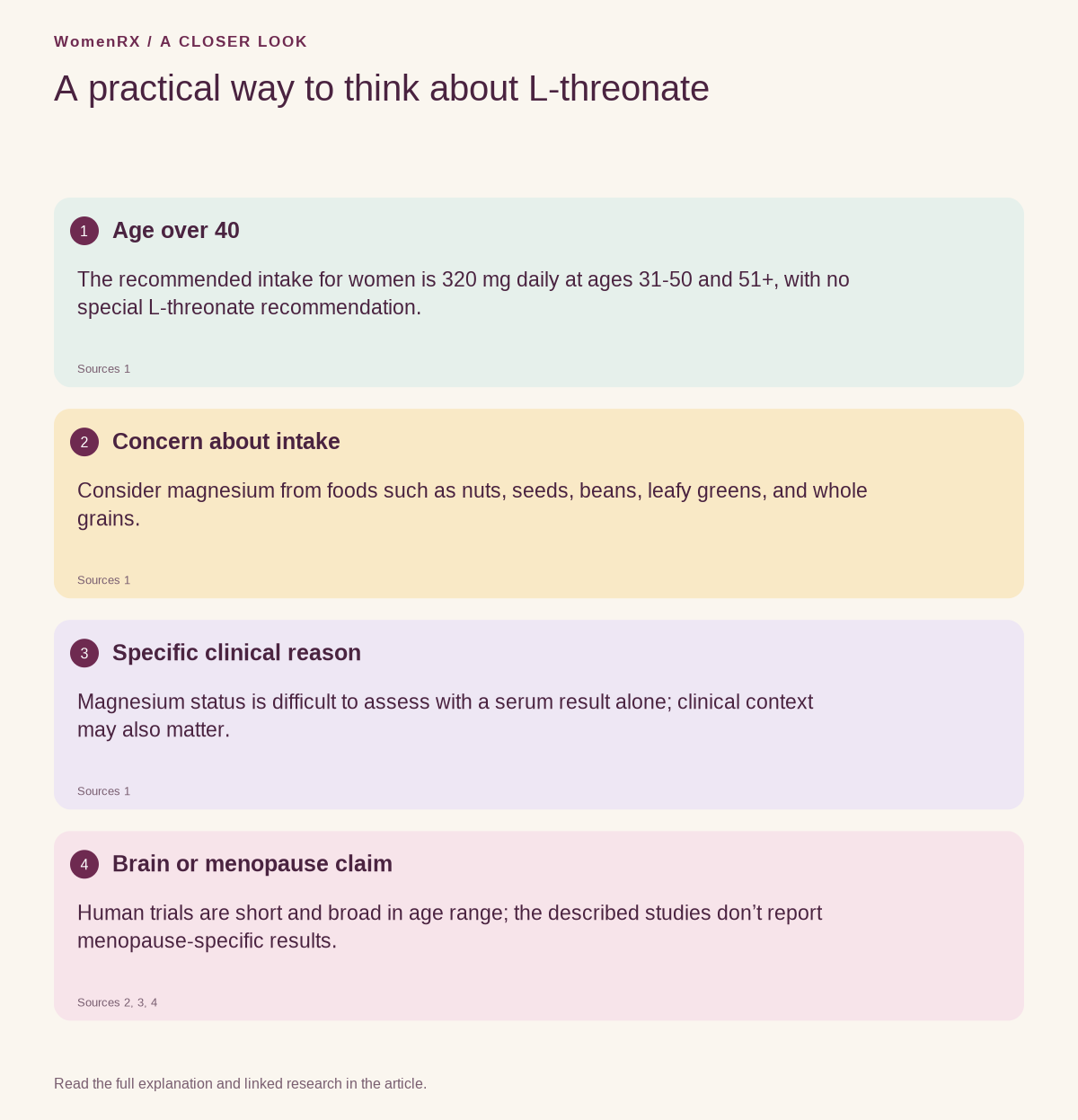
A practical way to think about L-threonate
Age over 40: The recommended intake for women is 320 mg daily at ages 31-50 and 51+, with no special L-threonate recommendation.1
Concern about intake: Consider magnesium from foods such as nuts, seeds, beans, leafy greens, and whole grains.1
Specific clinical reason: Magnesium status is difficult to assess with a serum result alone; clinical context may also matter.1
Brain or menopause claim: Human trials are short and broad in age range; the described studies don’t report menopause-specific results.234
Read the figure as text
Separate an overall magnesium intake question from a formulation claim tied to age, cognition, or menopause.- Age over 40: The recommended intake for women is 320 mg daily at ages 31-50 and 51+, with no special L-threonate recommendation.1
- Concern about intake: Consider magnesium from foods such as nuts, seeds, beans, leafy greens, and whole grains.1
- Specific clinical reason: Magnesium status is difficult to assess with a serum result alone; clinical context may also matter.1
- Brain or menopause claim: Human trials are short and broad in age range; the described studies don’t report menopause-specific results.234
More questions, answered
Does magnesium L-threonate treat menopause-related brain fog?
The human trials described here don’t establish that it treats menopause-related brain fog. They studied broad adult groups, and the trial descriptions don’t report menopause-specific outcomes. 23
Is a magnesium blood test a complete check of magnesium status?
No. Serum magnesium is commonly measured, but it doesn’t accurately reflect total body magnesium or levels in specific tissues. A fuller assessment may consider both tests and clinical context. 1
Sources you can check
- Magnesium - Health Professional Fact SheetAccessed 2026-09-25Return to first citation
- A Magtein®, Magnesium L-Threonate, -Based Formula Improves Brain Cognitive Functions in Healthy Chinese Adults.Zhang C, Hu Q, Li S, Dai F, Qian W, Hewlings S, Yan T, Wang Y. · Nutrients · 2022Return to first citation
- The effects of magnesium L-threonate (Magtein®) on cognitive performance and sleep quality in adults: a randomised, double-blind, placebo-controlled trial.Lopresti AL, Smith SJ. · Frontiers in nutrition · 2025Return to first citation
- Magnesium-L-threonate improves sleep quality and daytime functioning in adults with self-reported sleep problems: A randomized controlled trial.Hausenblas HA, Lynch T, Hooper S, Shrestha A, Rosendale D, Gu J. · Sleep medicine: X · 2024Return to first citation