Magnesium L-Threonate: How Long Until It Works?
A short sleep trial found differences after three weeks, but it doesn’t establish when benefits begin or how long cognition takes to change.
There isn’t a dependable time-to-effect estimate for magnesium L-threonate and cognition. One trial report summarizes human cognition studies with findings reported at six weeks, plus open-label studies lasting eight weeks in dementia and 12 weeks in ADHD. Those are study time points, not proven onset times. For sleep, an 80-person trial found selected differences after 21 days, without identifying when they began. 2
What the human studies tell us about timing
The clearest timing evidence comes from a 2024 randomized, double-blind trial of 80 adults ages 35 to 55 who reported sleep problems. Participants took magnesium L-threonate or placebo for 21 days. At the end, the supplement group showed improvements compared with placebo in several sleep and daytime measures, including some sleep-stage scores, alertness, mood, and energy. 2
That is a signal from one short study, not a promise that you’ll sleep better in three weeks. The trial assessed participants during the study, but its reported results don’t establish a reliable day when benefits start. It also doesn’t show whether results last after people stop taking the supplement. The findings are about adults with self-reported sleep problems, not necessarily people with a diagnosed sleep disorder. 2
For cognition, there isn’t a dependable time-to-effect estimate. A trial report’s introduction summarizes earlier human research: one study reported improvements in cognitive scores by six weeks. It also describes open-label studies lasting eight weeks in people with dementia and 12 weeks in people with ADHD, reporting improved cognitive functioning or measures. A separate paper’s abstract refers to a human trial in older adults that reported improved global cognitive abilities. These reports show that cognition has been studied in people, but they don’t establish when an individual might notice a benefit. The descriptions don’t provide enough detail to judge the studies fully or identify a reliable onset time. 1 2
A separate randomized study followed 109 women after breast cancer surgery during 12 weeks of magnesium L-threonate or placebo. It found no significant differences between groups in cognitive scores or sleep scores. That study doesn’t settle the question for other women, but it does show why claims of a predictable cognitive benefit shouldn’t be treated as established. 3
Brain mechanisms aren’t a clock
Magnesium L-threonate is often promoted using claims about brain delivery. Research in cultured neurons found that threonate affected intracellular magnesium and synapse-related measures; the paper also describes findings from animal studies. Those experiments can help explain a proposed mechanism, but they don’t tell you how quickly a person will notice better memory or sleep. 1
A substance’s ability to affect brain cells, or a proposed ability to reach the brain, is not the same as showing a meaningful benefit in people. For a practical time estimate, human trials need to measure the intended outcome at multiple points and show when a change reliably appears. The sleep trial offers a 21-day endpoint, not a proven onset time. The women’s post-surgery trial found no advantage on its sleep or cognitive measures over 12 weeks. 1 2 3
What the women’s evidence can and can’t answer
The post-surgery trial is directly relevant in one respect: all participants were women. But they were women recovering from breast cancer procedures, and the study’s results shouldn’t automatically be applied to women without that experience. It also excluded people who were pregnant or breastfeeding, so it cannot answer questions about use or safety during those life stages. 3
The sleep trial included adults ages 35 to 55, but its reported findings don’t provide sex-specific results. So it can’t tell you whether the sleep response or its timing differs for women. Sex-specific findings also aren’t reported in the descriptions of the cognition studies. 2
A practical way to read the claims
If you’re weighing a claim about sleep, separate “a study measured an outcome after three weeks” from “the supplement works within three weeks.” The first describes a study; the second implies a reliable effect and onset that this trial doesn’t establish. For memory or focus, human studies have reported findings at several assessment points, including six weeks, but these study time points don’t show when an effect begins or establish a predictable benefit for an individual. 2
Also keep the study amount in perspective, rather than treating it as a personal recommendation: the sleep trial tested 1 gram per day of the magnesium L-threonate compound, which the paper reports provided about 75 milligrams of elemental magnesium. The amount of a magnesium compound and the amount of elemental magnesium are not interchangeable label figures. 2
Study time points are not onset times
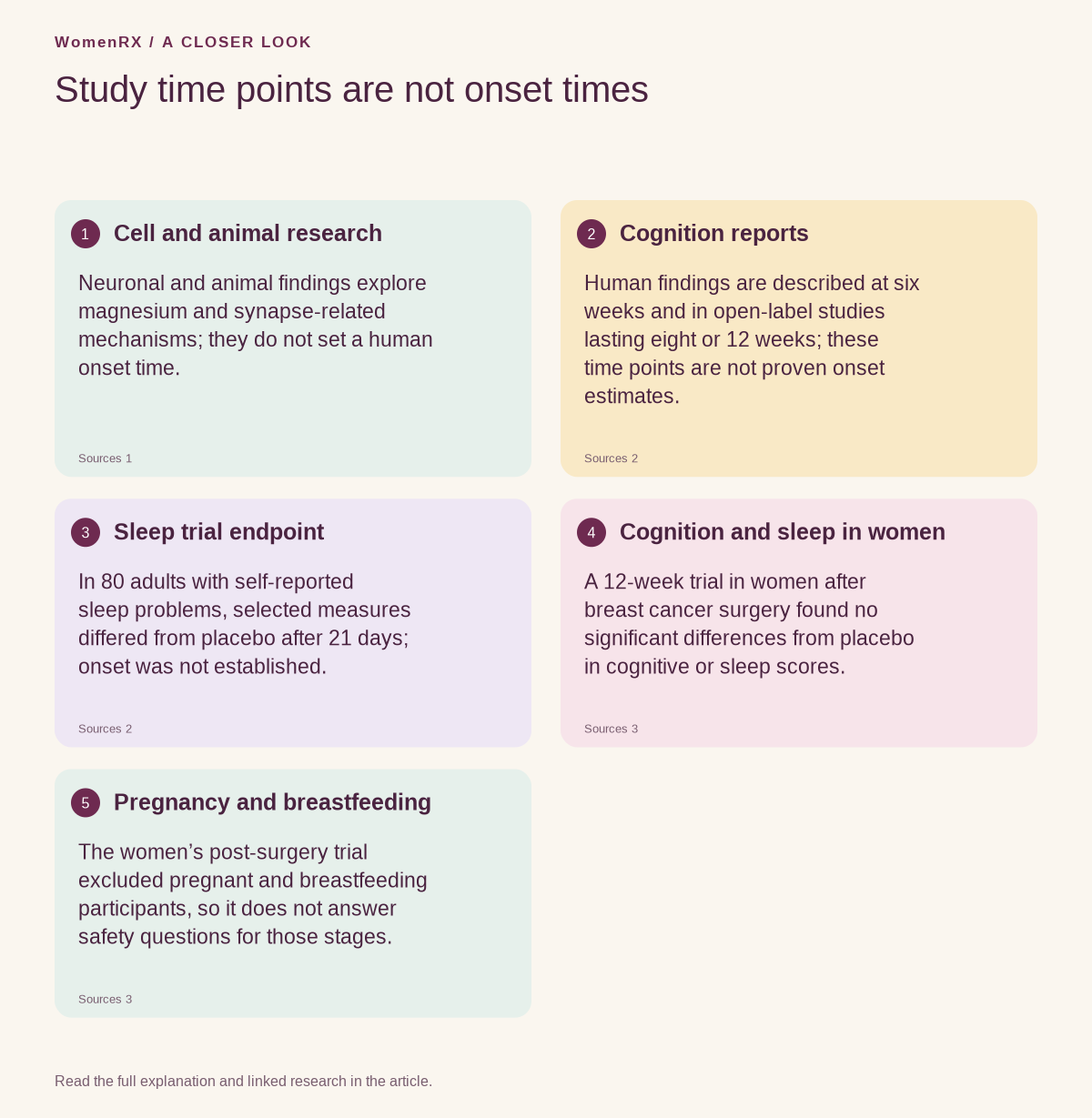
Cell and animal research: Neuronal and animal findings explore magnesium and synapse-related mechanisms; they do not set a human onset time.1
Cognition reports: Human findings are described at six weeks and in open-label studies lasting eight or 12 weeks; these time points are not proven onset estimates.2
Sleep trial endpoint: In 80 adults with self-reported sleep problems, selected measures differed from placebo after 21 days; onset was not established.2
Cognition and sleep in women: A 12-week trial in women after breast cancer surgery found no significant differences from placebo in cognitive or sleep scores.3
Pregnancy and breastfeeding: The women’s post-surgery trial excluded pregnant and breastfeeding participants, so it does not answer safety questions for those stages.3
Read the figure as text
Human studies have examined sleep and cognition at different time points, but a study’s endpoint does not tell you when an individual will notice an effect.- Cell and animal research: Neuronal and animal findings explore magnesium and synapse-related mechanisms; they do not set a human onset time.1
- Cognition reports: Human findings are described at six weeks and in open-label studies lasting eight or 12 weeks; these time points are not proven onset estimates.2
- Sleep trial endpoint: In 80 adults with self-reported sleep problems, selected measures differed from placebo after 21 days; onset was not established.2
- Cognition and sleep in women: A 12-week trial in women after breast cancer surgery found no significant differences from placebo in cognitive or sleep scores.3
- Pregnancy and breastfeeding: The women’s post-surgery trial excluded pregnant and breastfeeding participants, so it does not answer safety questions for those stages.3
More questions, answered
Does “brain bioavailability” mean you’ll notice an effect sooner?
No. Mechanistic and cell findings can support a proposed explanation, but they don’t establish a faster or noticeable effect in people. Human cognition reports include findings at six weeks and later study time points, but those don’t establish a reliable onset time. 1 2
Were women included in the human studies?
One 12-week trial enrolled women after breast cancer surgery and found no significant benefit over placebo for sleep or cognitive scores. The reported findings from the 21-day sleep trial don’t provide sex-specific results, and the cognition-study descriptions don’t report sex-specific findings. 2 3
Sources you can check
- Regulation of structural and functional synapse density by L-threonate through modulation of intraneuronal magnesium concentration.Sun Q, Weinger JG, Mao F, Liu G. · Neuropharmacology · 2016Return to first citation
- Magnesium-L-threonate improves sleep quality and daytime functioning in adults with self-reported sleep problems: A randomized controlled trial.Hausenblas HA, Lynch T, Hooper S, Shrestha A, Rosendale D, Gu J. · Sleep medicine: X · 2024Return to first citation
- A Randomized, Double-Blind, Placebo-Controlled Trial to Evaluate the Therapeutic Effect of Magnesium-L-Threonate Supplementation for Persistent Pain After Breast Cancer Surgery.Ni Y, Deng F, Yu S, Zhang J, Zhang X, Huang D, Zhou H. · Breast cancer (Dove Medical Press) · 2023Return to first citation