Magnesium: Food, Supplements, Evidence, and Safety
Start with your usual diet and life stage: magnesium targets include food and supplements, while the upper limit applies only to magnesium from supplements and medicines.
You don’t automatically need a magnesium supplement because you have a symptom or sometimes eat few magnesium-rich foods. Compare your usual intake with the recommended amount for your age and life stage, and remember that a blood test doesn’t fully capture magnesium stored in the body. If you consider a supplement, check its elemental magnesium, count magnesium-containing medicines, and take extra care if you have reduced kidney function. 1
Start with what you eat
Magnesium is found in leafy greens, beans and other legumes, nuts, seeds, and whole grains. For example, a half-cup of cooked spinach has 78 mg, an ounce of almonds has 80 mg, and a half-cup of cooked black beans has 60 mg. Fortified cereals and some beverages can contribute too. These are options to build into meals, not a required checklist. 1
For adult women, the recommended dietary allowance (RDA) is 310 mg a day at ages 19-30 and 320 mg at 31 and older. During pregnancy, it’s 350 mg at ages 19-30 and 360 mg at 31-50. During breastfeeding, it’s 310 mg at ages 19-30 and 320 mg at 31-50. These amounts include magnesium from food, beverages, supplements, and medicines; they’re not supplement-dose instructions. 1
A few ordinary food choices can add up. As an example, beans with whole grains, or nuts and seeds alongside meals, can contribute magnesium without relying on a pill. You don’t need to hit the target with one food or one meal.
Intake isn’t the same as a diagnosis
Many people in the United States consume less magnesium than the estimated average requirement for their age group, but an intake estimate doesn’t diagnose a deficiency. Magnesium status is difficult to assess: most of the body’s magnesium is in cells and bones, and the commonly used serum test doesn’t closely reflect total body stores. Clinicians may consider test results alongside diet, health conditions, and symptoms. 1
Low intake or loss is more likely in some situations, including chronic diarrhea or malabsorption, type 2 diabetes, alcohol dependence, and older age. These are reasons to consider the whole picture, not proof that any one symptom is caused by magnesium. 1
What a supplement label can and can’t tell you
Magnesium supplements come in several forms. Small studies summarized by the NIH find that forms such as citrate, chloride, lactate, and aspartate tend to be absorbed more completely than oxide and sulfate. That’s an absorption comparison, not proof that one form is best for every person or health goal. Check the Supplement Facts panel for the amount of elemental magnesium; it lists the magnesium itself, not the full weight of the compound. 1
Match a supplement claim to the specific outcome and population studied. For migraine prevention, the NIH fact sheet describes limited trial evidence and reports that an American Academy of Neurology and American Headache Society guideline judged magnesium probably effective. The doses used in migraine research can exceed the general upper limit for supplements and medicines, so this isn’t a reason to self-treat with a high dose. 1
Evidence for another condition doesn’t automatically carry over. In a 12-month randomized trial of adults with type 2 diabetes, magnesium oxide did not produce a statistically significant reduction in median HbA1c compared with placebo. The study’s summary did not report a women-specific result, so it can’t establish a distinct benefit for women. 3
The intake recommendations are organized by age and life stage, including pregnancy and breastfeeding, rather than by menstrual symptoms or menopause. A symptom alone also can’t tell you whether your magnesium intake is low. 1
Safety: count supplements and medicines together
For adults, the upper limit is 350 mg a day from supplements and medicines. It does not include magnesium naturally present in food. This limit is different from the RDA, which counts all sources. High supplemental or medicinal amounts can cause diarrhea, nausea, or abdominal cramping; magnesium is also an ingredient in some antacids and laxatives, so check those labels before adding a supplement. 1
Kidney function changes the safety picture because the kidneys remove excess magnesium. Impaired kidney function can raise the risk of magnesium building up in the body. One small, eight-week randomized trial in people with stage 3 or 4 chronic kidney disease reported no serious adverse events related to the study medication, but it does not establish long-term safety. If you have kidney disease, don’t treat that short-term finding as a reason to choose a supplement on your own. 12
Count food, supplements and magnesium-containing medicines
First, look at a few days of your usual meals and note common sources such as beans, nuts, seeds, whole grains, and greens. Compare the overall pattern, not a single day, with the RDA for your age and life stage. If you’re considering a supplement, check its elemental magnesium and any magnesium in medicines you already use. If you have kidney disease, ongoing digestive problems, or a condition that may affect magnesium balance, get advice specific to your situation before adding one. The aim is to answer a real intake or care question, not to use a supplement as a catch-all for nonspecific symptoms. 1
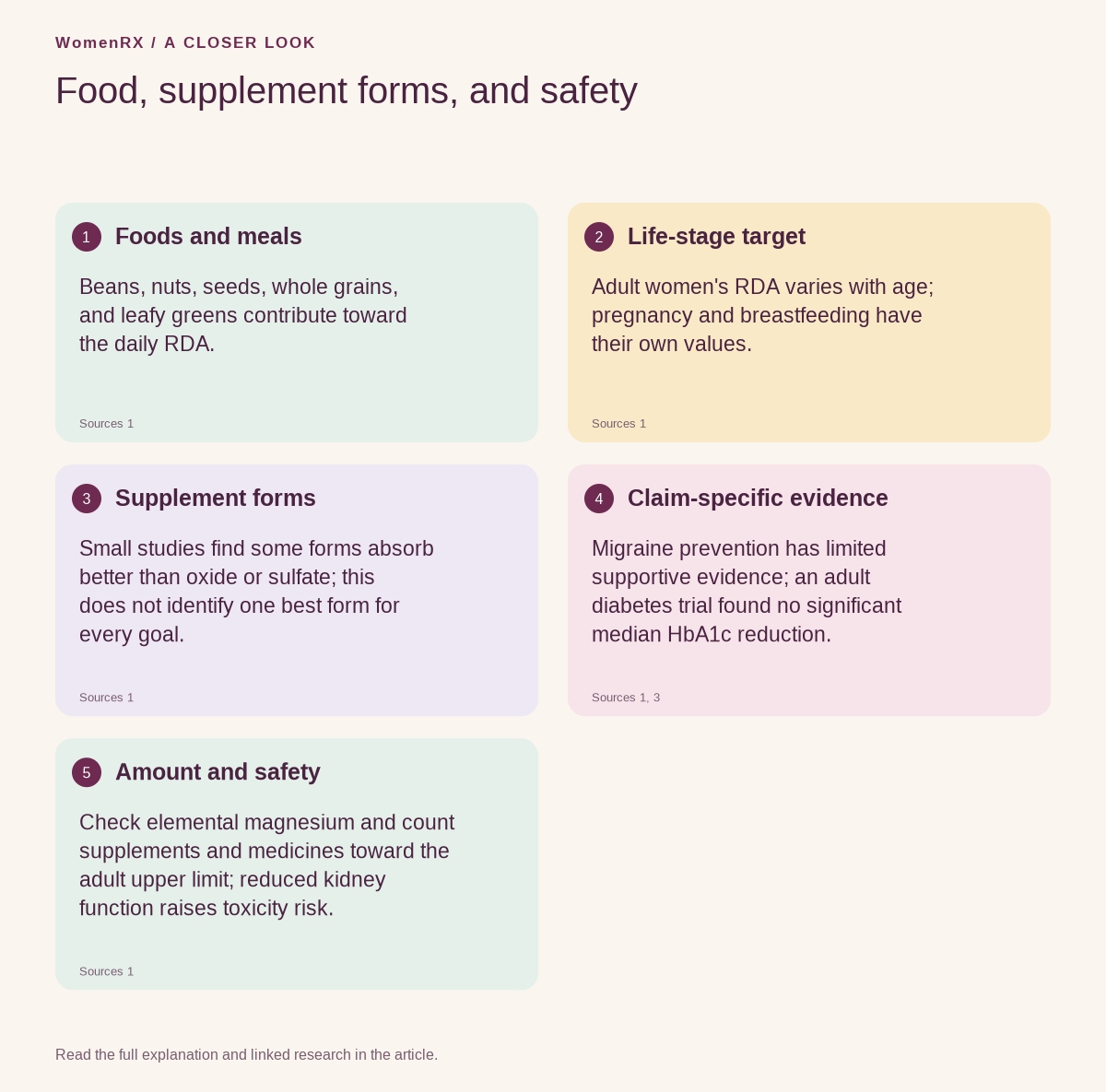
Food, supplement forms, and safety
Foods and meals: Beans, nuts, seeds, whole grains, and leafy greens contribute toward the daily RDA.1
Life-stage target: Adult women's RDA varies with age; pregnancy and breastfeeding have their own values.1
Supplement forms: Small studies find some forms absorb better than oxide or sulfate; this does not identify one best form for every goal.1
Claim-specific evidence: Migraine prevention has limited supportive evidence; an adult diabetes trial found no significant median HbA1c reduction.13
Amount and safety: Check elemental magnesium and count supplements and medicines toward the adult upper limit; reduced kidney function raises toxicity risk.1
Read the figure as text
See how food and supplements contribute differently, what form comparisons actually show, and which safety checks matter.- Foods and meals: Beans, nuts, seeds, whole grains, and leafy greens contribute toward the daily RDA.1
- Life-stage target: Adult women's RDA varies with age; pregnancy and breastfeeding have their own values.1
- Supplement forms: Small studies find some forms absorb better than oxide or sulfate; this does not identify one best form for every goal.1
- Claim-specific evidence: Migraine prevention has limited supportive evidence; an adult diabetes trial found no significant median HbA1c reduction.13
- Amount and safety: Check elemental magnesium and count supplements and medicines toward the adult upper limit; reduced kidney function raises toxicity risk.1
Sources you can check
- Magnesium - Health Professional Fact SheetAccessed 2026-09-25Return to first citation
- Oral Magnesium Supplementation in Chronic Kidney Disease Stages 3 and 4: Efficacy, Safety, and Effect on Serum Calcification Propensity-A Prospective Randomized Double-Blinded Placebo-Controlled Clinical Trial.Bressendorff I, Hansen D, Schou M, Silver B, Pasch A, Bouchelouche P, Pedersen L, Rasmussen LM, Brandi L. · Kidney international reports · 2017Return to first citation
- The effect of oral magnesium supplementation on glycemic control and metabolic parameters in type 2 diabetes mellitus: a double-blind randomized controlled trial.Al-Maqbali JS, Al Alawi AM, Osman A, Al-Farqani A, Kumar S, Al Futisi A, Al-Mamari A, Al-Zakwani I, Al Za'abi M. · Frontiers in endocrinology · 2026Return to first citation