Magnesium After 40: What Women Actually Need
Turning 40 or entering menopause doesn’t automatically create a new need for magnesium supplements.
For women, the recommended magnesium intake is 320 mg a day from all sources from age 31 onward, including after 40 and after 51. That’s a food-and-drink target, not a supplement dose. Whether a supplement makes sense depends more on your usual intake, health conditions, and medicines than on age or menopause alone. 1
Age alone isn’t a reason to start
There’s no magnesium intake jump at 40. The recommended dietary allowance (RDA) for women is 320 mg a day from ages 31 through 50 and remains 320 mg a day at 51 and older. The RDA is a target for total intake, including food and drinks, not an amount you need to take as a supplement. 1
Menopause doesn’t create a separate magnesium RDA in this guidance. So if you’re in perimenopause or postmenopause, age or life stage by itself doesn’t tell you that you need a pill. 1
Start with what you eat and your health history
Magnesium is found in foods such as leafy greens, beans, nuts, seeds, and whole grains. For example, a half-cup of cooked spinach provides 78 mg, while a half-cup of black beans provides 60 mg. Looking at your overall pattern of eating can help you see whether you’re regularly getting magnesium-rich foods, without needing to treat one meal or one day as a test. 1
Many people in the United States consume less magnesium from food and drinks than the estimated average requirement for their age and sex. That doesn’t mean they’re clinically deficient: an intake below the estimated average requirement is not the same as a diagnosis, and national magnesium status isn’t routinely measured. 1
Some health situations make low magnesium more plausible. These include conditions that affect absorption, such as Crohn’s disease or celiac disease, type 2 diabetes, and alcohol dependence. Older adults are also more likely to have factors that can affect magnesium intake or losses. If any of these apply, it’s more useful to discuss your overall risk and diet than to assume a symptom proves you need a supplement. 1
Symptoms don’t identify the cause by themselves
A symptom you connect with menopause, such as a change in sleep or mood, doesn’t establish that your magnesium is low. Research on supplements in women has looked at different outcomes and combinations. For example, a systematic review found that magnesium with vitamin B6, but not magnesium alone, reduced premenstrual anxiety in the studies it reviewed. That result doesn’t show that magnesium treats menopause symptoms. 2
A small study in postmenopausal women with osteoporosis examined bone-turnover markers over 30 days. Changes in those markers are not the same as showing fewer fractures or better long-term bone health. The finding isn’t a reason for every woman after menopause to take magnesium. 3
If you’re considering a supplement
A practical first step is to estimate your usual intake from food and drinks, then ask whether your health history or medicines could affect magnesium. You might ask: “Does my diet or medical history make low magnesium more likely, and would checking my magnesium status change what we do?” There isn’t one perfect test: serum magnesium is commonly used, but it doesn’t reliably reflect the body’s total magnesium stores, so results may need to be considered alongside your clinical picture. 1
If you do look at a product, the Supplement Facts panel lists elemental magnesium, not the weight of the full magnesium compound. Also count magnesium in medicines such as some antacids and laxatives. For adults, the upper limit of 350 mg a day applies to magnesium from supplements and medications, not magnesium naturally present in food. It’s a safety ceiling, not a target or a personal dosing recommendation. 1
Too much supplemental or medication-based magnesium can cause diarrhea, nausea, and abdominal cramping. The risk of serious buildup is higher when kidney function is impaired, because the kidneys may not remove excess magnesium effectively. That makes it especially worth reviewing a proposed supplement with a clinician if you have kidney problems or already use magnesium-containing medicines. 1
after 40, focus on whether your diet and health circumstances point to a reason to assess intake or status. Menopause alone doesn’t establish a need, and a supplement shouldn’t be treated as a general fix for menopause symptoms.
Does a magnesium supplement make sense?
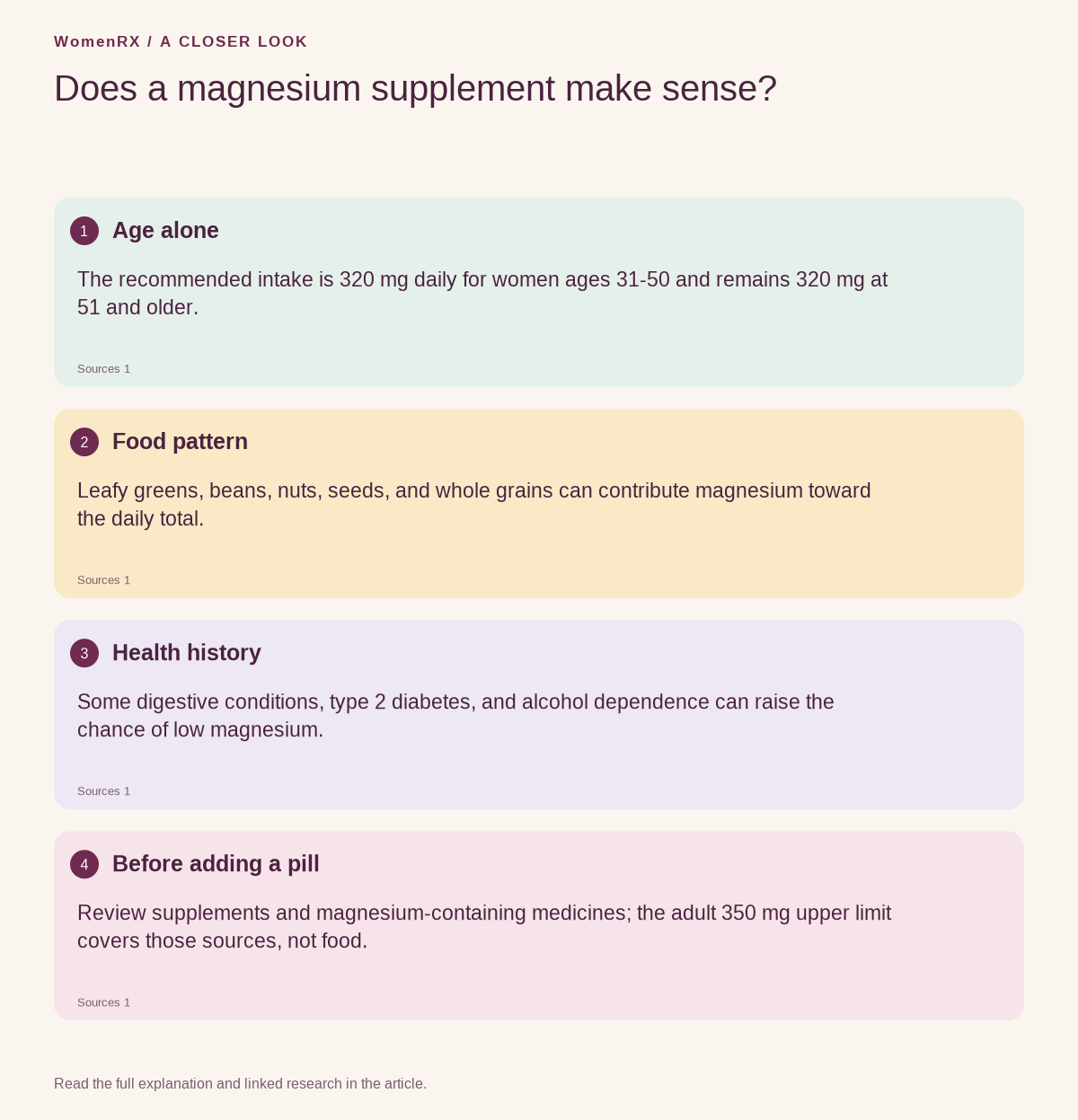
Age alone: The recommended intake is 320 mg daily for women ages 31-50 and remains 320 mg at 51 and older.1
Food pattern: Leafy greens, beans, nuts, seeds, and whole grains can contribute magnesium toward the daily total.1
Health history: Some digestive conditions, type 2 diabetes, and alcohol dependence can raise the chance of low magnesium.1
Before adding a pill: Review supplements and magnesium-containing medicines; the adult 350 mg upper limit covers those sources, not food.1
Read the figure as text
Use these distinctions to separate a reason to assess magnesium from the assumption that age or menopause automatically calls for a supplement.- Age alone: The recommended intake is 320 mg daily for women ages 31-50 and remains 320 mg at 51 and older.1
- Food pattern: Leafy greens, beans, nuts, seeds, and whole grains can contribute magnesium toward the daily total.1
- Health history: Some digestive conditions, type 2 diabetes, and alcohol dependence can raise the chance of low magnesium.1
- Before adding a pill: Review supplements and magnesium-containing medicines; the adult 350 mg upper limit covers those sources, not food.1
More questions, answered
Does magnesium from food count toward the daily recommendation?
Yes. The 320 mg daily recommendation for women ages 31 and older is for total intake, including food and drinks. The 350 mg upper limit applies only to magnesium from supplements and medications. 1
Can a blood test tell me exactly how much magnesium I have?
A serum magnesium test is commonly used, but it doesn’t accurately reflect total body magnesium on its own. A clinician may consider results alongside your health history and intake. 1
Sources you can check
- Magnesium - Health Professional Fact SheetAccessed 2026-09-25Return to first citation
- The impact of essential fatty acid, B vitamins, vitamin C, magnesium and zinc supplementation on stress levels in women: a systematic review.McCabe D, Lisy K, Lockwood C, Colbeck M. · JBI database of systematic reviews and implementation reports · 2017Return to first citation
- Short-term oral magnesium supplementation suppresses bone turnover in postmenopausal osteoporotic women.Aydin H, Deyneli O, Yavuz D, Gözü H, Mutlu N, Kaygusuz I, Akalin S. · Biological trace element research · 2010Return to first citation