Magnesium for Menopause Symptoms: What the Evidence Shows
Sleep studies and supplement findings in women offer clues, but they don’t answer whether magnesium helps hot flashes.
The findings discussed here don’t answer whether magnesium helps hot flashes: the sleep trials studied older adults with insomnia, and the women’s supplement review examined anxiety and stress rather than hot flashes. For sleep, older-adult trials suggest a possible modest benefit, but the evidence was low to very low quality and wasn’t specific to menopause. 1 2
Start with the symptom you want to change
Magnesium plays important roles in the body, but that alone doesn’t tell you whether a supplement will ease a particular menopause symptom. The sleep trials and women’s supplement findings described here don’t answer whether magnesium helps hot flashes or night sweats. They also don’t establish magnesium as a general remedy for menopause symptoms. 1 2
For bothersome hot flashes and night sweats, the North American Menopause Society identifies hormone therapy as the most effective treatment for vasomotor symptoms. Whether it’s a suitable option depends on a person’s health and circumstances, so treatment decisions are individualized. 3
Sleep: a possible clue, not menopause-specific proof
A review pooled three randomized trials of oral magnesium involving 151 older adults with insomnia. Compared with placebo, magnesium was associated with falling asleep about 17 minutes sooner. Total sleep time was about 16 minutes longer, but that difference was not statistically significant. The studies had moderate-to-high risk of bias, and the review rated the evidence low to very low quality. 1
That result may be relevant if sleep is your main concern, but it doesn’t show that magnesium treats menopause-related insomnia. The trials studied older adults with insomnia, not sleep changes specifically during perimenopause or postmenopause. And if night sweats are waking you, a result about insomnia in a different group doesn’t tell you whether magnesium will address the cause of your disrupted sleep. 1
Anxiety findings depend on the supplement and life stage
A systematic review of supplements in women reported that magnesium combined with vitamin B6 may reduce anxiety before a period. That’s a different life stage and a combined supplement, so it doesn’t show that magnesium alone eases menopause-related anxiety. The review’s reported finding on anxiety during menopause concerned essential fatty acids, not magnesium. 2
What the safety findings do, and don’t, say
The older-adult insomnia research doesn’t establish a universally safe supplement dose for someone with menopause symptoms or provide a verified list of medicine interactions. Some trials excluded people with kidney disease and participants taking certain medicines. Those exclusions don’t prove that magnesium interacts with every excluded medicine; they do mean the results from those trials don’t tell us how well they apply to those situations. 1
If you have kidney disease or take regular medicines, you could show a pharmacist or clinician the exact product and its label before deciding whether to use it. Treat that as a precaution, not proof that a particular interaction exists. The sleep trials used different amounts and formulations, rather than testing one standard product, so a dose used in a study shouldn’t be taken as a personal recommendation. 1
A practical way to weigh the evidence
First, match the evidence to your main symptom. The sleep findings are a limited signal from older adults with insomnia, not proof for menopause-related sleep disruption. The women’s supplement review doesn’t provide a magnesium finding for hot flashes, and its menopause-related anxiety finding was about essential fatty acids. 1 2
Then consider safety separately from hoped-for benefit. If you’re thinking about a supplement, the exact product and your health situation matter; the studies summarized here don’t establish an appropriate dose for you. For bothersome hot flashes, you can ask about options with evidence for vasomotor symptoms rather than treating magnesium as a general menopause remedy. 1 3
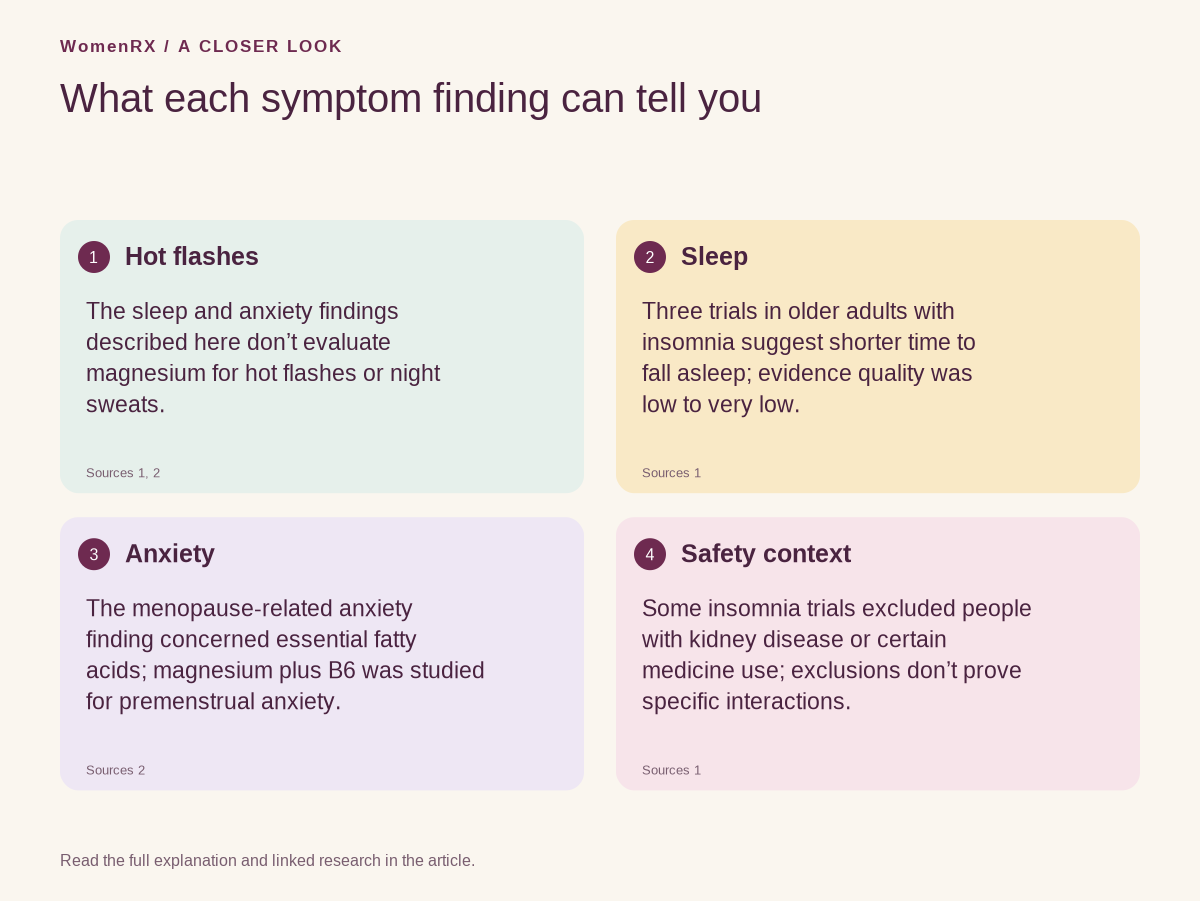
What each symptom finding can tell you
Hot flashes: The sleep and anxiety findings described here don’t evaluate magnesium for hot flashes or night sweats.12
Sleep: Three trials in older adults with insomnia suggest shorter time to fall asleep; evidence quality was low to very low.1
Anxiety: The menopause-related anxiety finding concerned essential fatty acids; magnesium plus B6 was studied for premenstrual anxiety.2
Safety context: Some insomnia trials excluded people with kidney disease or certain medicine use; exclusions don’t prove specific interactions.1
Read the figure as text
These findings concern different symptoms and populations, so a result for sleep or anxiety shouldn’t be treated as an answer about hot flashes.- Hot flashes: The sleep and anxiety findings described here don’t evaluate magnesium for hot flashes or night sweats.12
- Sleep: Three trials in older adults with insomnia suggest shorter time to fall asleep; evidence quality was low to very low.1
- Anxiety: The menopause-related anxiety finding concerned essential fatty acids; magnesium plus B6 was studied for premenstrual anxiety.2
- Safety context: Some insomnia trials excluded people with kidney disease or certain medicine use; exclusions don’t prove specific interactions.1
More questions, answered
Do these findings show that magnesium helps hot flashes?
No. The sleep trials studied older adults with insomnia, and the women’s supplement review examined anxiety and stress. Those findings don’t answer whether magnesium helps hot flashes or night sweats. 1 2
Is magnesium proven to help menopause-related anxiety?
The women’s supplement review doesn’t report a menopause-related anxiety benefit from magnesium. Its menopause finding concerned essential fatty acids; magnesium combined with vitamin B6 was discussed for premenstrual anxiety, a different situation. 2
Sources you can check
- Oral magnesium supplementation for insomnia in older adults: a Systematic Review & Meta-Analysis.Mah J, Pitre T. · BMC complementary medicine and therapies · 2021Return to first citation
- The impact of essential fatty acid, B vitamins, vitamin C, magnesium and zinc supplementation on stress levels in women: a systematic review.McCabe D, Lisy K, Lockwood C, Colbeck M. · JBI database of systematic reviews and implementation reports · 2017Return to first citation
- The 2022 hormone therapy position statement of The North American Menopause Society.“The 2022 Hormone Therapy Position Statement of The North American Menopause Society” Advisory Panel. · Menopause (New York, N.Y.) · 2022Return to first citation