Magnesium During Menopause: What It Can and Cannot Do
Magnesium matters for health, but meeting your needs and treating menopause symptoms are two different goals.
Magnesium is a nutrient your body needs, including during perimenopause and after menopause. Menopause symptoms alone don’t show that you’re deficient.7 The cited perimenopause review does not establish magnesium as a hot-flash treatment.4 A sleep trial tested magnesium alongside four other ingredients, so it cannot show whether magnesium alone improves sleep.5
If magnesium keeps appearing in products labeled for menopause, it’s reasonable to wonder whether you’re missing something. The useful distinction is between getting enough magnesium, having a magnesium deficiency, and taking extra magnesium to treat a symptom. Evidence for one doesn’t automatically support the others.
Getting enough is not the same as treating a symptom
Magnesium helps with processes that include muscle and nerve function and bone health. Foods that provide it include green vegetables, whole grains, nuts, and seeds.36 Those are reasons to pay attention to what you eat, whether you still have periods or are years past your last one. They don’t establish magnesium-rich foods as a treatment for night sweats.
Low intake and deficiency aren’t interchangeable, either. US dietary surveys find that many people consume less magnesium than recommended, but symptomatic deficiency caused by low intake alone is uncommon in otherwise healthy people. The kidneys help conserve magnesium when intake is low. Health conditions, excessive losses, and certain medicines can change that picture.7 You can have a reason to look more closely at your intake without assuming that a hot flash, a restless night, or menopause itself is evidence of deficiency.
Estrogen changes may affect how magnesium is absorbed, distributed, and retained, according to a narrative review. That biological connection is worth studying, but it doesn’t show that everyone in perimenopause or postmenopause needs a supplement.3 It also doesn’t turn magnesium into a hormone treatment.
What the symptom claims actually tell you
Hot flashes and night sweats: A perimenopause review describes hormone therapy as the most effective treatment for vasomotor symptoms, the clinical term for hot flashes and night sweats. It discusses magnesium in relation to bone health, not as a demonstrated hot-flash treatment.4 If these symptoms are disrupting your day or sleep, choosing a product because it contains magnesium could delay a more useful conversation about options for the symptom you want to address.
Sleep: One randomized, placebo-controlled trial enrolled healthy perimenopausal and postmenopausal women who had substantial sleep disturbance but few hot flashes or night sweats. After three weeks, the group taking a supplement with magnesium plus L-theanine, gamma-aminobutyric acid, S-adenosyl methionine, and propyl gallate reported better sleep outcomes than the placebo group.5 That’s relevant to women with sleep trouble that isn’t mainly driven by night sweats. It is not a test of magnesium alone, and it doesn’t tell us whether the combination would help someone whose sleep is repeatedly interrupted by night sweats.
Mood, cramps, and the menstrual cycle: Magnesium has been studied for premenstrual symptoms, including emotional and behavioral symptoms. Premenstrual symptoms occur in relation to a menstrual cycle; they aren’t the same thing as menopause symptoms.3 If you’re in perimenopause and still having periods, that distinction matters. A claim about premenstrual symptoms cannot simply be transferred to mood changes or muscle complaints after menopause.
Bones: Magnesium has a role in bone health, and a perimenopause review includes it among nutrients discussed for supporting bones.34 That’s a reason not to overlook adequate nutrition. It is not evidence that adding a magnesium supplement prevents fractures or treats osteoporosis in postmenopausal women.
When a supplement is a different decision
A supplement may be worth discussing when there’s a specific concern about intake or magnesium loss, rather than a broad promise to ‘balance’ menopause. For example, low intake over time, certain health conditions, and some medicines can contribute to deficiency. In a discussion of people with chronic kidney disease, a review identifies loop and thiazide diuretics among factors that can increase urinary magnesium loss.6 That doesn’t mean everyone taking one is deficient; it means the reason for considering magnesium is more specific than age or menopause status.
The kidneys normally help regulate magnesium, while chronic kidney disease reduces their ability to filter the blood as they should.61 Kidney disease alone doesn’t establish a magnesium deficiency or tell you whether a supplement would be safe for you. Magnesium can also appear in medicines, and the established upper limit for magnesium from supplements and medications is separate from magnesium naturally present in food.7
A menopause label doesn’t tell you whether a product addresses your particular concern. In a 2026 analysis of 201 products sold through UK retailers, nearly half contained magnesium, and formulations varied widely.2 That finding describes a UK product sample, not what every US product contains or whether those products work. Read the ingredient list rather than assuming ‘menopause supplement’ means magnesium alone; a result from a multi-ingredient study can’t be assigned to whichever ingredient appears familiar.
The most useful next move depends on your question. If it’s ‘Am I getting enough?’, start with your usual foods and whether a health condition or medicine might affect magnesium. If it’s ‘Why can’t I sleep?’, separate nights disturbed by sweats from sleep trouble without them; the magnesium-containing sleep trial studied women with little vasomotor symptom burden.5 And if it’s ‘Will this treat my hot flashes?’, a product’s magnesium content is not, on its own, a sound reason to expect relief.4
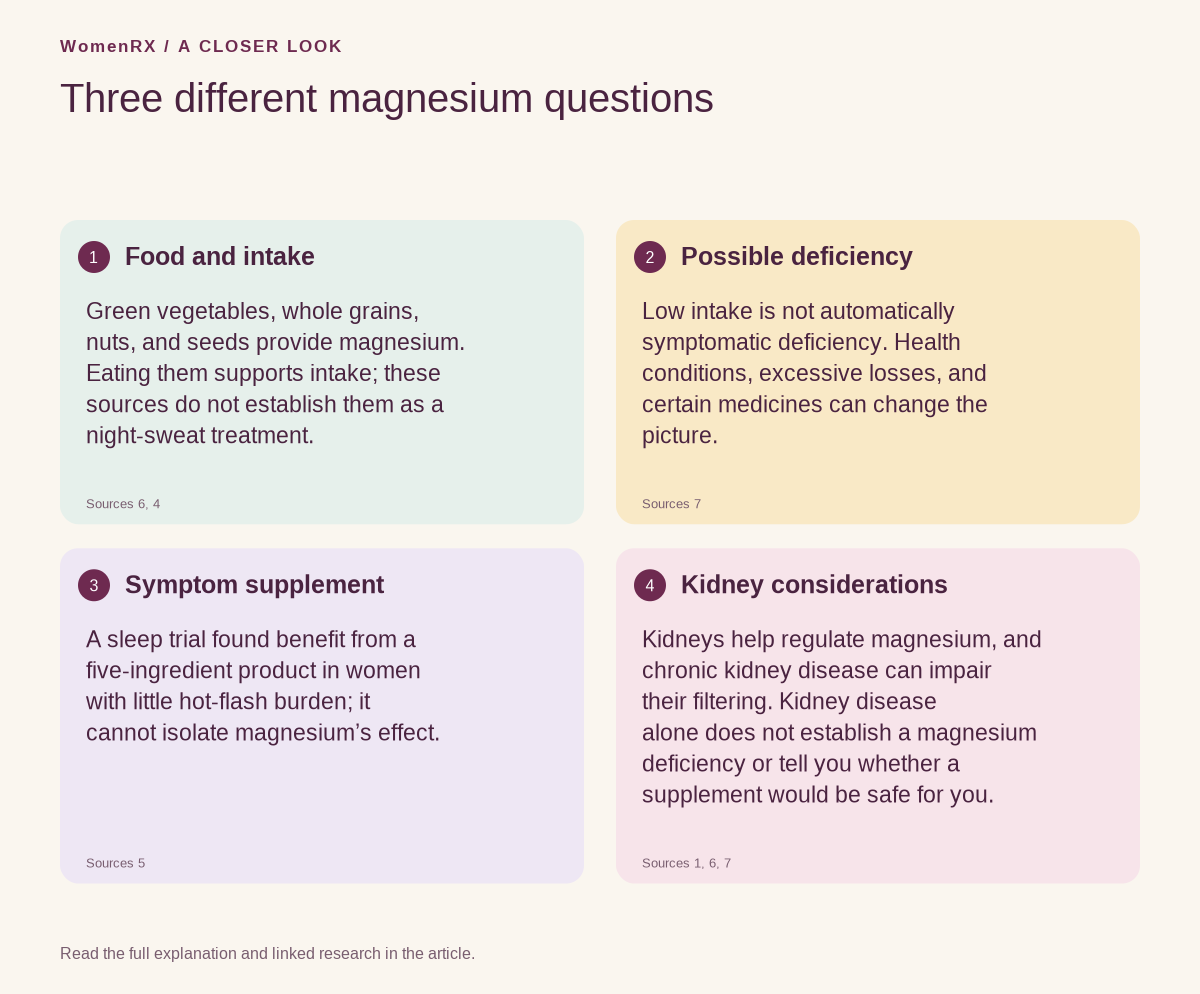
Three different magnesium questions
Food and intake: Green vegetables, whole grains, nuts, and seeds provide magnesium. Eating them supports intake; these sources do not establish them as a night-sweat treatment.64
Possible deficiency: Low intake is not automatically symptomatic deficiency. Health conditions, excessive losses, and certain medicines can change the picture.7
Symptom supplement: A sleep trial found benefit from a five-ingredient product in women with little hot-flash burden; it cannot isolate magnesium’s effect.5
Kidney considerations: Kidneys help regulate magnesium, and chronic kidney disease can impair their filtering. Kidney disease alone does not establish a magnesium deficiency or tell you whether a supplement would be safe for you.167
Read the figure as text
The same nutrient can be relevant to your diet, a possible deficiency, or a symptom claim, but each question needs different evidence.- Food and intake: Green vegetables, whole grains, nuts, and seeds provide magnesium. Eating them supports intake; these sources do not establish them as a night-sweat treatment.64
- Possible deficiency: Low intake is not automatically symptomatic deficiency. Health conditions, excessive losses, and certain medicines can change the picture.7
- Symptom supplement: A sleep trial found benefit from a five-ingredient product in women with little hot-flash burden; it cannot isolate magnesium’s effect.5
- Kidney considerations: Kidneys help regulate magnesium, and chronic kidney disease can impair their filtering. Kidney disease alone does not establish a magnesium deficiency or tell you whether a supplement would be safe for you.167
More questions, answered
Can a routine blood test tell me whether I need magnesium?
Not necessarily. Magnesium isn’t included in routine electrolyte testing, and dietary intake is often used as a starting point for assessing magnesium status. If you’re concerned because of a health condition or a medicine that can affect magnesium, the question is more specific than whether menopause has lowered your level.7
Sources you can check
- Chronic Kidney Disease | Kidney Disease | CKD | MedlineplusAccessed 2026-09-25Return to first citation
- What is in the bottle? An analysis of the ingredients in menopause supplements.Sullivan P, Boylan AM, Harper JC. · Climacteric : the journal of the International Menopause Society · 2026Return to first citation
- Magnesium: Exploring Gender Differences in Its Health Impact and Dietary Intake.Mazza E, Maurotti S, Ferro Y, Castagna A, Pujia C, Sciacqua A, Pujia A, Montalcini T. · Nutrients · 2025Return to first citation
- Integrative approaches to perimenopause.Kennard A, Saunders KT. · The American journal of medicine · 2026Return to first citation
- Nonsedating neurotransmitter-modulating supplement for nonvasomotor sleep disturbance in menopause.Carbonneau S, Mysliwiec V, Doyle AL, Stratton M, Dweck A, Tartar J, Alesi M, Mason L, Komorowski J, VanDusseldorp TA. · Menopause (New York, N.Y.) · 2026Return to first citation
- Role of Magnesium, Effects of Hypomagnesemia, and Benefits of Magnesium Supplements in Cardiovascular and Chronic Kidney Diseases.Panta R, Regmi S. · Cureus · 2024Return to first citation
- Magnesium - Health Professional Fact SheetAccessed 2026-09-25Return to first citation