Magnesium Glycinate: What It May Help and What It Cannot Show
The label’s elemental magnesium amount matters more than the weight of the glycinate compound, and the sleep research doesn’t establish that glycinate is better than other forms.
Magnesium glycinate provides magnesium, but its name alone doesn’t tell you how much elemental magnesium a serving contains or prove that it works better for sleep, cramps, or another concern. Check the Supplement Facts panel for elemental magnesium. Sleep studies of magnesium supplements overall have mixed results, and they don’t establish a specific benefit for glycinate. 1 2
Start with the amount of magnesium, not the compound name
On a supplement label, the magnesium amount in Supplement Facts is the elemental magnesium: the amount to count when comparing servings and total intake. It isn’t the weight of the full magnesium-containing compound. So if a product’s front label highlights a larger weight for “magnesium glycinate” or “magnesium bisglycinate,” look to Supplement Facts for the elemental magnesium amount. 1
That number helps you compare products, but it doesn’t tell you whether a form will help a particular symptom. Magnesium supplements come in different forms, and absorption varies. The NIH Office of Dietary Supplements notes that aspartate, citrate, lactate, and chloride tend to be more bioavailable than oxide and sulfate. Its summary doesn’t establish that glycinate is better absorbed or more effective than those forms. 1
For sleep, overall magnesium evidence is mixed
A 2026 systematic review included 12 randomized trials of magnesium as a stand-alone intervention for sleep, insomnia, or poor sleep in adults. The trials varied in formulation, amount, duration, participants, and how sleep was measured. Their findings were inconsistent, and the review rated certainty as low to very low. It concluded that the evidence doesn’t support magnesium as a routine insomnia treatment, though some adults may have modest benefits on selected subjective outcomes. The review doesn’t establish a glycinate-specific effect. Its reported overall findings also don’t establish a sleep benefit for women specifically, or during pregnancy or breastfeeding. 2
That means a sleep claim on a magnesium glycinate product shouldn’t be read as proof that this form reliably improves sleep. The findings for magnesium overall also can’t tell you whether a benefit applies during pregnancy, breastfeeding, or a particular phase of the menstrual cycle.
Cramps and menstrual symptoms are separate claims
Sleep research doesn’t answer whether magnesium glycinate relieves menstrual cramps. Nor does a product’s magnesium form, by itself, demonstrate that it prevents leg cramps. Treat those as distinct claims rather than assuming that evidence for one symptom transfers to another.
If you’re considering magnesium because you suspect a deficiency, choosing a supplement form can’t confirm that you’re deficient. Measuring magnesium in blood is common, but serum levels don’t accurately reflect total body magnesium; assessment may also depend on clinical context. 1
Pregnancy and breastfeeding change the intake context
Magnesium needs are described as total daily intake, not as a target amount from a glycinate supplement alone. For adults ages 19-30, the recommended daily amount is 310 mg for women, 350 mg during pregnancy, and 310 mg while breastfeeding. For women ages 31-50, the corresponding amounts are 320 mg, 360 mg, and 320 mg. These recommendations include magnesium from food and other sources. 1
The adult upper limit for magnesium from supplements and medications is 350 mg per day; magnesium naturally present in food and drinks doesn’t count toward that limit. This upper limit is not a recommended supplement dose, and pregnancy intake recommendations are not a reason to assume a supplement is needed. 1
Keep safety and your full intake in view
High amounts from supplements or magnesium-containing medicines can cause diarrhea, nausea, and abdominal cramping. Magnesium is also found in some antacids and laxatives, so include those when considering total supplemental or medicinal intake. The risk of magnesium building up is higher when kidney function is impaired, because the kidneys have a harder time removing excess magnesium. 1
A useful label check is to compare the elemental magnesium per serving, serving size, and other magnesium-containing products you already use. Then match the product’s claim to the outcome you actually care about. A glycinate label can tell you the form; it can’t, on its own, show that the product will improve sleep or cramps.
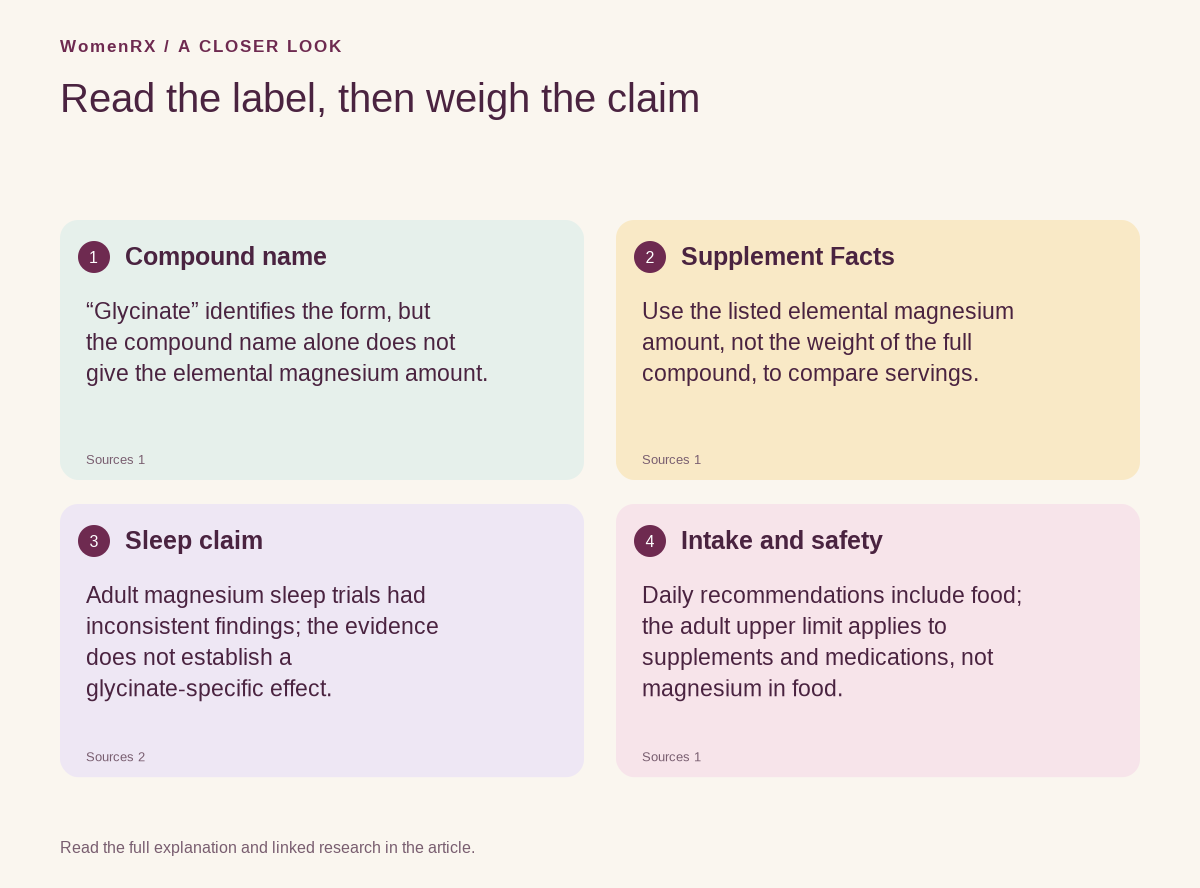
Read the label, then weigh the claim
Compound name: “Glycinate” identifies the form, but the compound name alone does not give the elemental magnesium amount.1
Supplement Facts: Use the listed elemental magnesium amount, not the weight of the full compound, to compare servings.1
Sleep claim: Adult magnesium sleep trials had inconsistent findings; the evidence does not establish a glycinate-specific effect.2
Intake and safety: Daily recommendations include food; the adult upper limit applies to supplements and medications, not magnesium in food.1
Read the figure as text
Separate what the label can tell you about magnesium content from what research can say about a claimed benefit.- Compound name: “Glycinate” identifies the form, but the compound name alone does not give the elemental magnesium amount.1
- Supplement Facts: Use the listed elemental magnesium amount, not the weight of the full compound, to compare servings.1
- Sleep claim: Adult magnesium sleep trials had inconsistent findings; the evidence does not establish a glycinate-specific effect.2
- Intake and safety: Daily recommendations include food; the adult upper limit applies to supplements and medications, not magnesium in food.1
More questions, answered
Is magnesium glycinate the same as elemental magnesium?
No. Magnesium glycinate is the compound form; the Supplement Facts panel lists the amount of elemental magnesium in the product. Use that listed amount when comparing servings. 1
Does the sleep research show magnesium glycinate works?
The reviewed adult trials varied in magnesium form and had inconsistent results overall. The review doesn’t establish a specific sleep benefit for glycinate. 2
Sources you can check
- Magnesium - Health Professional Fact SheetAccessed 2026-09-25Return to first citation
- Magnesium Supplementation for Sleep in Adults: A Systematic Review of Randomized Controlled Trials.Lopresti AL, Smith SJ, Drummond PD. · Journal of dietary supplements · 2026Return to first citation