Magnesium Glycinate: What Labels and Sleep Evidence Show
Compare the stated elemental magnesium per serving, then check whether the sleep research actually tested glycinate.
A product’s glycinate name doesn’t establish that it improves sleep. Compare the amount of elemental magnesium listed per serving, not just a prominent weight for the whole compound, because trials report elemental amounts and use different forms. The adult sleep-trial evidence is mixed and low certainty, and it doesn’t establish a glycinate-specific benefit or a special effect for women or menopause. 2 3
Start with what the label lets you compare
When you compare two bottles, look for the amount of magnesium itself per serving and how many capsules or tablets make up that serving. A label that highlights the weight of a magnesium compound without making the elemental magnesium amount clear doesn’t let you compare its dose with the amounts used in research. Sleep trials report elemental magnesium amounts, and those amounts and formulations vary. 2 3
Also check whether the amount is for one capsule or a multi-capsule serving. That’s a practical comparison, not evidence that a larger serving works better. Don’t treat the compound’s total weight as the amount of magnesium itself.
The compound name isn’t proof of a sleep benefit
Magnesium glycinate is one form of magnesium; a study of magnesium glycinate classifies it as an amino-acid-bound compound, but that study was conducted in mice and did not test sleep benefits in people. 5 A product’s name, or a claim such as “relaxation support,” can tell you what the seller is promoting. It can’t show that the product has been proven to improve a particular sleep outcome.
For sleep, the useful question is whether a trial tested glycinate itself, in people like you, and measured the outcome you care about, such as time to fall asleep or sleep quality. A study of a different magnesium form can’t by itself establish that glycinate works the same way, works better, or is easier on the stomach.
What the sleep studies can and can’t tell you
A 2026 systematic review included 12 randomized trials of magnesium alone for sleep, insomnia, or poor sleep in adults. The studies used varied forms, elemental amounts, durations, and sleep measures; their findings were inconsistent, and the review rated the certainty of evidence low to very low. Its overall conclusion was that magnesium isn’t supported as a routine insomnia treatment, though some adults may see modest improvement in selected subjective outcomes. 2
An earlier review focused on older adults and found three placebo-controlled trials involving 151 people. The trials used magnesium oxide or citrate, not glycinate. In a pooled analysis, sleep-onset latency was 17.36 minutes lower with magnesium than placebo, but evidence quality was low to very low, and the review authors noted limitations in the studies. That result is not proof that a glycinate product will shorten the time it takes you to fall asleep. 3
A broader review of observational and intervention studies also found that associations between magnesium status and sleep did not settle whether taking supplements improves sleep: randomized trials had uncertain findings. An association is not the same as showing that a supplement caused better sleep. 4
What to look for if you’re comparing products
- A clear elemental amount per serving. This is the figure to compare across products and with trial reports. 2 3
- The full serving size. Check how many pills make up the stated serving so you know what the listed amount covers.
- A specific, testable claim. “Supports relaxation” is broad; it doesn’t tell you whether the claimed outcome is falling asleep sooner, sleeping longer, or something else.
- Evidence that matches the form and outcome. Adult magnesium research overall is not the same as a glycinate-specific sleep trial. 2 3
These checks can help you compare what products disclose; they can’t identify a best brand or guarantee a result. In particular, the available sleep-review findings don’t establish that glycinate is more effective or gentler than other forms.
Don’t assume the findings are specific to women
The sleep reviews summarize adult evidence, but the reports cited here don’t establish a separate benefit for women or for people in perimenopause or menopause. A product marketed “for women” doesn’t make the evidence women-specific. To support that claim, research would need to report results for women separately or study the relevant group directly. Clinical trials can be designed for particular groups, so the population studied is worth checking rather than assuming. 1 2
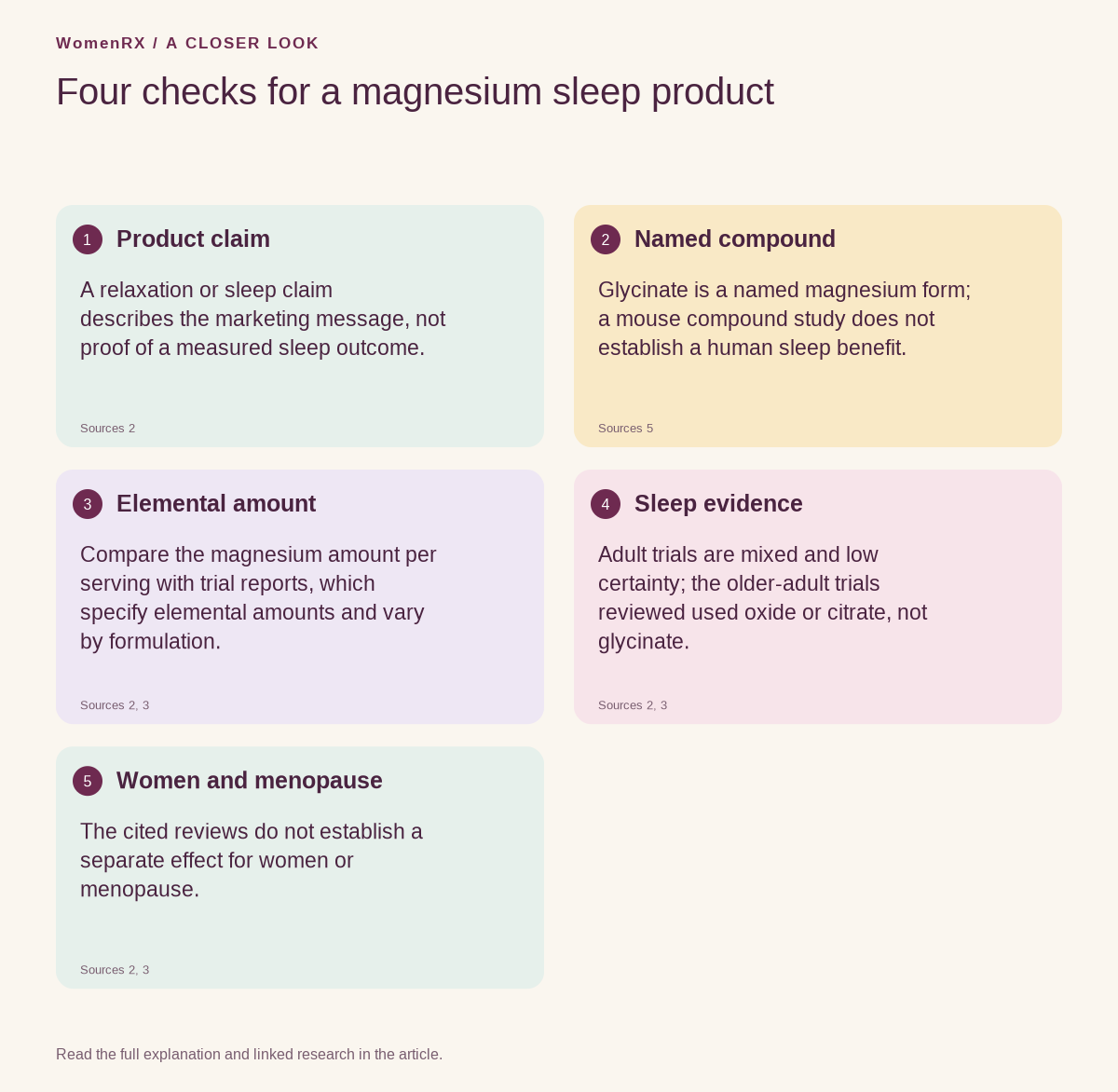
Four checks for a magnesium sleep product
Product claim: A relaxation or sleep claim describes the marketing message, not proof of a measured sleep outcome.2
Named compound: Glycinate is a named magnesium form; a mouse compound study does not establish a human sleep benefit.5
Elemental amount: Compare the magnesium amount per serving with trial reports, which specify elemental amounts and vary by formulation.23
Sleep evidence: Adult trials are mixed and low certainty; the older-adult trials reviewed used oxide or citrate, not glycinate.23
Women and menopause: The cited reviews do not establish a separate effect for women or menopause.23
Read the figure as text
Separate what a product says from what its label discloses and what sleep research has actually tested.- Product claim: A relaxation or sleep claim describes the marketing message, not proof of a measured sleep outcome.2
- Named compound: Glycinate is a named magnesium form; a mouse compound study does not establish a human sleep benefit.5
- Elemental amount: Compare the magnesium amount per serving with trial reports, which specify elemental amounts and vary by formulation.23
- Sleep evidence: Adult trials are mixed and low certainty; the older-adult trials reviewed used oxide or citrate, not glycinate.23
- Women and menopause: The cited reviews do not establish a separate effect for women or menopause.23
More questions, answered
Does magnesium glycinate have stronger sleep evidence than other forms?
The reviews describe mixed magnesium sleep research using varied forms, and an older-adult review included oxide and citrate trials rather than glycinate. They don’t establish that glycinate works better for sleep. 2 3
Does the sleep research show a special benefit for menopause?
The adult sleep-review findings cited here don’t establish a menopause-specific effect. They shouldn’t be read as proof of a benefit specific to women or menopause. 2
Sources you can check
- Clinical Trials: MedlinePlusAccessed 2026-09-25Return to first citation
- Magnesium Supplementation for Sleep in Adults: A Systematic Review of Randomized Controlled Trials.Lopresti AL, Smith SJ, Drummond PD. · Journal of dietary supplements · 2026Return to first citation
- Oral magnesium supplementation for insomnia in older adults: a Systematic Review & Meta-Analysis.Mah J, Pitre T. · BMC complementary medicine and therapies · 2021Return to first citation
- The Role of Magnesium in Sleep Health: a Systematic Review of Available Literature.Arab A, Rafie N, Amani R, Shirani F. · Biological trace element research · 2023Return to first citation
- Dose-Dependent Absorption Profile of Different Magnesium Compounds.Ates M, Kizildag S, Yuksel O, Hosgorler F, Yuce Z, Guvendi G, Kandis S, Karakilic A, Koc B, Uysal N. · Biological trace element research · 2019Return to first citation