Magnesium Glycinate in Women: What Research Shows
A small pregnancy trial found fewer leg cramps, but that result doesn’t establish broader benefits for women.
The clearest direct evidence is one small, four-week trial in pregnant women with frequent leg cramps. Women assigned magnesium bisglycinate were more likely than those given placebo to have at least a 50% reduction in cramp frequency and intensity. That’s a specific finding, not proof that glycinate helps menstrual symptoms, menopause symptoms, sleep, or women generally. 3
The claim depends on what you’re hoping it will do
Magnesium is involved in muscle and nerve function, but that basic role doesn’t show that a particular supplement will ease a symptom. For magnesium glycinate, also called bisglycinate, the most directly relevant human evidence here concerns leg cramps during pregnancy, not a broad set of benefits specific to women. 13
In a randomized, placebo-controlled trial, 80 pregnant women with leg cramps at least twice a week completed four weeks of treatment. Among those assigned magnesium bisglycinate chelate, 86.0% had at least a 50% reduction in cramp frequency, compared with 60.5% assigned placebo. A reduction of at least 50% in cramp intensity was reported by 69.8% and 48.8%, respectively. 3
Those results are encouraging for that particular symptom and life stage, but they don’t establish that glycinate prevents cramps for everyone, works for other pregnancy concerns, or treats symptoms outside pregnancy. The trial was small and short, and its abstract reports 300 mg per day of the chelate without clarifying whether that figure means elemental magnesium. 3
Why other magnesium studies don’t prove glycinate works
Studies of magnesium in general, or of another magnesium salt, can’t be treated as trials of glycinate. For example, an NIH fact sheet describes a short study of magnesium citrate in 20 postmenopausal women with osteoporosis. It reported a change in bone-turnover measures, not evidence that glycinate prevents osteoporosis or fractures. 1
Pregnancy-cramp research also isn’t consistent across formulations. In a separate four-week trial, pregnant women assigned magnesium citrate did not have a greater reduction in leg-cramp frequency than those assigned placebo. This doesn’t cancel out the bisglycinate finding: the studies used different forms, and one small trial of each cannot settle whether magnesium helps pregnancy cramps overall. 35 A broader review likewise found benefit in pregnancy-related cramps across several magnesium trials, while finding no significant effect for adult nocturnal or persistent leg cramps. Those pooled findings aren’t specific to glycinate. 4
The distinction matters for common claims about periods and menopause, too. The direct glycinate trial described above studied pregnancy-related cramps. The available evidence does not establish glycinate as a treatment for menstrual symptoms or menopause symptoms. Findings about magnesium overall, or about another form, aren’t enough to make that formulation-specific claim.
What to take from the evidence
If you’re considering glycinate for pregnancy-related leg cramps, the trial offers a possible signal of benefit, not a settled answer. It did not test pregnancy outcomes such as preventing preeclampsia or improving birth outcomes. And it shouldn’t be used to conclude that glycinate is needed during pregnancy: guidance says to check with a health care provider before taking supplements while pregnant. 23
If you’re comparing labels, look at the amount of elemental magnesium, not just the weight of the glycinate compound. The pregnancy trial reports 300 mg per day of magnesium bisglycinate chelate, but its abstract doesn’t clarify the elemental amount, so don’t assume that trial figure is directly comparable to the elemental amount on a supplement label. The adult upper limit for magnesium from supplements and medications is 350 mg per day; this is a safety limit, not a recommended target, and it excludes magnesium naturally present in food. 13
High supplemental or medication amounts can cause diarrhea, nausea, and abdominal cramping. Extra caution matters with impaired kidney function, because the kidneys help remove excess magnesium. 1 The practical takeaway: glycinate has a promising but narrow study in pregnant women with leg cramps. Claims about other symptoms or life stages need direct evidence for those outcomes and that form.
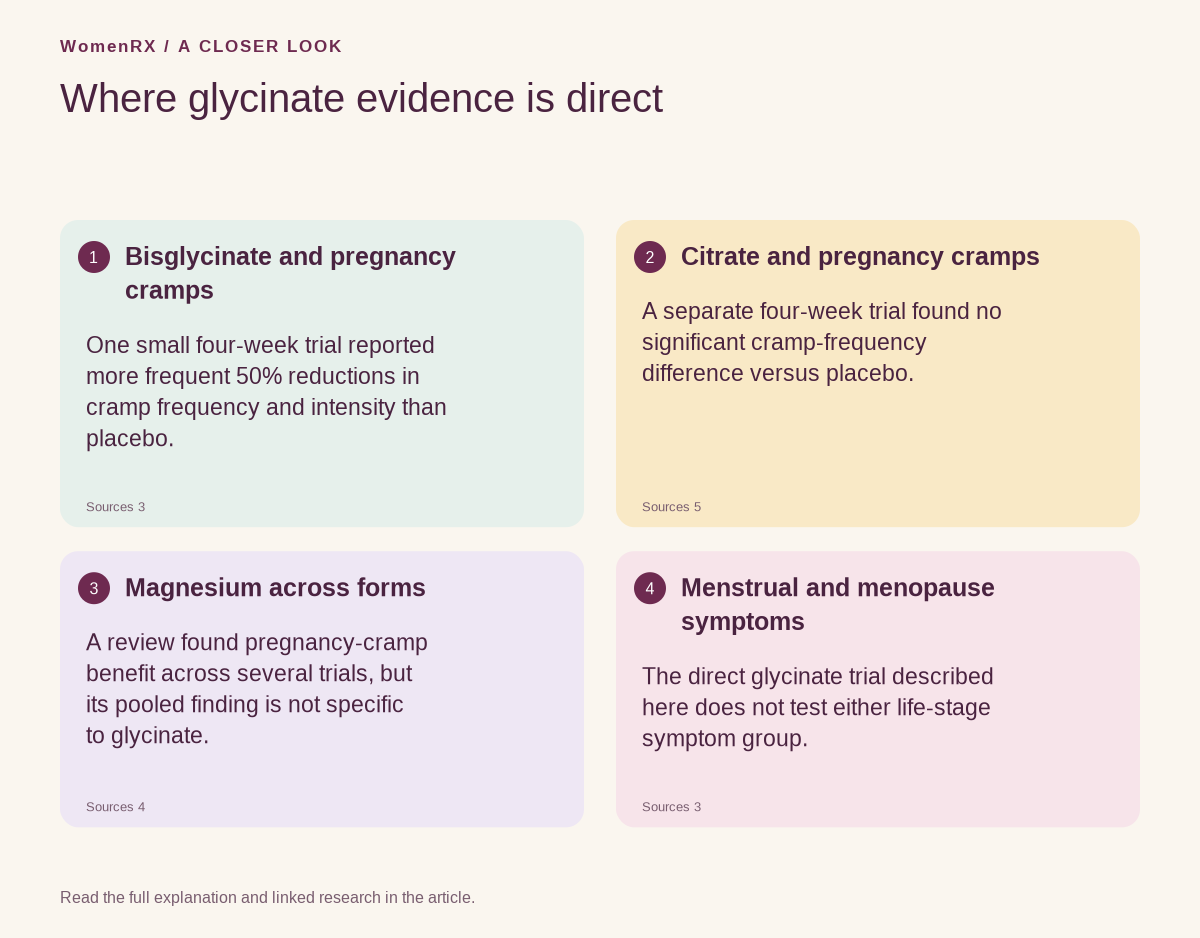
Where glycinate evidence is direct
Bisglycinate and pregnancy cramps: One small four-week trial reported more frequent 50% reductions in cramp frequency and intensity than placebo.3
Citrate and pregnancy cramps: A separate four-week trial found no significant cramp-frequency difference versus placebo.5
Magnesium across forms: A review found pregnancy-cramp benefit across several trials, but its pooled finding is not specific to glycinate.4
Menstrual and menopause symptoms: The direct glycinate trial described here does not test either life-stage symptom group.3
Read the figure as text
Compare the direct pregnancy-cramp trial with evidence from other magnesium forms and broader magnesium research.- Bisglycinate and pregnancy cramps: One small four-week trial reported more frequent 50% reductions in cramp frequency and intensity than placebo.3
- Citrate and pregnancy cramps: A separate four-week trial found no significant cramp-frequency difference versus placebo.5
- Magnesium across forms: A review found pregnancy-cramp benefit across several trials, but its pooled finding is not specific to glycinate.4
- Menstrual and menopause symptoms: The direct glycinate trial described here does not test either life-stage symptom group.3
More questions, answered
Does magnesium glycinate have proven benefits for menstrual cramps?
The direct trial discussed here studied leg cramps during pregnancy, not menstrual cramps. It doesn’t establish glycinate as a treatment for period pain. 3
Is the 300 mg in the pregnancy trial the same as 300 mg of magnesium on a label?
Not necessarily. The trial abstract reports 300 mg per day of magnesium bisglycinate chelate but doesn’t clarify the elemental magnesium amount. Supplement labels list elemental magnesium, so the figures may not be directly comparable. 13
Sources you can check
- Magnesium - Health Professional Fact SheetAccessed 2026-09-25Return to first citation
- Pregnancy and Medicines | MedlinePlusAccessed 2026-09-25Return to first citation
- Oral magnesium for relief in pregnancy-induced leg cramps: a randomised controlled trial.Supakatisant C, Phupong V. · Maternal & child nutrition · 2015Return to first citation
- The Role of Electrolytes in Muscle Pain Syndromes: A Systematic Review and Meta-Analysis With Implications for Temporomandibular Disorder.Patil S, Falkowski A, Venkataiah VS, Bhandi S, Licari FW, Patil AG. · International dental journal · 2026Return to first citation
- Oral magnesium supplementation for leg cramps in pregnancy-An observational controlled trial.Araújo CAL, Lorena SB, Cavalcanti GCS, Leão GLS, Tenório GP, Alves JGB. · PloS one · 2020Return to first citation