When Should You Take Magnesium Glycinate?
NIH guidance doesn’t specify a preferred time; product directions, medicine spacing, and tolerability can help shape a workable schedule.
NIH magnesium guidance doesn’t specify a preferred time of day. Check your product’s directions, then consider any medicines that need to be spaced from magnesium and whether the supplement agrees with you. A randomized trial of magnesium sulfate given during surgery assessed postoperative insomnia, but it didn’t test oral magnesium glycinate or bedtime dosing, so it can’t answer whether taking glycinate at night helps sleep. 1 2
Start with the directions, not a magic hour
The NIH magnesium fact sheet doesn’t specify a preferred time of day for taking magnesium. Check your product’s directions. If they don’t set a schedule, the practical questions are whether magnesium needs to be spaced from a medicine you take and whether the supplement fits comfortably into your routine.
A randomized trial in 80 people undergoing lumbar fixation studied magnesium sulfate given during surgery and assessed postoperative insomnia. It did not test oral magnesium glycinate or compare morning with bedtime use, so its findings can’t tell you whether taking glycinate at night helps sleep. 2
Check medicine spacing before choosing a time
Magnesium can reduce absorption of some medicines when they’re taken too close together. NIH guidance says magnesium-containing supplements or medicines can interfere with oral bisphosphonates, such as alendronate. It says taking magnesium at least two hours before or after an oral bisphosphonate can minimize this interaction. 1
Magnesium can also bind to tetracycline and quinolone antibiotics, including doxycycline and ciprofloxacin. The guidance says these antibiotics should be taken at least two hours before, or four to six hours after, a magnesium-containing supplement. Follow the instructions for your specific prescription, and ask a pharmacist to help fit both schedules together rather than shifting a prescribed medicine on your own. 1
For example, if your antibiotic has a morning dose and your supplement directions point you toward breakfast, don’t assume the two can be taken together. A pharmacist can help you find a workable time based on the exact antibiotic and its instructions.
Let tolerability guide the routine
High amounts of magnesium from supplements or medicines can cause diarrhea, nausea, and abdominal cramping. If you notice these effects, don’t assume that changing the time of day will solve the problem. Check the amount of elemental magnesium listed on the Supplement Facts panel and review the product directions with a pharmacist or clinician. 1
The NIH fact sheet notes that supplement labels list elemental magnesium, not the weight of the whole magnesium compound. It also sets an adult upper limit of 350 mg per day from supplements and medicines, not from food. That limit is not a personal target, and a clinician may recommend a different amount for a specific reason. 1
Pregnancy changes the intake context
Magnesium intake recommendations vary by life stage, and NIH guidance provides pregnancy-specific reference amounts. It doesn’t specify a pregnancy-specific time of day for taking magnesium. If you’re pregnant, include magnesium from your prenatal vitamin and other supplements when discussing your total with your obstetric care team or pharmacist. A bedtime convention isn’t a substitute for checking the overall intake. 1
The useful distinctions are your circumstances: pregnancy, other supplements, why you’re considering magnesium, and any medicines with spacing requirements.
A simple way to choose
Start with the product directions. Then check whether you take an oral bisphosphonate or a tetracycline or quinolone antibiotic. If so, make the medicine-spacing instructions the priority. If not, choose a time that fits your routine and that you tolerate.
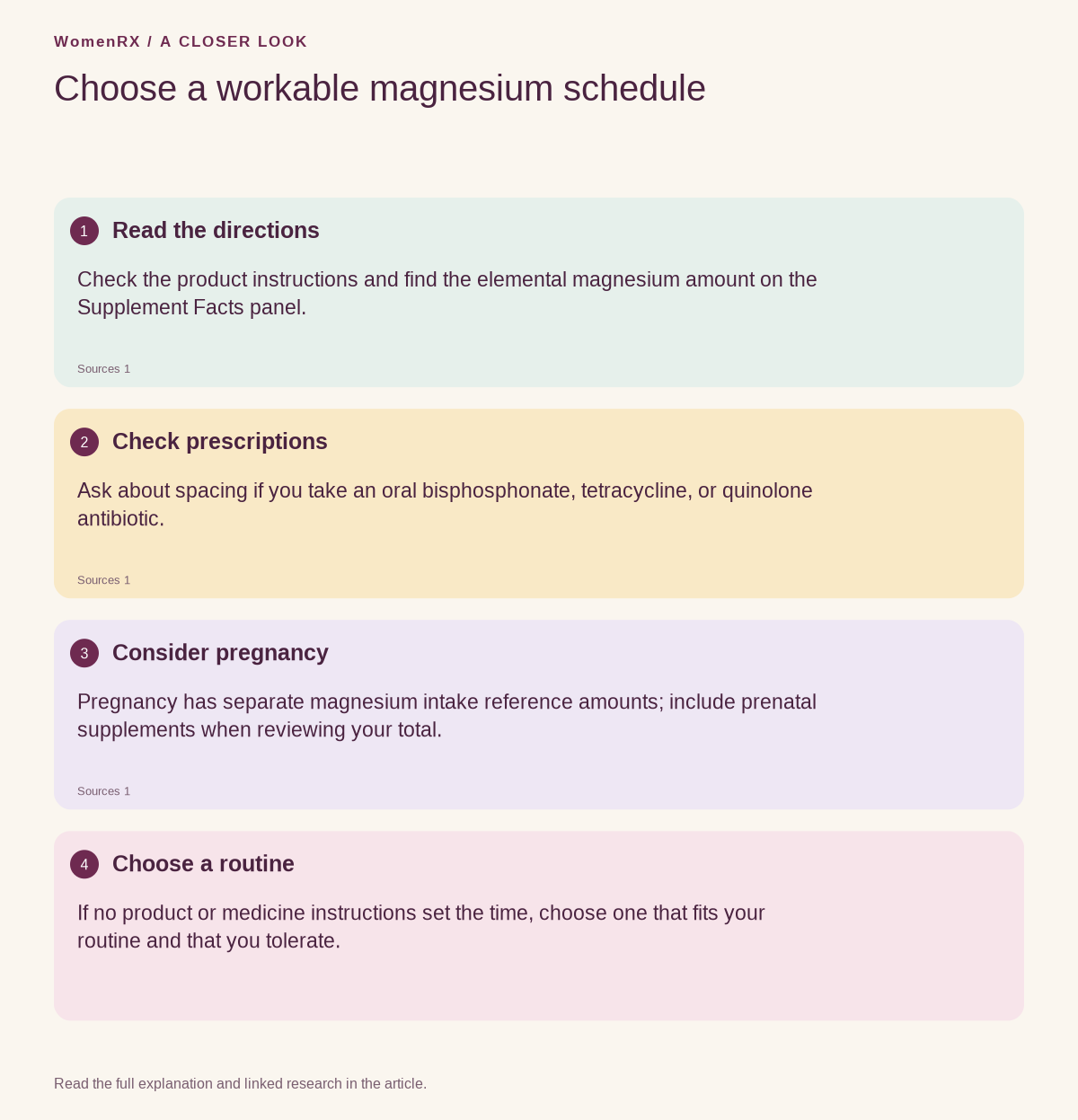
Choose a workable magnesium schedule
Read the directions: Check the product instructions and find the elemental magnesium amount on the Supplement Facts panel.1
Check prescriptions: Ask about spacing if you take an oral bisphosphonate, tetracycline, or quinolone antibiotic.1
Consider pregnancy: Pregnancy has separate magnesium intake reference amounts; include prenatal supplements when reviewing your total.1
Choose a routine: If no product or medicine instructions set the time, choose one that fits your routine and that you tolerate.
Read the figure as text
Check these practical details before settling on a time of day.- Read the directions: Check the product instructions and find the elemental magnesium amount on the Supplement Facts panel.1
- Check prescriptions: Ask about spacing if you take an oral bisphosphonate, tetracycline, or quinolone antibiotic.1
- Consider pregnancy: Pregnancy has separate magnesium intake reference amounts; include prenatal supplements when reviewing your total.1
- Choose a routine: If no product or medicine instructions set the time, choose one that fits your routine and that you tolerate.
More questions, answered
Does the supplement label show the amount of magnesium?
The Supplement Facts panel lists elemental magnesium, rather than the weight of the entire magnesium compound. 1
Sources you can check
- Magnesium - Health Professional Fact SheetAccessed 2026-09-25Return to first citation
- Effect of intra-operative Magnesium sulphate on the occurrence of post-operative delirium and insomnia in patients undergoing lumbar fixation: a randomized controlled trial.Fathy W, Hussein M, Elanwar R, Elmoutaz H, Abdelsadek DA, Kassim DY. · BMC anesthesiology · 2024Return to first citation