When Is the Best Time to Take Magnesium?
Morning and bedtime aren’t universal winners; product directions, stomach comfort, and medicine spacing matter more.
There isn’t a universal morning-or-night schedule for magnesium. Start with the product directions, then choose a time you can stick with that doesn’t worsen stomach symptoms and leaves the right gap from medicines that interact. Magnesium can reduce absorption of some antibiotics and oral bisphosphonates, so check the exact timing for your medication rather than guessing. 1
Start with the label, not the clock
For a magnesium supplement, the most useful time is one that follows the product directions, fits your routine, and doesn’t conflict with a medicine schedule. The NIH Office of Dietary Supplements describes differences in how magnesium forms are absorbed and lists medication interactions, but it doesn’t set a universal morning or bedtime schedule. 1
Check the Supplement Facts panel for the amount of elemental magnesium. The listed amount refers to elemental magnesium, not the weight of the whole magnesium compound. Products can contain different forms, and absorption varies among them; changing the time of day won’t make all forms equivalent. 1
Higher doses of magnesium from supplements or medicines can cause diarrhea, nausea, or abdominal cramping. Don’t assume moving a supplement to bedtime will solve these symptoms. Check the product directions and ask a pharmacist whether the product, timing, or your other medicines could be contributing. 1
Check medicine spacing before you settle on a routine
Magnesium can bind with certain medicines in the gut and reduce how much of the medicine is absorbed. For oral bisphosphonates such as alendronate, magnesium-containing supplements or medicines should be taken at least two hours before or after the bisphosphonate. 1
For tetracycline antibiotics, such as doxycycline, and quinolone antibiotics, such as ciprofloxacin, the spacing works differently: take the antibiotic at least two hours before magnesium, or four to six hours after magnesium. Follow the directions for your specific prescription, and ask a pharmacist to help fit both into your schedule. 1
Not every medicine pairing has the same evidence or rule. In a randomized trial of 45 adults taking rosuvastatin and magnesium oxide, taking the two together did not significantly change LDL cholesterol compared with taking them at separate times after meals over 12 weeks. The study tested one medicine and one magnesium form in a small group, so it doesn’t establish that other combinations can be taken together. 2
Some medicines affect magnesium levels rather than simply competing with a supplement for absorption. Long-term proton pump inhibitor use can be associated with low magnesium, while some diuretics can increase magnesium loss in urine and others can reduce it. Spacing a supplement from these medicines may not address that issue; a medication-specific review is more useful. 1
Meals and bedtime: what they can and can’t tell you
Follow the directions on your specific product about taking it with food. Higher doses of magnesium from supplements or medicines can cause digestive symptoms, but those symptoms alone don’t establish that one clock time is best for everyone. If taking it at a certain time regularly bothers your stomach, ask a pharmacist whether changing the timing or product is appropriate. 1
Magnesium has roles in nerve and muscle function, but that fact by itself doesn’t show that a bedtime supplement improves sleep. If you’re considering magnesium for sleep, don’t treat nighttime timing as a proven benefit; first make sure the product is suitable and doesn’t conflict with your medicines. 1
Pregnancy and menopause don’t create one schedule
Pregnancy isn’t a reason to assume that morning or night is universally better. The product directions and any medicine-spacing needs still matter; magnesium can interact with some antibiotics and oral bisphosphonates. 1
If you take an oral bisphosphonate for bone health during or after menopause, the spacing rule matters regardless of the time you prefer to take magnesium. Ask about the exact medicines you use rather than assuming all menopause treatments interact the same way. 1
A simple routine can be: read the product directions, check your medication list for an interaction, set the necessary spacing, then choose a convenient time and reassess if stomach symptoms occur. The goal is a workable routine that respects the specific product and medicines you take, not a special hour on the clock.
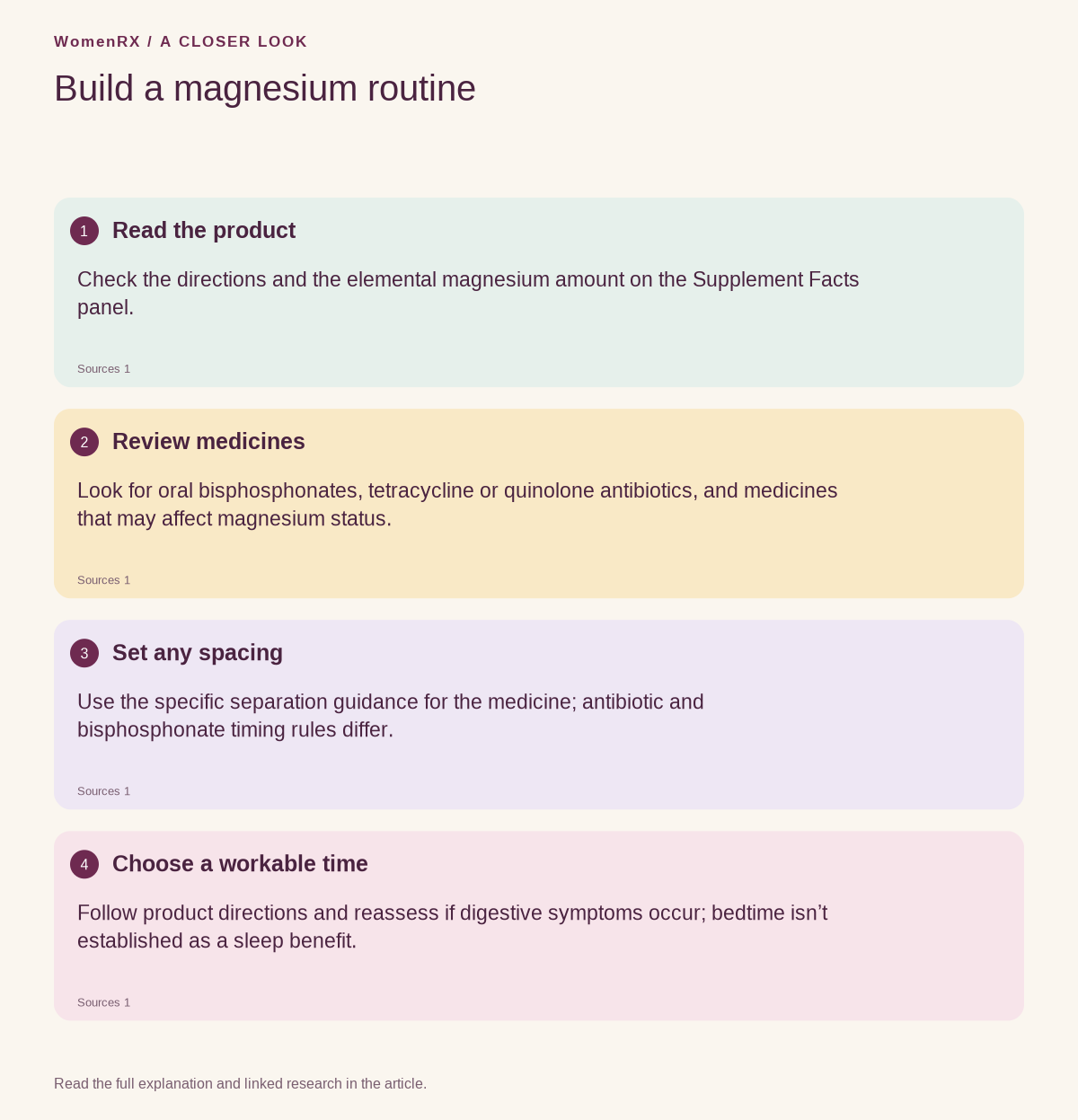
Build a magnesium routine
Read the product: Check the directions and the elemental magnesium amount on the Supplement Facts panel.1
Review medicines: Look for oral bisphosphonates, tetracycline or quinolone antibiotics, and medicines that may affect magnesium status.1
Set any spacing: Use the specific separation guidance for the medicine; antibiotic and bisphosphonate timing rules differ.1
Choose a workable time: Follow product directions and reassess if digestive symptoms occur; bedtime isn’t established as a sleep benefit.1
Read the figure as text
Check the product and medicine schedule first; choose a convenient time only after those details are clear.- Read the product: Check the directions and the elemental magnesium amount on the Supplement Facts panel.1
- Review medicines: Look for oral bisphosphonates, tetracycline or quinolone antibiotics, and medicines that may affect magnesium status.1
- Set any spacing: Use the specific separation guidance for the medicine; antibiotic and bisphosphonate timing rules differ.1
- Choose a workable time: Follow product directions and reassess if digestive symptoms occur; bedtime isn’t established as a sleep benefit.1
More questions, answered
Does magnesium have to be taken with food?
The NIH guidance doesn’t give one meal rule for every magnesium supplement. Follow the directions for your specific product. If you have digestive symptoms, don’t assume a meal or a different time will fix them; ask a pharmacist about your product and medication schedule. 1
Is bedtime magnesium better for sleep?
Magnesium’s role in nerve function doesn’t by itself establish that taking a supplement at bedtime improves sleep. Choose timing around the product directions, tolerability, and medicine spacing instead. 1
Sources you can check
- Magnesium - Health Professional Fact SheetAccessed 2026-09-25Return to first citation
- Clinical Effects of the Concurrent Ingestion of Rosuvastatin and Magnesium Oxide: A Multicenter, Randomized, Parallel-Group Trial.Nakashima A, Tokura K, Misaki M, Miyazu D, Kobayashi K, Urata H, Watanabe H, Shimomura H, Miyazaki M, Imakyure O. · Journal of clinical medicine research · 2025Return to first citation