GABA for Sleep or Stress: Is There a Best Time?
Human studies offer early, mixed findings for oral GABA, but none establishes that bedtime is the best time to take it.
There’s no research-established best time to take oral GABA for sleep or stress. A small trial in women reported better sleep measures after 90 days, while another trial found no significant group-level effect on self-reported sleep after statistical correction. Neither compared bedtime with another time, and the studies don’t establish medicine-interaction or pregnancy and breastfeeding safety. 2 3
GABA has a recognized role as a neurotransmitter made in the body, and people also consume it in foods. But that role doesn’t tell you whether a GABA supplement taken by mouth will improve sleep or stress, or when it might work best. Human supplement studies need to test those outcomes directly. 3
Sleep findings depend on what was measured
One randomized, placebo-controlled trial studied 30 sedentary women with overweight or obesity who were also doing physical exercise. The group taking GABA had improved habitual sleep-efficiency measures and lower Pittsburgh Sleep Quality Index (PSQI) scores after 90 days. The study also reported changes in negative affect and depression scores. This is a result in a small, specific group, not proof that GABA treats insomnia, anxiety, or stress for women generally. 2
Another randomized, placebo-controlled trial enrolled 52 adults ages 50 to 70 with prediabetes. Sleep quality was a secondary outcome. After adjustment for multiple comparisons, the researchers found no significant group-level effects on other measured outcomes, including self-reported sleep quality. The study description doesn’t report a women-specific analysis, so it can’t answer whether the result differed for women. 3
A third, smaller study followed 19 adults taking GABA together with L-theanine for four weeks. Participants’ PSQI scores improved, but there was no comparison group, and the two supplements were combined. The study can’t show whether GABA alone caused the change or whether it would happen compared with placebo. 4
These studies don’t all answer the same question: one reports a sleep signal in a particular group, another found no significant group-level sleep effect after adjustment, and the uncontrolled study tested a combination. That’s not enough to promise a reliable benefit.
Bedtime hasn’t been tested against other times
The reported trials don’t compare taking GABA in the morning with taking it at night, or test whether bedtime is better. A study lasting weeks or months can assess change over that period, but it doesn’t establish the best time of day. So choosing bedtime because the goal is sleep is an assumption, not a timing rule supported by these trials. 2 3 4
Sleep or stress? They aren’t interchangeable outcomes
A sleep questionnaire measures reported sleep, while a change in mood is a different finding. In the women’s trial, researchers reported changes in negative affect and depression scores, but those measures don’t establish that oral GABA relieves everyday stress or treats an anxiety disorder. The study description doesn’t report a specific stress-relief result. 2
That distinction matters if stress is your main concern. Stress can be a short-term response to a demand or a longer-lasting strain, and a supplement study’s mood scores don’t show that the supplement addresses the cause or effects of ongoing stress. 1 2
What remains unclear about safety
The study descriptions don’t establish which medicines, if any, interact with oral GABA, or whether combining it with a particular medicine is safe. They also don’t establish safety during pregnancy or breastfeeding. That’s a limit of what these studies report, not proof that no relevant research exists. If you take medication or are pregnant or breastfeeding, ask a pharmacist or prescriber to check the specific product and your situation rather than relying on these sleep findings. 2 3 4
For now, there’s no evidence-based timing advantage to choosing bedtime. The more useful distinction is whether a study measured the outcome you care about: early results on some sleep and mood measures don’t establish a dependable effect on stress, a best time, or safety for every situation.
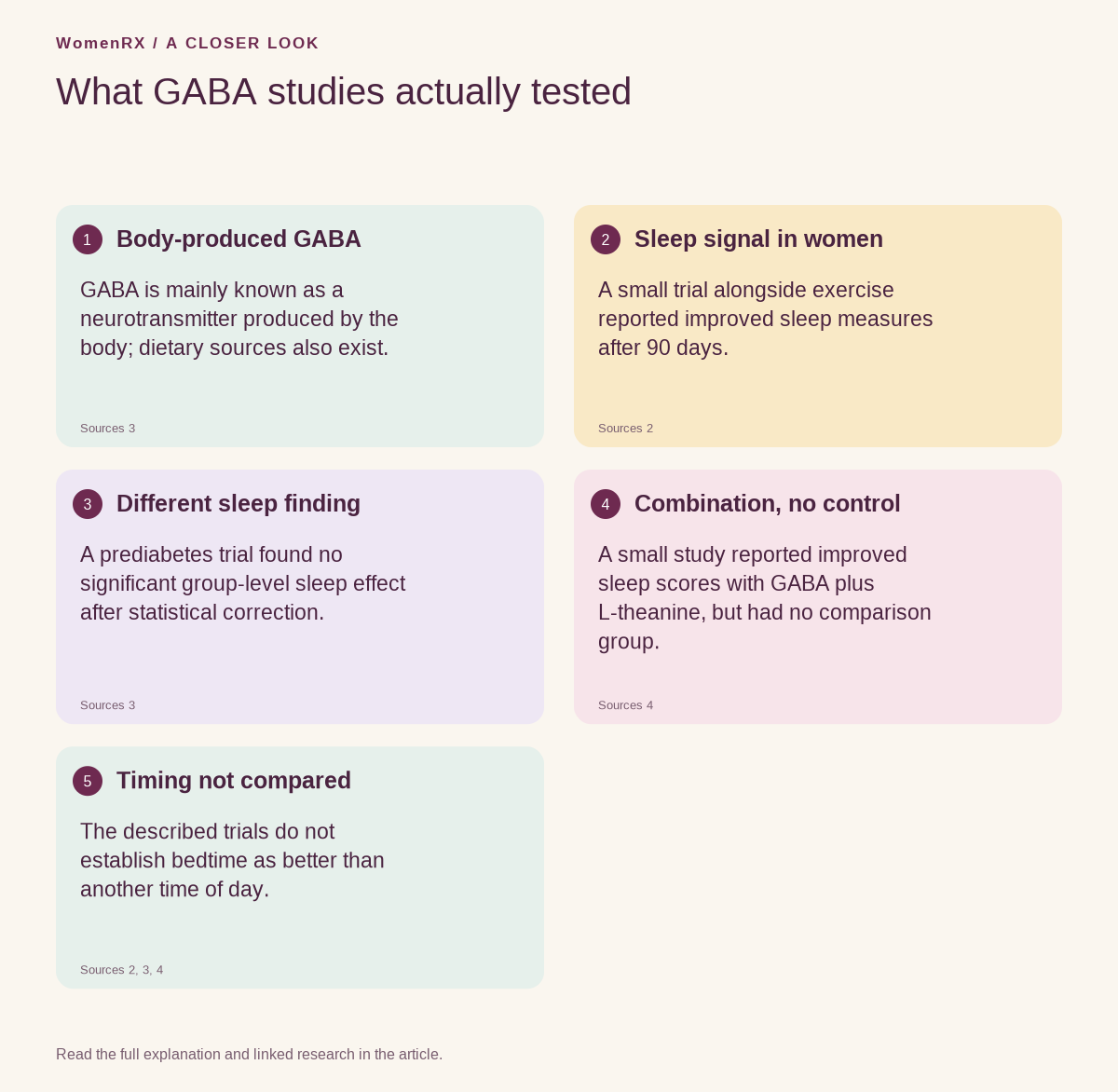
What GABA studies actually tested
Body-produced GABA: GABA is mainly known as a neurotransmitter produced by the body; dietary sources also exist.3
Sleep signal in women: A small trial alongside exercise reported improved sleep measures after 90 days.2
Different sleep finding: A prediabetes trial found no significant group-level sleep effect after statistical correction.3
Combination, no control: A small study reported improved sleep scores with GABA plus L-theanine, but had no comparison group.4
Timing not compared: The described trials do not establish bedtime as better than another time of day.234
Read the figure as text
Separate the body's neurotransmitter from supplement outcomes, then compare those outcomes with the timing and safety questions people often have.- Body-produced GABA: GABA is mainly known as a neurotransmitter produced by the body; dietary sources also exist.3
- Sleep signal in women: A small trial alongside exercise reported improved sleep measures after 90 days.2
- Different sleep finding: A prediabetes trial found no significant group-level sleep effect after statistical correction.3
- Combination, no control: A small study reported improved sleep scores with GABA plus L-theanine, but had no comparison group.4
- Timing not compared: The described trials do not establish bedtime as better than another time of day.234
More questions, answered
Do the studies show that GABA works better at night?
No. The described studies don’t compare nighttime use with use at another time, so they can’t establish that taking it at bedtime works better. 2 3 4
Do the studies show whether GABA is safe with my medication?
They don’t establish medication interactions or confirm that a specific combination is safe. Ask a pharmacist or prescriber to check your medication and the particular supplement product.
Do these studies establish safety during pregnancy or breastfeeding?
No. The study descriptions don’t establish safety in pregnancy or while breastfeeding. That’s a limit of these findings, not proof that no research exists. 2 3 4
Sources you can check
- Stress: MedlinePlusAccessed 2026-09-25Return to first citation
- GABA Supplementation, Increased Heart-Rate Variability, Emotional Response, Sleep Efficiency and Reduced Depression in Sedentary Overweight Women Undergoing Physical Exercise: Placebo-Controlled, Randomized Clinical Trial.Guimarães AP, Seidel H, Pires LVM, Trindade CO, Baleeiro RDS, Souza PM, Silva FGDE, Coelho DB, Becker LK, Oliveira EC. · Journal of dietary supplements · 2024Return to first citation
- Effects of γ-aminobutyric acid supplementation on glucose control in adults with prediabetes: A double-blind, randomized, placebo-controlled trial.de Bie TH, Witkamp RF, Balvers MG, Jongsma MA. · The American journal of clinical nutrition · 2023Return to first citation
- Effects of combined GABA and L-theanine supplementation on sleep quality: an exploratory study.Konno H, Naganuma K, Kamada Y. · European review for medical and pharmacological sciences · 2026Return to first citation