GABA for Sleep or Stress: What the Studies Actually Show
One small study in women reported sleep-related improvements after 90 days, but the available trials don’t establish how quickly GABA works or whether it relieves stress.
There isn’t enough human evidence to say how soon a GABA supplement might affect sleep or stress. A small trial in women assessed outcomes over 90 days, while a separate trial found no significant effect on self-reported sleep quality after 95 days. Neither result establishes a reliable timeline or a proven stress benefit. 1 2
The brain’s GABA system isn’t the same as a GABA supplement
GABA is a neurotransmitter the body makes. That biological role can help explain why researchers study GABA and sleep, but it doesn’t show that taking GABA by mouth will produce a calming or sleep effect. A supplement trial has to test the oral product itself and measure an outcome that matters to people. 1 2
That distinction matters when you see claims built around GABA’s role in the body. A reason to study an ingredient is not proof that a supplement works, and findings about one product or group don’t automatically apply to another.
What the human trials measured
One randomized, placebo-controlled trial studied 30 sedentary women with overweight or obesity who were also doing physical exercise. The study assessed sleep and emotional measures over 90 days. Its abstract reports improvements in sleep-related measures and in depression scores in the GABA group. This is a limited finding: it comes from a small group, in the context of an exercise program, and doesn’t tell us whether GABA alone improves sleep for other people. The emotional and depression measures also don’t establish that GABA treats stress. 2
A separate randomized, placebo-controlled trial enrolled 52 adults with prediabetes, ages 50 to 70, and followed them for 95 days. Sleep quality was an exploratory secondary outcome. After adjustment for multiple comparisons, the trial found no significant group-level effects on the measured outcomes, including sleep quality. The abstract doesn’t report sleep results separately for women and men. 1
Taken together, these studies don’t identify a dependable time to feel an effect. One reported sleep-related improvements at the end of a 90-day study; the other did not find a significant sleep-quality effect after 95 days. That’s not evidence that you should wait a set number of days for a benefit.
A quick way to assess a product claim
Before weighing a GABA claim, check what was actually tested:
- The outcome: Was it sleep quality, time to fall asleep, a stress rating, or something else? A change in one measure doesn’t prove improvement in all of them.
- The study group and dose: Was it a small group of women who were exercising, or adults with prediabetes? The women’s study tested 200 mg once daily over 90 days; the prediabetes study tested 500 mg three times daily over 95 days. These are the regimens studied, not recommended doses. Ask whether the results fit your situation. The trial reports don’t establish effects during pregnancy or breastfeeding. 1 2
- The comparison and duration: Was the product compared with a placebo, and when were outcomes measured? An endpoint after 90 days doesn’t show when an effect began.
- The product itself: Does the claim match the specific GABA product studied? Don’t assume results for one preparation apply to every supplement.
- Safety details: Do the study results describe side effects and who was excluded? The trial abstracts don’t provide enough detail to establish safety in pregnancy or breastfeeding, or to evaluate interactions with medicines.
These questions can help separate a study result from a broad marketing promise. They also give you specific details to raise when discussing a supplement alongside other treatments, rather than assuming it is interchangeable with a prescription medicine.
What to discuss about safety and other treatments
The available trial summaries don’t establish GABA’s safety for everyone or answer whether it interacts with a particular medicine. If you’re considering it, bring the exact product label and the treatments you already use into the discussion. Ask whether the evidence applies to your goal, what side effects were observed in the relevant study, and whether there’s a reason to avoid combining it with your current care.
If your main concern is ongoing stress, note what you hope would change, such as feeling less tense or sleeping more soundly. Those are distinct goals, and the GABA trial evidence described here doesn’t demonstrate a reliable benefit for either one. For sleep, focus on whether a study measured the specific problem you’re having, not simply whether it mentioned GABA or sleep.
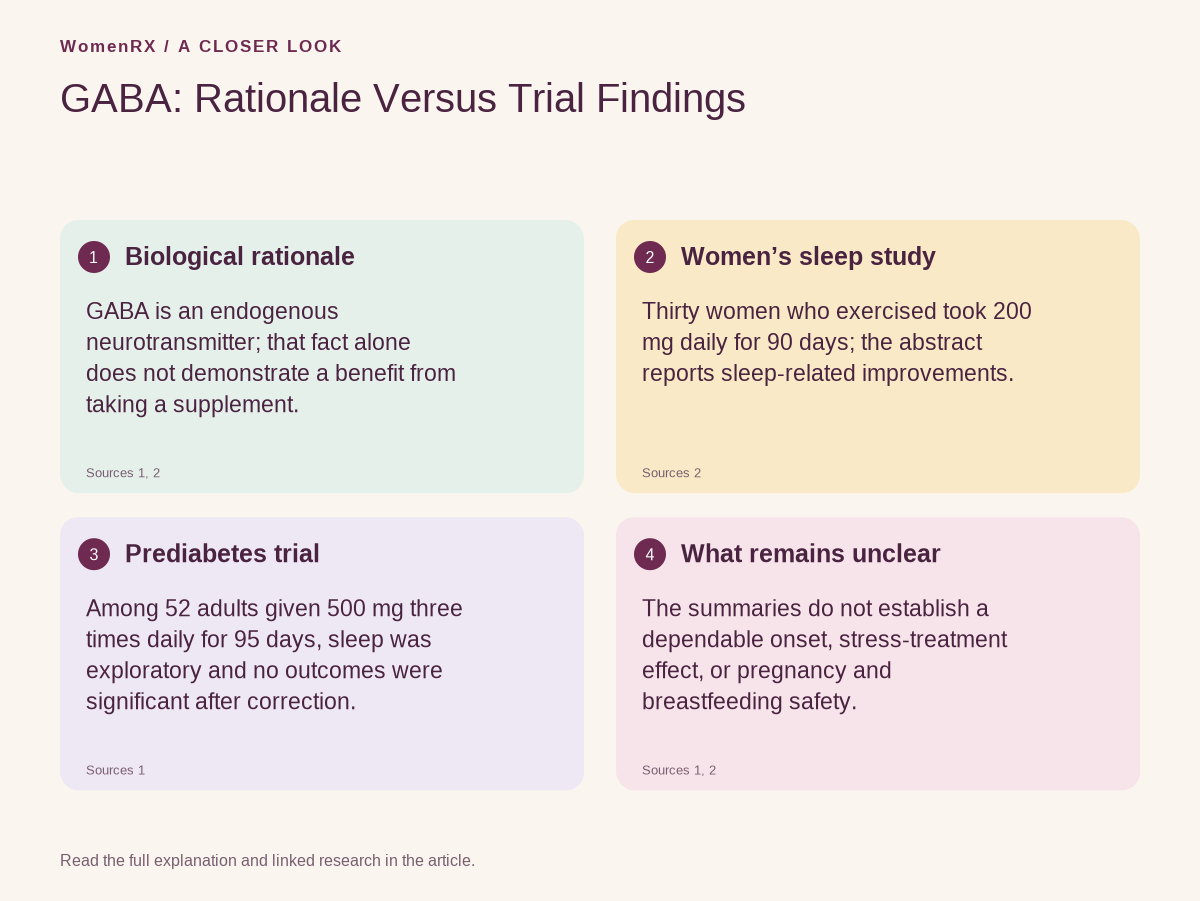
GABA: Rationale Versus Trial Findings
Biological rationale: GABA is an endogenous neurotransmitter; that fact alone does not demonstrate a benefit from taking a supplement.12
Women’s sleep study: Thirty women who exercised took 200 mg daily for 90 days; the abstract reports sleep-related improvements.2
Prediabetes trial: Among 52 adults given 500 mg three times daily for 95 days, sleep was exploratory and no outcomes were significant after correction.1
What remains unclear: The summaries do not establish a dependable onset, stress-treatment effect, or pregnancy and breastfeeding safety.12
Read the figure as text
The body’s GABA signaling offers a reason to study supplements, but the clinical question is what oral GABA changed in human trials.- Biological rationale: GABA is an endogenous neurotransmitter; that fact alone does not demonstrate a benefit from taking a supplement.12
- Women’s sleep study: Thirty women who exercised took 200 mg daily for 90 days; the abstract reports sleep-related improvements.2
- Prediabetes trial: Among 52 adults given 500 mg three times daily for 95 days, sleep was exploratory and no outcomes were significant after correction.1
- What remains unclear: The summaries do not establish a dependable onset, stress-treatment effect, or pregnancy and breastfeeding safety.12
More questions, answered
Does GABA work right away for sleep?
The trials described here don’t establish a same-night effect or a reliable time to benefit. One small study in women assessed outcomes over 90 days; another found no significant sleep-quality effect after 95 days. 1 2
Does the research show that GABA supplements reduce stress?
Not clearly. The small women’s trial reported changes in emotional and depression measures, but those findings don’t demonstrate that GABA treats stress. 2
Do these studies establish safety during pregnancy or breastfeeding?
No. The trial summaries don’t provide enough information about pregnancy or breastfeeding to establish safety in either situation. 1 2
Sources you can check
- Effects of γ-aminobutyric acid supplementation on glucose control in adults with prediabetes: A double-blind, randomized, placebo-controlled trial.de Bie TH, Witkamp RF, Balvers MG, Jongsma MA. · The American journal of clinical nutrition · 2023Return to first citation
- GABA Supplementation, Increased Heart-Rate Variability, Emotional Response, Sleep Efficiency and Reduced Depression in Sedentary Overweight Women Undergoing Physical Exercise: Placebo-Controlled, Randomized Clinical Trial.Guimarães AP, Seidel H, Pires LVM, Trindade CO, Baleeiro RDS, Souza PM, Silva FGDE, Coelho DB, Becker LK, Oliveira EC. · Journal of dietary supplements · 2024Return to first citation