GABA in the Morning or at Night for Sleep?
Human research offers very limited evidence about oral GABA and sleep, and the reported studies don’t establish a better time of day to take it.
If you’re considering GABA for sleep, the available findings don’t establish whether morning or nighttime use works better. A review of 14 placebo-controlled human studies found very limited evidence for sleep benefits, and the studies varied in their methods. A separate three-week trial in perimenopausal and postmenopausal women tested GABA with several other ingredients, not GABA alone. Neither set of findings gives a morning-versus-night comparison. 3 4
What the human studies actually tested
If you’re taking GABA for sleep, bedtime may sound like the obvious choice. But a proposed calming effect isn’t the same as evidence that nighttime dosing works better.
A systematic review included 14 placebo-controlled human studies examining stress, sleep, or related outcomes. The studies differed in dose, duration, and the measures they used. Overall, the review found very limited evidence for sleep benefits from oral GABA. Its reported findings don’t describe a direct morning-versus-night comparison. 3
That leaves a specific question unanswered: whether timing changes the effect. The study details reported in the review don’t establish which schedules individual trials used, so they don’t support choosing a time of day. This isn’t proof that no study has ever compared timing; it means the reported evidence doesn’t settle the comparison.
What the menopause-stage trial can tell you
A randomized trial enrolled perimenopausal and postmenopausal women with sleep disturbance and tested a combination supplement containing GABA, L-theanine, magnesium, S-adenosyl methionine, and propyl gallate for three weeks. The combination improved reported sleep outcomes compared with placebo. Because several ingredients were taken together, the trial can’t show what GABA alone contributed. And the trial description gives its duration and ingredients, not a morning-versus-night comparison. 4
The study included women in perimenopause and postmenopause, but it doesn’t provide a basis for timing GABA differently by menopause stage. It also doesn’t answer timing questions tied to menstrual cycles or pregnancy.
A practical takeaway
If you already take GABA, the reported findings don’t tell you that moving it to morning or bedtime will improve your sleep. If you’re considering it, keep the limited evidence for sleep benefit in view, and don’t treat bedtime use as proven just because sleep is the goal. 3
If trouble falling asleep or staying asleep keeps happening, the issue may be insomnia rather than supplement timing. Cognitive behavioral therapy is one treatment that can help with chronic insomnia. Regularly taking more than 30 minutes to fall asleep, waking repeatedly and struggling to return to sleep, or feeling sleepy during the day are signs that sleep problems may deserve attention. 1 2
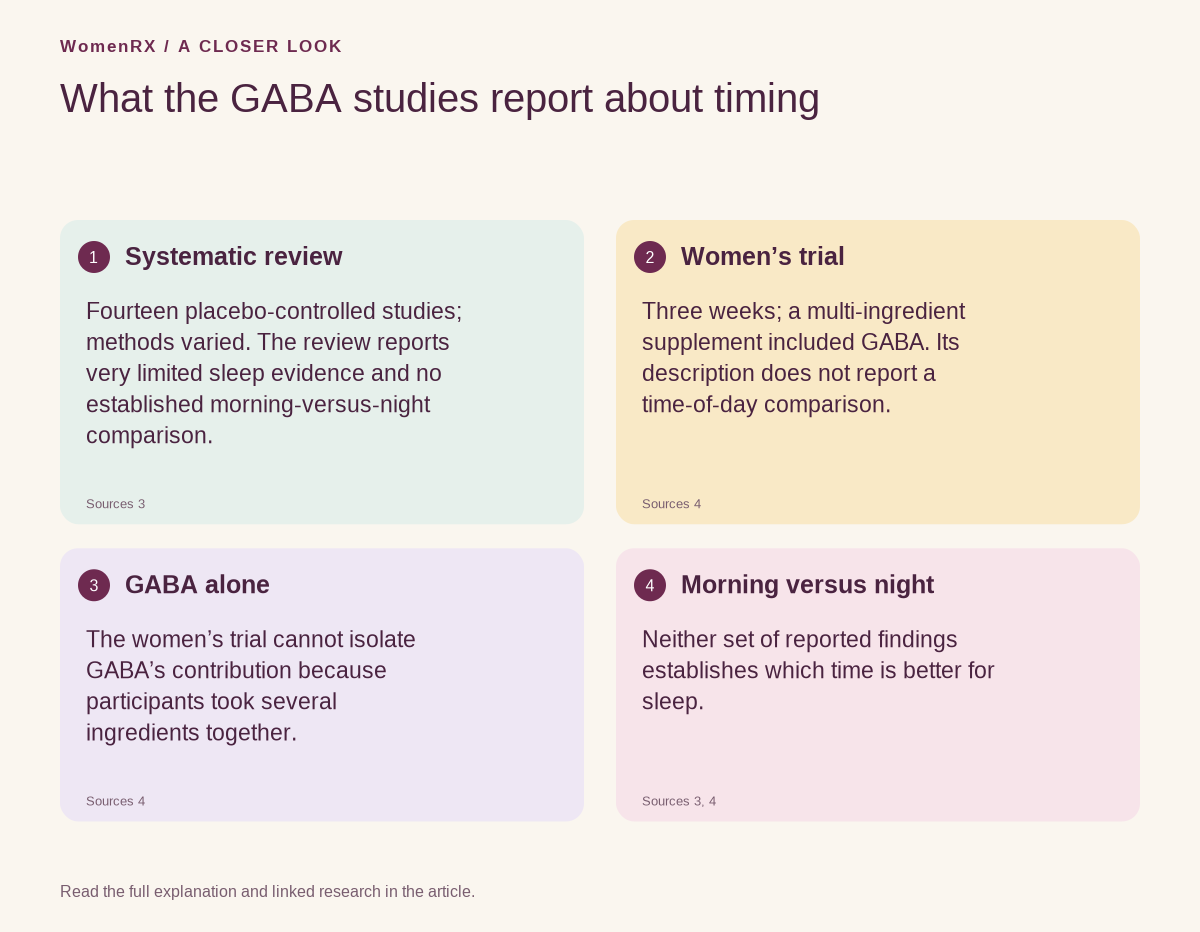
What the GABA studies report about timing
Systematic review: Fourteen placebo-controlled studies; methods varied. The review reports very limited sleep evidence and no established morning-versus-night comparison.3
Women’s trial: Three weeks; a multi-ingredient supplement included GABA. Its description does not report a time-of-day comparison.4
GABA alone: The women’s trial cannot isolate GABA’s contribution because participants took several ingredients together.4
Morning versus night: Neither set of reported findings establishes which time is better for sleep.34
Read the figure as text
Compare the human evidence by study type, duration, product, and what it says about time of day.- Systematic review: Fourteen placebo-controlled studies; methods varied. The review reports very limited sleep evidence and no established morning-versus-night comparison.3
- Women’s trial: Three weeks; a multi-ingredient supplement included GABA. Its description does not report a time-of-day comparison.4
- GABA alone: The women’s trial cannot isolate GABA’s contribution because participants took several ingredients together.4
- Morning versus night: Neither set of reported findings establishes which time is better for sleep.34
Sources you can check
- Sleep Disorders | MedlinePlusAccessed 2026-09-25Return to first citation
- Insomnia | MedlinePlusAccessed 2026-09-25Return to first citation
- Effects of Oral Gamma-Aminobutyric Acid (GABA) Administration on Stress and Sleep in Humans: A Systematic Review.Hepsomali P, Groeger JA, Nishihira J, Scholey A. · Frontiers in neuroscience · 2020Return to first citation
- Nonsedating neurotransmitter-modulating supplement for nonvasomotor sleep disturbance in menopause.Carbonneau S, Mysliwiec V, Doyle AL, Stratton M, Dweck A, Tartar J, Alesi M, Mason L, Komorowski J, VanDusseldorp TA. · Menopause (New York, N.Y.) · 2026Return to first citation