GABA Supplements: What Studied Doses Actually Show
A sleep trial used 100 mg of GABA in a three-ingredient drink, but that isn’t a proven standalone dose for sleep.
There’s no established standalone GABA dose for sleep. A four-week women’s trial used 100 mg daily in a three-ingredient drink; another tested a five-ingredient supplement without stating its GABA amount. An analysis of U.S. product labels found suggested daily intakes of about 45 mg to 3 g, not proven effective doses. Check the whole product, especially with blood-pressure medicine or during pregnancy or breastfeeding. 2314
What was studied for sleep
If you’re looking at GABA for sleep, the first distinction is between GABA alone and a product that contains GABA. The women’s trials here tested combinations. Their results are useful for understanding what researchers tried, but they can’t isolate GABA’s contribution.
In one randomized trial, 70 Chinese women ages 25 to 55 who reported poor sleep were assigned to a daily drink containing 100 mg of GABA plus Poria cocos and Ziziphus spinose, or to a placebo drink. After four weeks, the combination group had greater improvements in measured sleep duration and reported sleep quality than the placebo group. Because three active ingredients were given together, the result doesn’t tell us whether 100 mg of GABA on its own would help. 2
A second randomized trial enrolled 128 perimenopausal and postmenopausal women with moderate-to-severe sleep disturbance but few hot flashes or night sweats. Over three weeks, a supplement containing GABA, L-theanine, magnesium, S-adenosyl methionine, and propyl gallate improved reported sleep disturbance and sleep-related impairment more than placebo. The published abstract doesn’t state how much GABA the supplement contained. It’s evidence about that combination in women with low hot-flash and night-sweat burden, not evidence that GABA treats menopause symptoms generally. 3
Why a studied amount isn’t a product recommendation
The 100 mg figure is the amount of GABA in one specific three-ingredient drink used for four weeks. It isn’t a tested dose of GABA by itself. The menopause sleep trial offers no GABA amount to compare with a label. Neither trial tested whether taking more GABA works better. 23
For a comparison outside those sleep trials, a United States Pharmacopeia safety review describes studies using 120 mg of GABA daily for 12 weeks in a soy-sauce product given to adults with hypertension, 2 g three times daily for seven days in an oral GABA study, and 18 g daily for four days in a small study that included eight women. These amounts were tested in different products, populations, and study designs. The short high-dose studies don’t show that taking more helps sleep or that a high amount is safe over months. 4
An analysis of U.S. Dietary Supplement Label Database listings reported suggested GABA intakes from approximately 45 mg to 3 g per day, with most products recommending about 600 to 750 mg per day in divided doses. The database snapshot was from November 17, 2025. These are label recommendations, not amounts established to help sleep or measurements verifying what each product contains. 1
When you compare a product with a study, check more than the milligrams: What else is in it? Does the label state an amount per serving or a suggested total per day? How long was the product studied, and in whom? For example, a capsule containing only GABA isn’t the drink tested in the four-week trial, even if its label says 100 mg. A matching number doesn’t make two formulations equivalent. 2
What the safety findings do and don’t cover
No adverse events were reported during the four-week drink trial or its 14-day follow-up. The three-week menopause trial found no difference in adverse events between the combination and placebo groups. Those observations apply to the particular products and short periods studied. 23
The Pharmacopeia review found no serious adverse events associated with GABA in the human studies it examined, including the short high-dose studies. Reported effects in some studies included abdominal discomfort, headache, drowsiness, and a temporary burning sensation in the throat. The reviewers found no studies specifically designed to evaluate GABA’s safety and tolerability. That makes the findings reassuring in a limited way, not proof of long-term safety at any amount. 4
If you take blood-pressure medicine, check before adding GABA. Some studies reviewed by the Pharmacopeia found a temporary drop in blood pressure with GABA-containing products, though results were not uniform across studies. The reviewers raised the possibility of blood pressure falling too low when GABA is combined with antihypertensive medicine. That’s a potential interaction, not an established outcome for every product. Bring the exact label to your pharmacist or prescribing clinician so they can consider the combination you’d actually take. 4
Pregnancy and breastfeeding need a separate decision. The Pharmacopeia review found no studies of GABA’s effects during either period, and the four-week drink trial excluded women who were pregnant, breastfeeding, or preparing for pregnancy. A reproductive study in rats found no treatment-related effects at the amounts tested, but it cannot establish safety in human pregnancy or breastfeeding. If either situation applies to you, don’t treat an ordinary supplement label or a short sleep trial as an answer to that safety question. 421
The drink trial also excluded people using sleeping pills or sedatives, so it cannot tell you what happens when its ingredients are taken alongside them. If you use one, ask a pharmacist about the whole product rather than assuming the trial established that combination’s safety. 2
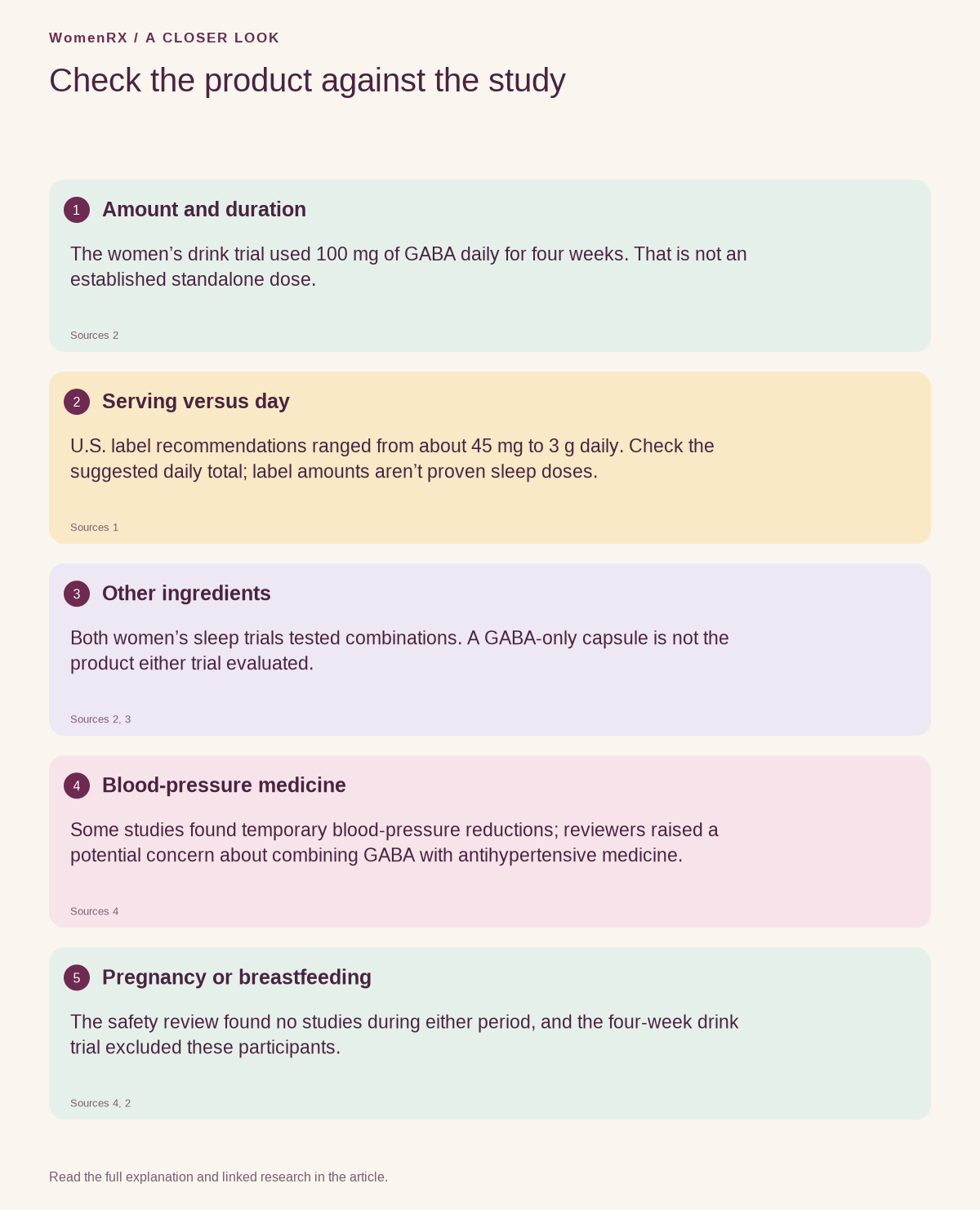
Check the product against the study
Amount and duration: The women’s drink trial used 100 mg of GABA daily for four weeks. That is not an established standalone dose.2
Serving versus day: U.S. label recommendations ranged from about 45 mg to 3 g daily. Check the suggested daily total; label amounts aren’t proven sleep doses.1
Other ingredients: Both women’s sleep trials tested combinations. A GABA-only capsule is not the product either trial evaluated.23
Blood-pressure medicine: Some studies found temporary blood-pressure reductions; reviewers raised a potential concern about combining GABA with antihypertensive medicine.4
Pregnancy or breastfeeding: The safety review found no studies during either period, and the four-week drink trial excluded these participants.42
Read the figure as text
A matching GABA amount is only one part of a useful comparison.- Amount and duration: The women’s drink trial used 100 mg of GABA daily for four weeks. That is not an established standalone dose.2
- Serving versus day: U.S. label recommendations ranged from about 45 mg to 3 g daily. Check the suggested daily total; label amounts aren’t proven sleep doses.1
- Other ingredients: Both women’s sleep trials tested combinations. A GABA-only capsule is not the product either trial evaluated.23
- Blood-pressure medicine: Some studies found temporary blood-pressure reductions; reviewers raised a potential concern about combining GABA with antihypertensive medicine.4
- Pregnancy or breastfeeding: The safety review found no studies during either period, and the four-week drink trial excluded these participants.42
More questions, answered
Does the menopause trial show that GABA helps hot flashes?
No. It studied sleep in perimenopausal and postmenopausal women who had few hot flashes and night sweats, using a supplement with five ingredients. Its findings don’t establish an effect of GABA alone on hot flashes. 3
Sources you can check
- Repeated oral administration of gamma-aminobutyric acid (GABA) does not cause reproductive or developmental toxicity in rats.Li X, Kulkarni A, Yamada H, Yamashita Y, Kim YI. · Toxicology reports · 2026Return to first citation
- Effects of a combination of Poria Cocos, Ziziphus spinose, and gamma-aminobutyric acid (GABA) on sleep quality and skin health: A randomized double-blind placebo-controlled clinical trial.Hao Y, Song W, Qu L. · Food science & nutrition · 2024Return to first citation
- Nonsedating neurotransmitter-modulating supplement for nonvasomotor sleep disturbance in menopause.Carbonneau S, Mysliwiec V, Doyle AL, Stratton M, Dweck A, Tartar J, Alesi M, Mason L, Komorowski J, VanDusseldorp TA. · Menopause (New York, N.Y.) · 2026Return to first citation
- United States Pharmacopeia (USP) Safety Review of Gamma -Aminobutyric Acid (GABA)Accessed 2026-09-26Return to first citation