GABA Supplements: What Human Studies Actually Show
GABA helps regulate activity in the brain, but that established role doesn’t tell us whether swallowing it will improve sleep or ease anxiety.
GABA is a neurotransmitter involved in calming neural activity, but an oral supplement isn’t the same as GABA made and used in the brain.6 Human studies of oral GABA have examined attention, glucose control, and sleep as a secondary outcome. Their findings don’t establish a sleep or anxiety benefit for women, and it remains uncertain whether swallowed GABA reaches the brain in meaningful amounts.57
The useful distinction: GABA in your brain versus GABA in a capsule
Gamma-aminobutyric acid, or GABA, is a chemical messenger that helps limit activity in the brain. That’s the established biology behind the supplement’s calming pitch. But making a chemical in your body and swallowing that same chemical are different things. Whether oral GABA crosses into the brain in meaningful amounts remains debated.67
This also explains why a treatment described as GABAergic isn’t evidence for a GABA capsule. Some medicines act on GABA receptors; oral GABA supplements contain GABA itself. Research on one can’t establish the effects of the other.6
What has actually been tested in people?
Sleep: In a double-blind trial, 52 adults ages 50 to 70 with prediabetes received oral GABA or a placebo for 95 days. Sleep quality was an exploratory secondary outcome, not the main reason for the trial. After the researchers adjusted for testing multiple outcomes, they found no significant group-level effect on sleep quality. That doesn’t settle whether GABA could help someone with insomnia; this trial wasn’t designed around treating insomnia.5
Attention: A randomized, double-blind, placebo-controlled experiment in healthy young adults found fewer errors on one task requiring participants to identify the order of rapidly presented visual events after GABA than after placebo. It found no effect on spatial attention or on another measure of temporal integration. This is a narrow laboratory finding, not evidence that a supplement improves everyday focus or relieves anxiety.7
Blood sugar: The same 95-day prediabetes trial found that oral GABA did not improve the primary outcome, glucose response after an oral glucose tolerance test, compared with placebo.5 A separate six-month study tested a controlled-release oral GABA formulation in 35 men with long-standing type 1 diabetes. It found no improvement in the measures of insulin-producing cell function studied. That trial had no group receiving a placebo without GABA, and its findings cannot establish an effect in women.4
These studies answer specific questions in specific groups. They don’t add up to proof that a GABA supplement treats anxiety, restores sleep, or improves hormones. They also don’t prove that no other relevant studies exist. For the decision in front of you, the key point is that GABA’s well-established role in the brain is stronger evidence than the clinical evidence for those supplement claims.567
What changes if you’re considering it for sleep or anxiety?
Start with the problem you want to solve, rather than the ingredient’s proposed mechanism. For example, regularly waking during the night is different from feeling keyed up before a stressful event. Insomnia can be linked to stress, medicines, other health conditions, or another sleep disorder; menopause can be one contributing factor. Finding the cause can point to a more useful approach than assuming a GABA capsule will address it.12
If sleep trouble has become ongoing or is affecting your days, evidence-based care may include changes to sleep habits or cognitive behavioral therapy, depending on the situation.1 If fear or worry persists and interferes with daily life, anxiety disorders have established treatments, including psychotherapy and medicines.3 You don’t have to decide that a supplement works before taking either problem seriously.
What about safety and women-specific effects?
The studies above don’t establish a reliable safety profile for routine GABA supplement use across adult women, during pregnancy, or postpartum. The attention study’s summary doesn’t report results by sex, and the prediabetes trial’s summary doesn’t provide a women-specific result. The type 1 diabetes study enrolled only men.457
In that diabetes study, nine participants had elevated levels of a liver enzyme called AST, and two withdrew for that reason. Because every study arm received GABA and one arm also received another drug for part of the trial, the finding doesn’t tell us how often an ordinary GABA supplement would cause this problem. It does mean the study should not be presented as proof of long-term safety.4
If a product combines GABA with other ingredients, its label and the evidence for each ingredient matter too. Results from a probiotic that may produce GABA, for example, do not test the effects of swallowing GABA itself.8
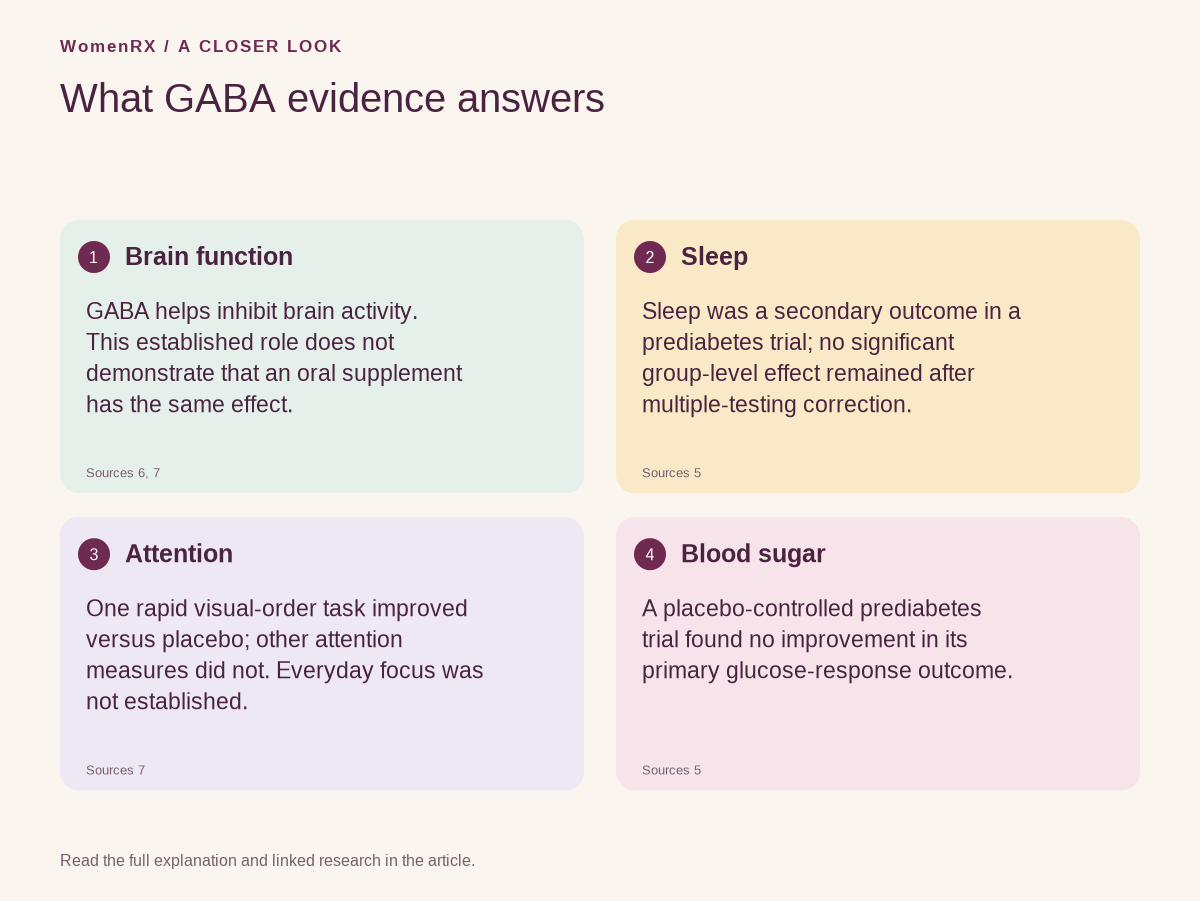
What GABA evidence answers
Brain function: GABA helps inhibit brain activity. This established role does not demonstrate that an oral supplement has the same effect.67
Sleep: Sleep was a secondary outcome in a prediabetes trial; no significant group-level effect remained after multiple-testing correction.5
Attention: One rapid visual-order task improved versus placebo; other attention measures did not. Everyday focus was not established.7
Blood sugar: A placebo-controlled prediabetes trial found no improvement in its primary glucose-response outcome.5
Read the figure as text
The reason GABA sounds promising is not the same as a demonstrated benefit from swallowing it.- Brain function: GABA helps inhibit brain activity. This established role does not demonstrate that an oral supplement has the same effect.67
- Sleep: Sleep was a secondary outcome in a prediabetes trial; no significant group-level effect remained after multiple-testing correction.5
- Attention: One rapid visual-order task improved versus placebo; other attention measures did not. Everyday focus was not established.7
- Blood sugar: A placebo-controlled prediabetes trial found no improvement in its primary glucose-response outcome.5
More questions, answered
Does GABA in food tell us whether a supplement works?
No. GABA can come from foods, including tomatoes and fermented foods, but that fact alone doesn’t show that an oral GABA supplement improves sleep, mood, or blood sugar. Those are clinical questions that require appropriate human comparisons.5
Do GABA-related treatments for postpartum depression support GABA supplements?
No. Some treatments studied for depression act on GABA receptors, but they aren’t oral GABA supplements. Their results can’t be transferred to a capsule containing GABA.6
Sources you can check
- Insomnia | MedlinePlusAccessed 2026-09-25Return to first citation
- Insomnia - NHSAccessed 2026-09-25Return to first citation
- Anxiety: MedlinePlusAccessed 2026-09-25Return to first citation
- Long-term gamma-aminobutyric acid (GABA) treatment fails to regain beta-cell function in longstanding type 1 diabetes in a randomized trial.Hill H, Lundkvist P, Tsatsaris G, Birnir B, Espes D, Carlsson PO. · Scientific reports · 2025Return to first citation
- Effects of γ-aminobutyric acid supplementation on glucose control in adults with prediabetes: A double-blind, randomized, placebo-controlled trial.de Bie TH, Witkamp RF, Balvers MG, Jongsma MA. · The American journal of clinical nutrition · 2023Return to first citation
- Understanding the mechanism of action and clinical effects of neuroactive steroids and GABAergic compounds in major depressive disorder.Cutler AJ, Mattingly GW, Maletic V. · Translational psychiatry · 2023Return to first citation
- Supplementation of gamma-aminobutyric acid (GABA) affects temporal, but not spatial visual attention.Leonte A, Colzato LS, Steenbergen L, Hommel B, Akyürek EG. · Brain and cognition · 2018Return to first citation
- Lactiplantibacillus plantarum Lp815 decreases anxiety in people with mild to moderate anxiety: a direct-to-consumer, randomised, double-blind, placebo-controlled study.Grant AD, Erfe MCB, Delebecque CJ, Keller D, Zimmerman NP, Oliver PL, Youssef B, Moos J, Luna V, Craft N. · Beneficial microbes · 2025Return to first citation