GABA Supplements: What Safety Evidence Actually Shows
Short human studies haven’t identified serious safety problems, but they don’t establish long-term safety or prove that GABA supplements treat sleep problems.
Human safety research on oral GABA is limited and mostly short term. A safety review found no serious adverse events in studies lasting up to 12 weeks, but some participants had a temporary, modest drop in blood pressure. Pregnancy and breastfeeding haven’t been studied in the review, and a possible interaction with blood-pressure medicines is a precaution, not a proven interaction. 1
What the research can tell you
GABA is a substance the body uses as an inhibitory neurotransmitter in the nervous system. That fact helps explain why supplement makers connect GABA with relaxation, but it doesn’t show that swallowing GABA has the same effect as changing GABA signaling in the brain. A 2024 review states that oral GABA does not cross the blood-brain barrier; it’s therefore not established that a supplement directly increases brain GABA or works like a medicine that acts on GABA receptors. 3
Evidence for oral GABA alone as a sleep aid is limited. 2 A United States Pharmacopeia safety review identified studies of oral GABA for blood pressure, stress, and sleep, but it assessed safety, not proof of benefit. It also covered different forms, including GABA in fermented foods, so not every result necessarily applies to a standalone capsule. 1
One sleep study enrolled 70 women with sleep disorders, but it tested a supplement combining GABA with two herbal ingredients. Sleep measures improved in the combination group, but that design can’t show whether GABA itself helped, whether the herbs mattered, or whether the result applies to a GABA-only product. The study also doesn’t establish an effect specific to menopause. 2
Side effects and the blood-pressure question
In the studies reviewed by USP, no serious adverse events were reported. That’s reassuring as far as it goes, but it isn’t the same as proving that every product is harmless. The studies varied in dose and format, and most were not long-term safety studies. The review found no serious adverse events at intakes up to 18 grams a day for four days, and in a longer study using 120 milligrams a day for 12 weeks. Those are study findings, not recommended amounts. 1
The clearest safety signal was a temporary, moderate decrease in blood pressure, reported in some studies as less than a 10% change. The review says blood pressure returned to baseline within a few days after participants stopped taking GABA. Because of this finding, it considers it conceivable that taking GABA with blood-pressure-lowering medicine could increase the chance of blood pressure becoming too low. The review does not establish that this interaction occurs in practice. 1
If you take medicine for high blood pressure, treat this as a specific question to resolve with the person who manages that medicine before adding GABA. This finding is specific to blood pressure: don’t assume it establishes an interaction with other medicines. The research summarized here doesn’t establish other medication interactions. Combination supplements may contain other ingredients, which can have their own cautions.
Pregnancy, breastfeeding, and menopause
The USP review found no studies of GABA supplements during pregnancy or breastfeeding. It advises caution because GABA could affect neurotransmitters and hormones, including growth hormone and prolactin. That is a reason the evidence doesn’t support assuming a supplement is safe in these situations; it is not proof that harm will occur. 1
A randomized trial in women with sleep disorders tested GABA only as part of a multi-ingredient formula. It can’t show whether GABA itself helped, and it doesn’t establish a menopause-specific effect. 2
A quick way to judge a benefit claim
Before giving a sleep or relaxation claim much weight, check what was actually tested. Was it GABA alone, or a formula with herbs? Was the study in people with sleep problems, or a different group? Did it measure a meaningful sleep outcome, and for how long? A result from one short study of a combination product is not good evidence that GABA by itself will help you sleep.
The practical bottom line: short studies haven’t raised a clear signal of serious harm, but long-term safety and sleep benefits from GABA alone remain uncertain. Pregnancy and breastfeeding lack human study findings in the reviewed safety evidence, and blood pressure is the specific medication-related caution supported here. 1 2
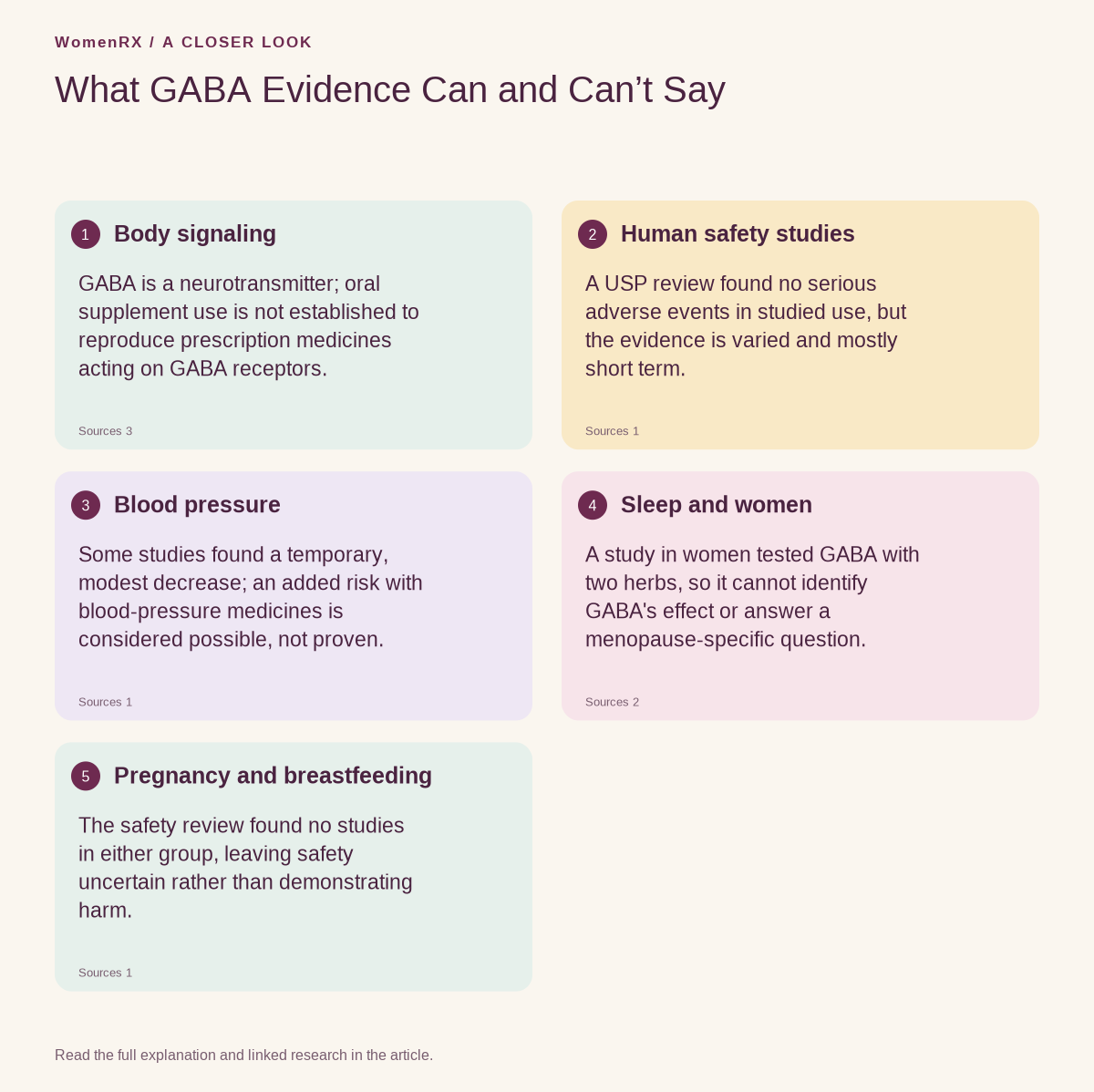
What GABA Evidence Can and Can’t Say
Body signaling: GABA is a neurotransmitter; oral supplement use is not established to reproduce prescription medicines acting on GABA receptors.3
Human safety studies: A USP review found no serious adverse events in studied use, but the evidence is varied and mostly short term.1
Blood pressure: Some studies found a temporary, modest decrease; an added risk with blood-pressure medicines is considered possible, not proven.1
Sleep and women: A study in women tested GABA with two herbs, so it cannot identify GABA's effect or answer a menopause-specific question.2
Pregnancy and breastfeeding: The safety review found no studies in either group, leaving safety uncertain rather than demonstrating harm.1
Read the figure as text
Separate what is known about the body's GABA signaling from short-term supplement safety findings and the limits of sleep research.- Body signaling: GABA is a neurotransmitter; oral supplement use is not established to reproduce prescription medicines acting on GABA receptors.3
- Human safety studies: A USP review found no serious adverse events in studied use, but the evidence is varied and mostly short term.1
- Blood pressure: Some studies found a temporary, modest decrease; an added risk with blood-pressure medicines is considered possible, not proven.1
- Sleep and women: A study in women tested GABA with two herbs, so it cannot identify GABA's effect or answer a menopause-specific question.2
- Pregnancy and breastfeeding: The safety review found no studies in either group, leaving safety uncertain rather than demonstrating harm.1
More questions, answered
Is GABA the same as a prescription medicine that acts on GABA receptors?
No. GABA is a natural neurotransmitter, but taking it as a supplement is not established to have the same effect as a prescription medicine acting on GABA receptors. A review states that oral GABA does not cross the blood-brain barrier. 3
Has GABA been shown to help with menopause-related sleep problems?
This evidence doesn’t establish that. A study in women with sleep disorders tested GABA alongside two herbs, so it can’t isolate GABA’s effect or show a menopause-specific benefit. 2
Sources you can check
- United States Pharmacopeia (USP) Safety Review of Gamma-Aminobutyric Acid (GABA).Oketch-Rabah HA, Madden EF, Roe AL, Betz JM. · Nutrients · 2021Return to first citation
- Effects of a combination of Poria Cocos, Ziziphus spinose, and gamma-aminobutyric acid (GABA) on sleep quality and skin health: A randomized double-blind placebo-controlled clinical trial.Hao Y, Song W, Qu L. · Food science & nutrition · 2024Return to first citation
- The role of GABA in type 1 diabetes.Mick GJ, McCormick KL. · Frontiers in endocrinology · 2024Return to first citation