How to Evaluate GABA Supplement Labels and Claims
A GABA sleep claim is only as useful as the match between the product, the people studied, and the outcome measured.
Check the amount of GABA per serving, every other active ingredient, and whether the study behind a claim tested that same formula and outcome. A short sleep trial in women tested GABA with two herbs, so it can’t show that GABA alone helped. Another trial found no significant effect on its exploratory sleep measure after statistical correction. Neither establishes a standalone benefit for sleep, stress, or mood. 1 2
A supplement label may promise better sleep or a calmer mood, but a study of one formula doesn’t automatically support another product’s claim. For GABA, the useful check is whether the ingredients, participants, and measured outcome in the research match what the label is promising.
First, make the formula visible
Look for the amount of GABA in each serving and the names and amounts of other active ingredients. If the product combines GABA with herbs, the research on that combination can’t tell you which ingredient, or combination of ingredients, accounts for a result.
That distinction applies to a four-week randomized trial of 70 Chinese women ages 25 to 55 who had poor sleep and self-reported skin concerns. The study compared a drink containing GABA, Poria cocos, and Ziziphus spinosa with a placebo. The drink provided 100 mg of GABA per serving, and the combination group had greater improvements than placebo in some sleep measures. The trial does not isolate GABA’s contribution, and it doesn’t establish that a different formula will have the same effect. 2
For a product claiming to match that research, compare the full ingredient list and amounts, not just the word “GABA” on the front. If amounts aren’t clear, you can’t tell whether the product resembles the formula that was studied.
Match the claim to the outcome
“Supports sleep” is a different claim from “supports relaxation” or “improves mood.” Look for research that measured the outcome named in the claim, rather than a proposed biological explanation or a result for a different outcome.
One randomized trial enrolled 52 adults with prediabetes and compared GABA with placebo for 95 days. Sleep quality was one of several secondary measures. After correction for multiple comparisons, the trial found no significant group-level effects among those secondary outcomes, including sleep quality. That result doesn’t answer every possible question about GABA, but it doesn’t demonstrate a sleep benefit in this group either. The abstract doesn’t report a women’s subgroup result. 1
GABA has a role as an inhibitory neurotransmitter in the nervous system, but that biological role alone doesn’t show that an oral supplement changes brain GABA or improves sleep, stress, or mood. 2 The human sleep trials described above don’t establish a standalone GABA benefit for those claims. A product’s mechanism language should not be treated as the same thing as a demonstrated outcome.
Keep women’s-health claims specific
The combination trial is relevant to women because it enrolled women, but it studied one blend, over four weeks, in women selected for poor sleep and skin concerns. It doesn’t show that GABA treats menstrual, pregnancy-related, postpartum, perimenopause, or postmenopause symptoms. The study information doesn’t report results by those life stages. 2
If a label connects GABA to a particular life-stage concern, check whether research tested that concern in people at that stage. A general sleep outcome is not evidence for a hormone-related claim.
Ask what testing and interaction information actually covers
A clinical trial of a specific formula does not verify the identity, amount, or purity of a different product. If quality is a deciding factor, ask the manufacturer what product-specific testing it can document, what was tested, and whether the tested formula is the one being sold. These sleep studies don’t establish quality for products outside the trials. 1 2
The trials also don’t provide medication-interaction guidance. If you take medicines, show a pharmacist the complete label, including herbs and other active ingredients, and ask about that formula rather than GABA in isolation. This research can’t answer whether a particular product is suitable with a particular medicine. 1 2
A quick label audit
- Amount: Is GABA’s amount stated per serving?
- Formula: Are all active ingredients and their amounts clear?
- Study match: Did research test this formula, or just GABA or a different blend?
- Outcome match: Did the study measure the benefit the label claims?
- Population match: Were people like you studied, including the relevant life stage if the claim is specific?
- Quality and medicines: Can the company document testing for this product, and has a pharmacist reviewed the full label if you take medicines?
These checks won’t tell you whether a supplement will work for you. They can show whether its headline claim goes beyond what the specific human study actually tested.
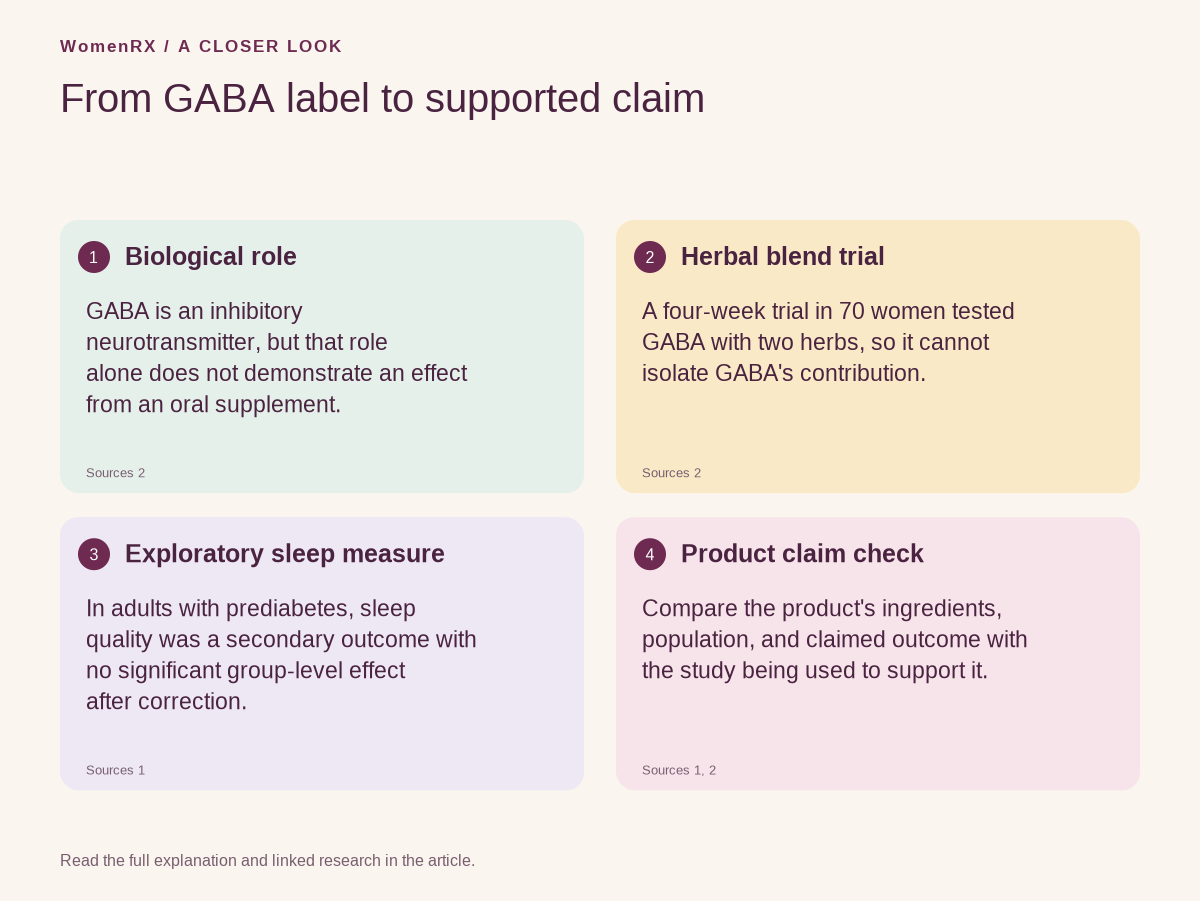
From GABA label to supported claim
Biological role: GABA is an inhibitory neurotransmitter, but that role alone does not demonstrate an effect from an oral supplement.2
Herbal blend trial: A four-week trial in 70 women tested GABA with two herbs, so it cannot isolate GABA's contribution.2
Exploratory sleep measure: In adults with prediabetes, sleep quality was a secondary outcome with no significant group-level effect after correction.1
Product claim check: Compare the product's ingredients, population, and claimed outcome with the study being used to support it.12
Read the figure as text
Use this evidence map to separate a proposed explanation from what human studies actually tested.- Biological role: GABA is an inhibitory neurotransmitter, but that role alone does not demonstrate an effect from an oral supplement.2
- Herbal blend trial: A four-week trial in 70 women tested GABA with two herbs, so it cannot isolate GABA's contribution.2
- Exploratory sleep measure: In adults with prediabetes, sleep quality was a secondary outcome with no significant group-level effect after correction.1
- Product claim check: Compare the product's ingredients, population, and claimed outcome with the study being used to support it.12
Sources you can check
- Effects of γ-aminobutyric acid supplementation on glucose control in adults with prediabetes: A double-blind, randomized, placebo-controlled trial.de Bie TH, Witkamp RF, Balvers MG, Jongsma MA. · The American journal of clinical nutrition · 2023Return to first citation
- Effects of a combination of Poria Cocos, Ziziphus spinose, and gamma-aminobutyric acid (GABA) on sleep quality and skin health: A randomized double-blind placebo-controlled clinical trial.Hao Y, Song W, Qu L. · Food science & nutrition · 2024Return to first citation