GABA After 40: Is There a Different Benefit?
Being over 40 or entering menopause hasn’t been shown to create a special need for GABA supplements.
Neither trial establishes that GABA supplements work differently after 40 or during perimenopause or menopause. One small trial studied GABA alongside exercise in women with obesity; a separate menopause-stage sleep trial tested a five-ingredient supplement that included GABA. Neither compares GABA alone across age or menopause groups. For hot flashes and night sweats, menopause guidance does not recommend supplements as an evidence-based treatment. 1 2 3
What these studies can tell you about age
If you’re over 40 and wondering whether menopause changes the benefits of GABA, neither trial shows that age creates a distinct reason to take it. A change in hormones or brain signaling during menopause doesn’t, by itself, show that taking GABA as a supplement will help.
The useful comparison is between what two different studies tested, not between general adults and a menopause group. One studied GABA with exercise in women with obesity; the other studied a multi-ingredient sleep supplement in perimenopausal and postmenopausal women. Because the studies tested different outcomes and neither tested GABA alone in a way that allows an age-group comparison, they can’t establish whether age or menopause changes GABA’s effects. 2 3
What a small women’s trial can, and can’t, tell you
A randomized, placebo-controlled trial included 26 women with obesity. Everyone followed an exercise program, and participants also received either GABA or placebo for 90 days. Some measures improved within the GABA group, including BMI and waist circumference. But the study reported no between-group differences in body mass, body fat, fat mass, or several other measures. Because GABA was paired with exercise, the trial also can’t tell us what GABA would do on its own. The women’s ages and menopause status aren’t specified in the abstract, so it doesn’t answer whether results differ after 40. 2
That’s a useful distinction: a change seen within one group isn’t the same as a demonstrated advantage over placebo. This small study doesn’t establish GABA as a weight-loss supplement or a treatment for menopause symptoms.
The menopause sleep study tested a blend
A randomized trial enrolled 128 perimenopausal and postmenopausal women with moderate-to-severe sleep disturbance and minimal hot flashes; 127 completed it. The trial tested a supplement containing GABA, L-theanine, magnesium, S-adenosyl methionine, and propyl gallate. After three weeks, the blend improved reported sleep measures compared with placebo. Because several ingredients were combined, the result can’t tell us whether GABA contributed, whether another ingredient mattered more, or whether GABA alone would help. The participants also had few vasomotor symptoms, so the study doesn’t show that the blend treats hot flashes or night sweats. 3
This is direct research in perimenopausal and postmenopausal women, but it’s not direct evidence for GABA as a standalone supplement. The abstract doesn’t provide an age-based comparison. A trial that isolates GABA and reports results by age or menopause stage would be needed to answer that question more clearly. 3
Hot flashes are a different question from sleep
For bothersome hot flashes and night sweats, the North American Menopause Society’s 2023 statement reviewed nonhormonal treatments and did not recommend supplements or herbal remedies as evidence-based options. That is guidance about the category, not a GABA-specific trial result. The statement supports other options for vasomotor symptoms, including cognitive behavioral therapy, clinical hypnosis, and certain prescription treatments. 1
So if your main reason for considering GABA is hot flashes, current guidance doesn’t support choosing a supplement for that purpose. If sleep is the concern, the combination-product trial is a reason to keep the question open, not proof that GABA by itself works.
A practical way to weigh the evidence
Before buying GABA, ask what you’re hoping it will address. For menopause-related hot flashes or night sweats, current research doesn’t support GABA as a treatment. For sleep, there’s a positive study of a multi-ingredient product in perimenopausal and postmenopausal women with minimal hot flashes, but it doesn’t identify GABA as the active ingredient. The available research doesn’t establish a benefit specific to being over 40.
In short, menopause-related changes in the body shouldn’t be mistaken for evidence that a GABA supplement will correct them. The key gap is whether GABA alone has a demonstrated benefit in women at a defined life stage, and whether that benefit differs by age or menopause status.
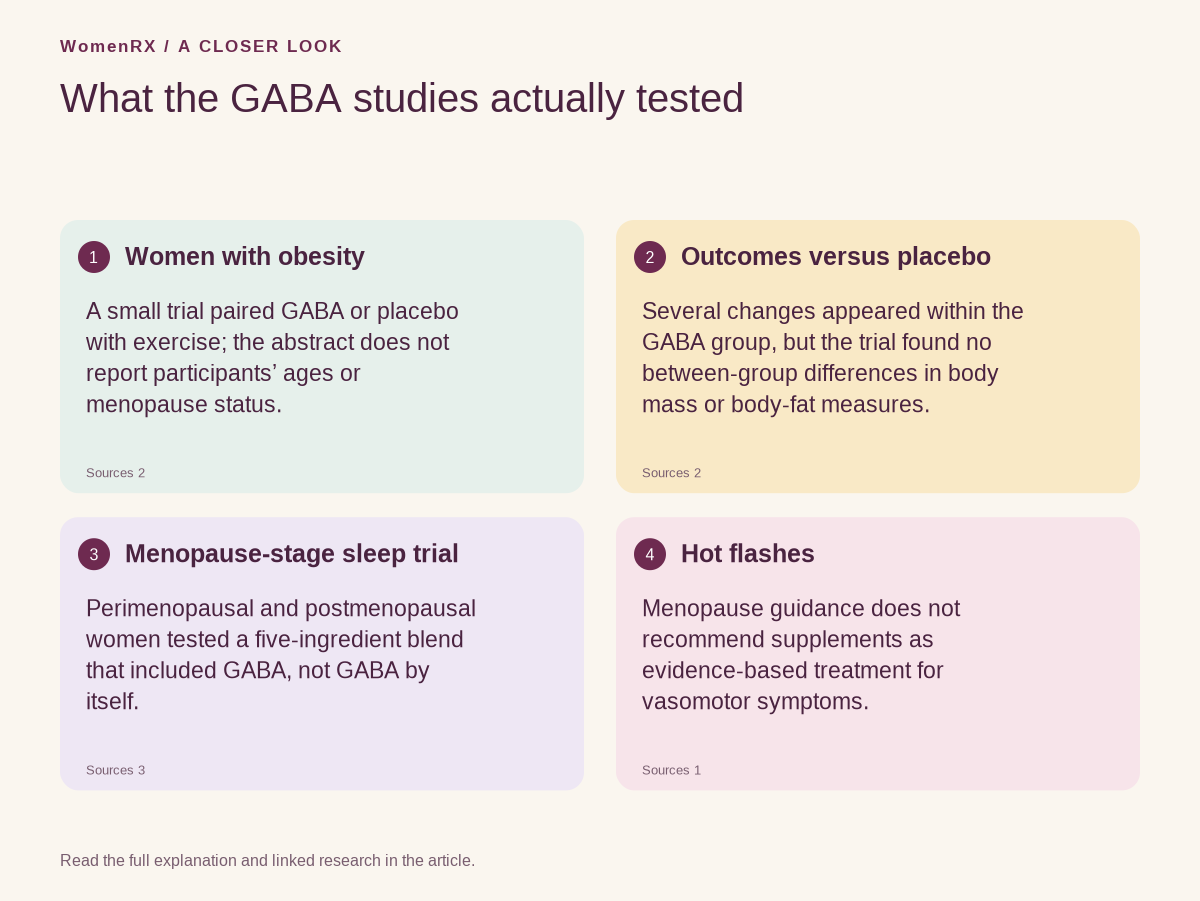
What the GABA studies actually tested
Women with obesity: A small trial paired GABA or placebo with exercise; the abstract does not report participants’ ages or menopause status.2
Outcomes versus placebo: Several changes appeared within the GABA group, but the trial found no between-group differences in body mass or body-fat measures.2
Menopause-stage sleep trial: Perimenopausal and postmenopausal women tested a five-ingredient blend that included GABA, not GABA by itself.3
Hot flashes: Menopause guidance does not recommend supplements as evidence-based treatment for vasomotor symptoms.1
Read the figure as text
These studies tested different questions. Neither compares GABA alone across age or menopause groups.- Women with obesity: A small trial paired GABA or placebo with exercise; the abstract does not report participants’ ages or menopause status.2
- Outcomes versus placebo: Several changes appeared within the GABA group, but the trial found no between-group differences in body mass or body-fat measures.2
- Menopause-stage sleep trial: Perimenopausal and postmenopausal women tested a five-ingredient blend that included GABA, not GABA by itself.3
- Hot flashes: Menopause guidance does not recommend supplements as evidence-based treatment for vasomotor symptoms.1
More questions, answered
Does menopause change how GABA works in the brain?
Hormonal changes can affect neurotransmitter systems, including GABA-related signaling. That biological connection doesn’t establish that an oral GABA supplement improves sleep, mood, or menopause symptoms. 4
Has GABA been shown to reduce hot flashes?
The evidence cited here doesn’t establish that GABA reduces hot flashes. Menopause guidance does not recommend supplements as evidence-based treatment for vasomotor symptoms, and the menopause-stage sleep trial tested a multi-ingredient blend in women with minimal hot flashes. 1 3
Sources you can check
- The 2023 nonhormone therapy position statement of The North American Menopause Society.Menopause (New York, N.Y.) · 2023Return to first citation
- Effects of combined gamma aminobutyric acid supplementation and exercise training on the body composition of women: A randomized double-blind trial.de Medeiros Pires LV, de Barros Martins A, Trindade CMO, Dos Santos Baleeiro R, Peixoto TG, Teixeira E Silva VL, de Castro Pinto KM, Guimarães Drummond E Silva F, Coelho DB, de Oli... · Clinical nutrition ESPEN · 2025Return to first citation
- Nonsedating neurotransmitter-modulating supplement for nonvasomotor sleep disturbance in menopause.Carbonneau S, Mysliwiec V, Doyle AL, Stratton M, Dweck A, Tartar J, Alesi M, Mason L, Komorowski J, VanDusseldorp TA. · Menopause (New York, N.Y.) · 2026Return to first citation
- Menopause and Mental Health.Crockett C, Lichtveld G, Macdonald R, Newson L, Rampling KJ. · Advances in therapy · 2026Return to first citation