GABA Supplements for Sleep or Stress: How to Weigh the Evidence
A small trial tested GABA on its own in women, but most of the other sleep findings come from multi-ingredient products that can’t show what GABA contributed.
Oral GABA has limited, mixed-context human evidence, not established proof that it treats insomnia or stress. One small trial tested GABA alongside exercise in women; other studies tested blends containing GABA and additional ingredients, including in menopausal women. Those blend results can’t be credited to GABA alone. Before trying a product, check every ingredient against your medicines and consider what else could address the sleep or stress problem.
Start with what the product actually contains
A bottle labeled “GABA for sleep” may not reflect what researchers have tested. The most useful distinction is whether a study tested GABA by itself or included it in a blend. When a product combines several ingredients, an improvement doesn’t tell us which ingredient helped, or whether the combination was necessary.
A small randomized trial tested GABA supplementation in women. It included 30 sedentary women with overweight or obesity, and everyone in both groups took part in physical exercise. Over 90 days, the GABA group was reported to improve on measures including sleep efficiency and sleep quality. This is a direct human finding, but the small, specific study can’t establish how well GABA works for women generally, or whether it helps without the exercise program. The abstract also doesn’t provide enough detail to judge how large or meaningful the sleep changes were for participants. 4
Sleep results from blends don’t isolate GABA
A four-week trial in 70 Chinese women with sleep disorders tested a drink containing GABA alongside two herbal extracts, compared with placebo. The combined product showed greater improvements in sleep duration and sleep-quality scores than placebo. That is relevant evidence about that particular blend, but it doesn’t show that GABA alone produced the benefit. 3
A trial in perimenopausal and postmenopausal women also reported improved sleep with a supplement containing GABA, L-theanine, magnesium, and other ingredients. Participants had moderate-to-severe sleep disturbance and few hot flashes or night sweats. Because the product combined ingredients, the study doesn’t establish a GABA-specific effect or show that GABA treats sleep disruption related to menopause. 2
So the evidence differs by outcome and design: a small standalone-GABA trial offers an early signal in one specific group of women; combination studies offer findings about blends, not GABA alone. None of these results establish oral GABA as a treatment for insomnia, anxiety, or hormone-related sleep symptoms.
What this means if stress is the concern
The women’s GABA trial reported changes in emotional measures as well as sleep measures, but it was small and included exercise in both groups. It doesn’t establish GABA as a treatment for an anxiety disorder or show that a supplement addresses the causes of ongoing stress. 4
Stress can be short-lived or ongoing, and it can affect sleep and daily functioning. Practical options MedlinePlus lists for managing long-term stress include regular exercise, relaxation practices such as breathing or meditation, getting enough sleep, limiting excess caffeine, and asking family or friends for support. These are options to consider alongside, or instead of, a supplement, not proof that any one approach will resolve every cause of poor sleep. 1
A short checklist before you choose
- Check whether it’s GABA alone or a blend. For a blend, look at every active ingredient. The study findings for a multi-ingredient product cannot tell you that GABA caused the result.
- Review medicines and other supplements. The sleep studies described above don’t establish which medicines interact with oral GABA or how safe it is for people taking them. Show a pharmacist or clinician the full product label and your medication list before adding it.
- Match the evidence to your situation. A small study in sedentary women with overweight or obesity, or a study of menopausal women using a multi-ingredient blend, may not apply to your particular sleep or stress concern.
- Don’t let a supplement stand in for help with persistent symptoms. MedlinePlus advises seeking help for severe symptoms lasting two weeks or more, including trouble sleeping, difficulty focusing, or being unable to do usual daily activities. 1
If you’re comparing products, a label that clearly lists each ingredient makes it easier to ask specific questions. The evidence doesn’t support choosing a product on the promise that GABA is proven to treat sleep or stress; it supports looking closely at what was tested, in whom, and as part of what else.
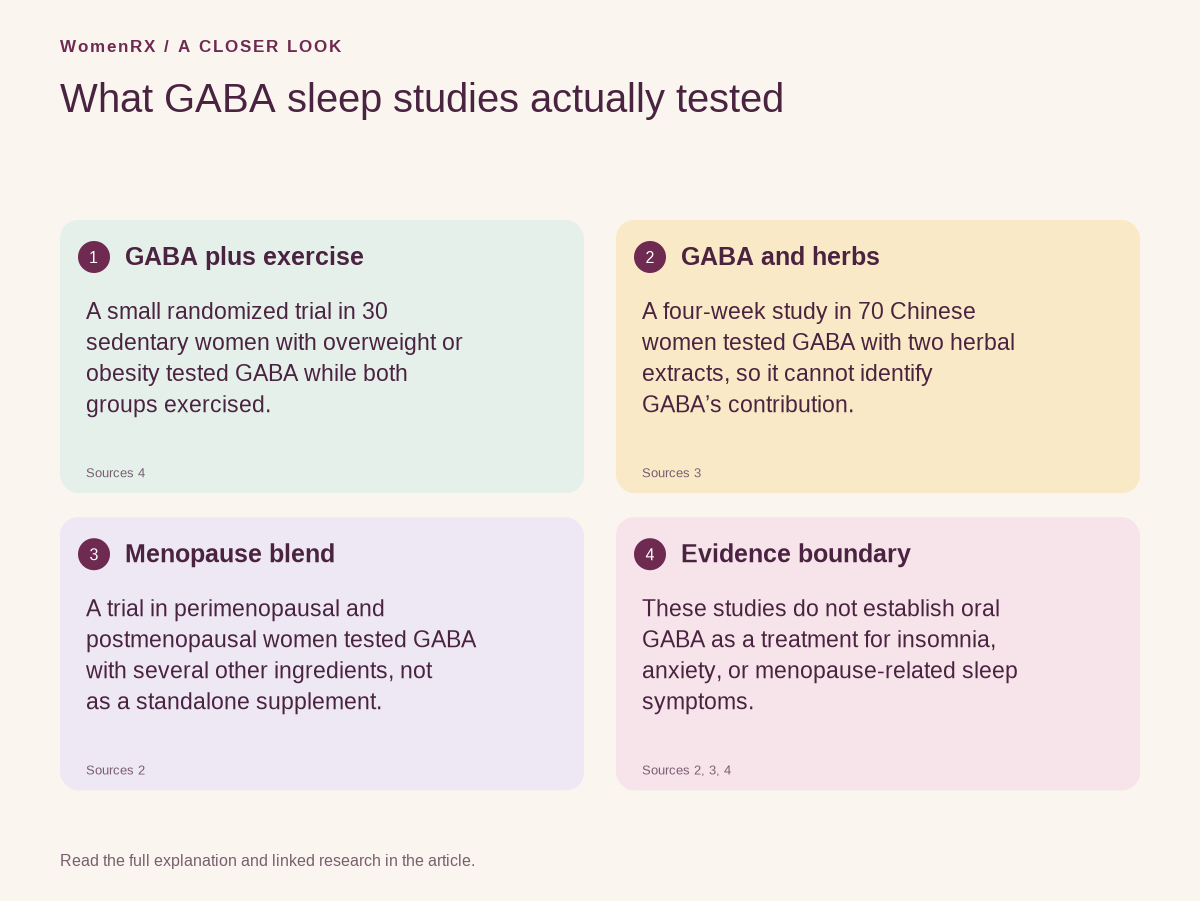
What GABA sleep studies actually tested
GABA plus exercise: A small randomized trial in 30 sedentary women with overweight or obesity tested GABA while both groups exercised.4
GABA and herbs: A four-week study in 70 Chinese women tested GABA with two herbal extracts, so it cannot identify GABA’s contribution.3
Menopause blend: A trial in perimenopausal and postmenopausal women tested GABA with several other ingredients, not as a standalone supplement.2
Evidence boundary: These studies do not establish oral GABA as a treatment for insomnia, anxiety, or menopause-related sleep symptoms.234
Read the figure as text
The standalone-GABA trial and the blend trials discussed here answer different questions.- GABA plus exercise: A small randomized trial in 30 sedentary women with overweight or obesity tested GABA while both groups exercised.4
- GABA and herbs: A four-week study in 70 Chinese women tested GABA with two herbal extracts, so it cannot identify GABA’s contribution.3
- Menopause blend: A trial in perimenopausal and postmenopausal women tested GABA with several other ingredients, not as a standalone supplement.2
- Evidence boundary: These studies do not establish oral GABA as a treatment for insomnia, anxiety, or menopause-related sleep symptoms.234
More questions, answered
Is GABA proven to help with menopause-related sleep changes?
No GABA-specific benefit is established here. A trial in perimenopausal and postmenopausal women found improved sleep with a multi-ingredient supplement containing GABA, but it could not determine which ingredient contributed to the result. 2
What GABA dose should I look for?
These studies don’t establish a dose for treating sleep or stress. One small trial tested GABA in women, and another tested GABA as part of a blend; those study designs aren’t enough to recommend a dose for you. 3 4
Sources you can check
- Stress: MedlinePlusAccessed 2026-09-25Return to first citation
- Nonsedating neurotransmitter-modulating supplement for nonvasomotor sleep disturbance in menopause.Carbonneau S, Mysliwiec V, Doyle AL, Stratton M, Dweck A, Tartar J, Alesi M, Mason L, Komorowski J, VanDusseldorp TA. · Menopause (New York, N.Y.) · 2026Return to first citation
- Effects of a combination of Poria Cocos, Ziziphus spinose, and gamma-aminobutyric acid (GABA) on sleep quality and skin health: A randomized double-blind placebo-controlled clinical trial.Hao Y, Song W, Qu L. · Food science & nutrition · 2024Return to first citation
- GABA Supplementation, Increased Heart-Rate Variability, Emotional Response, Sleep Efficiency and Reduced Depression in Sedentary Overweight Women Undergoing Physical Exercise: Placebo-Controlled, Randomized Clinical Trial.Guimarães AP, Seidel H, Pires LVM, Trindade CO, Baleeiro RDS, Souza PM, Silva FGDE, Coelho DB, Becker LK, Oliveira EC. · Journal of dietary supplements · 2024Return to first citation