What Magnesium Citrate Research Actually Shows
Research on magnesium citrate is specific to a few settings, including combination bowel preparation and a small study of bone turnover in postmenopausal women.
Magnesium-containing medicines are used as laxatives, but that doesn’t establish magnesium citrate alone as a treatment for routine constipation. Studies of sodium picosulfate with magnesium citrate concern bowel cleansing before procedures. Beyond bowel care, a small study in postmenopausal women reported suppressed bone turnover with citrate, not fewer fractures or a proven osteoporosis treatment. 1 4
Magnesium-containing laxatives are not proof for citrate alone
Magnesium-containing medicines are used as laxatives. The NIH describes the laxative effect of unabsorbed magnesium salts as coming from their osmotic activity in the intestine and colon, along with stimulation of gastric motility. 1 But that general information about magnesium salts does not establish that magnesium citrate alone treats routine constipation.
The difference matters because some research tests sodium picosulfate with magnesium citrate as a bowel-cleansing medicine before a procedure. In a review of six studies involving 3,285 patients, this combination was compared with polyethylene glycol preparations for colonoscopy cleansing. That is evidence about preparing the bowel for a procedure, not about treating everyday constipation with magnesium citrate alone. 4 A randomized study in 220 adults undergoing capsule procedures also tested a combination bowel-prep regimen, with cleansing results that differed from polyethylene glycol and tolerability that favored the magnesium-citrate combination. It still doesn’t answer whether a citrate supplement helps ongoing constipation. 5
The bowel-preparation abstracts don’t report sex-specific results, so they don’t show whether the findings differ for women. 4 5
Constipation can mean fewer than three bowel movements a week, hard or dry stool, or painful passing. 2 If you’re considering magnesium for this problem, check the product category: a bowel-prep medicine, a laxative, and a dietary supplement are not interchangeable just because magnesium citrate appears in the name.
What women-specific citrate research has studied
The clearest citrate-specific study beyond bowel care involved 20 postmenopausal women with osteoporosis. They received 290 mg of elemental magnesium as magnesium citrate daily for 30 days or placebo. The study reported suppressed bone turnover compared with placebo, suggesting a change in bone remodeling. But that is not the same as showing fewer fractures, stronger bones, or a proven treatment for osteoporosis. The study was small and short. 1
That result is relevant to postmenopause, but it shouldn’t be extended to cycling years, perimenopause, pregnancy, or postpartum. It also doesn’t establish that citrate prevents osteoporosis in women without the condition.
Why “magnesium helps” doesn’t always mean “citrate helps”
Magnesium has been studied for other outcomes, but findings about magnesium in general don’t automatically establish benefits from citrate. For example, migraine-prevention studies summarized by the NIH involved magnesium supplements without establishing citrate as the tested form. The same distinction applies to blood pressure research, where the reported trials evaluated magnesium supplementation rather than demonstrating a citrate-specific effect. 1
Diabetes research is even more clearly tied to other forms in the examples summarized by the NIH: studies tested magnesium oxide, magnesium chloride, or magnesium aspartate. Those results can’t be used as proof that magnesium citrate improves blood sugar. 1
Citrate may be absorbed more readily than magnesium oxide in small studies, but better absorption is not proof of a particular health benefit. It tells you something about the form, not whether it prevents migraines, lowers blood pressure, or treats a bone condition. 1
What to check before using a magnesium product
Look at the purpose and the amount of elemental magnesium on the label. The labeled amount refers to the magnesium itself, not the total weight of the citrate compound. 1 High amounts from supplements or medicines can cause diarrhea, nausea, and abdominal cramping; excess magnesium can be especially risky when kidney function is impaired because the kidneys help remove it. 1
Magnesium can also reduce absorption of oral bisphosphonates and certain antibiotics, including doxycycline, ciprofloxacin, and levofloxacin. If you take one of these medicines, check the product’s timing instructions with a pharmacist rather than assuming the combination is fine. 1
Pregnancy is a separate question. Constipation is common during pregnancy, but magnesium intake recommendations for pregnancy don’t establish that a magnesium citrate laxative is safe or effective for treating it. 1 3 Don’t use general magnesium findings as pregnancy-specific evidence.
The most useful takeaway: magnesium-containing medicines have a laxative role, and magnesium citrate has been studied as part of combination bowel-preparation regimens. Those findings do not establish citrate alone for routine constipation. One small study examined bone turnover in postmenopausal women; for other advertised benefits, check whether the research actually tested citrate and the outcome you care about.
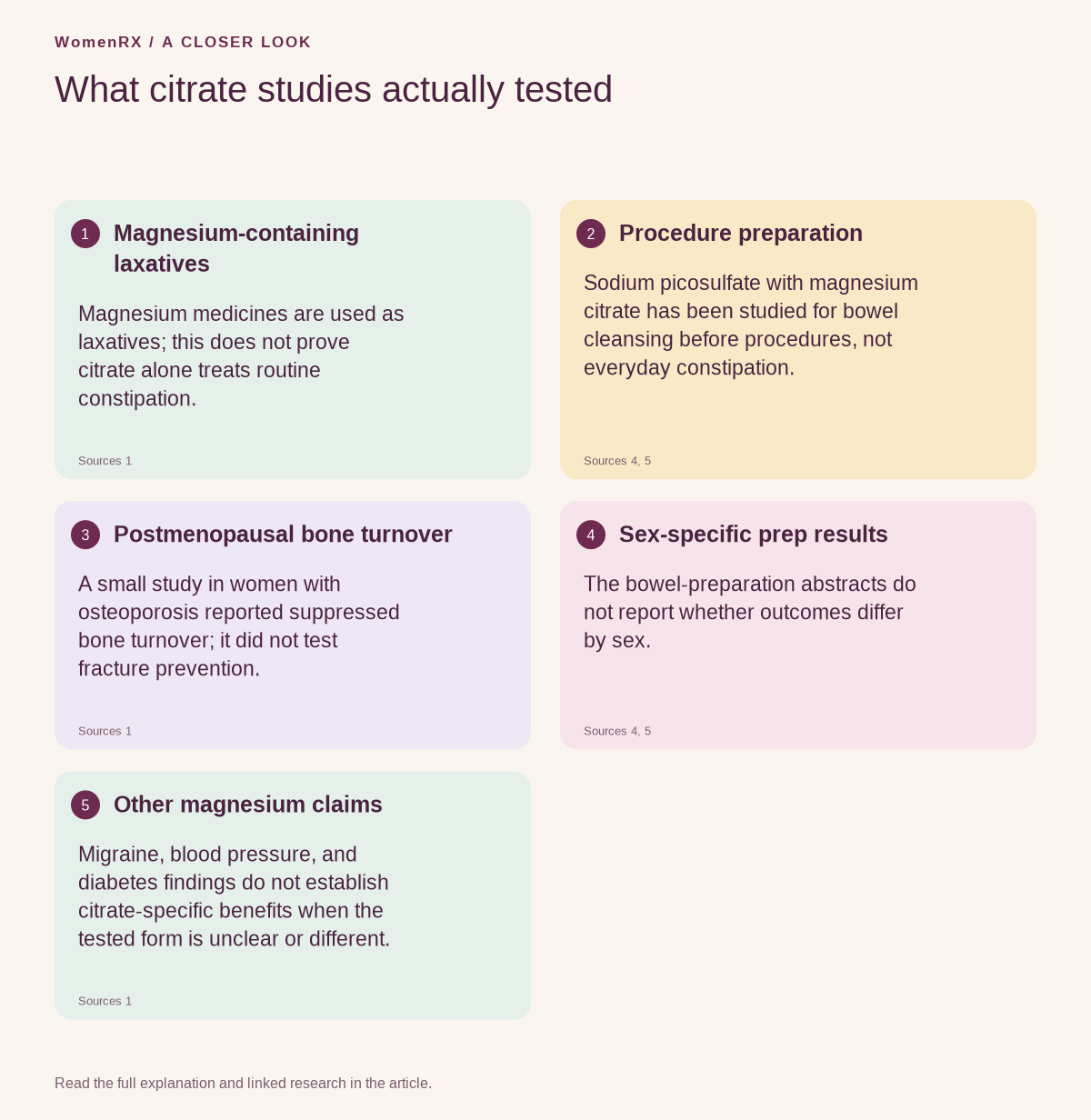
What citrate studies actually tested
Magnesium-containing laxatives: Magnesium medicines are used as laxatives; this does not prove citrate alone treats routine constipation.1
Procedure preparation: Sodium picosulfate with magnesium citrate has been studied for bowel cleansing before procedures, not everyday constipation.45
Postmenopausal bone turnover: A small study in women with osteoporosis reported suppressed bone turnover; it did not test fracture prevention.1
Sex-specific prep results: The bowel-preparation abstracts do not report whether outcomes differ by sex.45
Other magnesium claims: Migraine, blood pressure, and diabetes findings do not establish citrate-specific benefits when the tested form is unclear or different.1
Read the figure as text
These evidence categories separate magnesium-containing laxative use from combination procedure preparation and other claims where the form or outcome differs.- Magnesium-containing laxatives: Magnesium medicines are used as laxatives; this does not prove citrate alone treats routine constipation.1
- Procedure preparation: Sodium picosulfate with magnesium citrate has been studied for bowel cleansing before procedures, not everyday constipation.45
- Postmenopausal bone turnover: A small study in women with osteoporosis reported suppressed bone turnover; it did not test fracture prevention.1
- Sex-specific prep results: The bowel-preparation abstracts do not report whether outcomes differ by sex.45
- Other magnesium claims: Migraine, blood pressure, and diabetes findings do not establish citrate-specific benefits when the tested form is unclear or different.1
More questions, answered
Does a study of magnesium citrate prove it prevents osteoporosis?
No. A small, short study in postmenopausal women with osteoporosis reported suppressed bone turnover compared with placebo. It did not establish that citrate prevents fractures or treats osteoporosis. 1
Are colonoscopy-prep results evidence for everyday constipation?
Not by themselves. The cited studies tested bowel-preparation combinations before procedures, with bowel cleansing as the outcome. They don’t establish the effect of a magnesium citrate supplement on ordinary or chronic constipation. 4 5
Sources you can check
- Magnesium - Health Professional Fact SheetAccessed 2026-09-25Return to first citation
- Constipation | MedlinePlusAccessed 2026-09-25Return to first citation
- Constipation - NHSAccessed 2026-09-25Return to first citation
- Efficacy and safety of split-dose ultra-low-volume polyethylene glycol with ascorbic acid versus sodium picosulfate with magnesium citrate for bowel preparation: a systematic review and meta-analysis.Abdallfatah A, Hageen AW, Albader D, Al-Tamimi A, Alsalumi K, Alzmmam A, Abdullah M, Alreshaid L, Aldhuwayhi S, Almarri N, Fallatah W, Altamimi A. · European journal of gastroenterology & hepatology · 2026Return to first citation
- Efficacy of 1 L PEG Ascorbate vs Sodium Picosulfate With Magnesium Citrate Bowel Preparations for Capsule Colonoscopy and Pan-Intestinal Capsule Endoscopy: A Prospective Study.Gonçalves JC, Souto M, Magalhães J, Rosa B, Cotter J. · Clinical and translational gastroenterology · 2026Return to first citation