When Should You Take Magnesium Citrate?
The right timing depends more on the product and your other medicines than on choosing morning or bedtime.
For a regular magnesium citrate supplement, follow that product’s directions; morning and bedtime aren’t interchangeable rules for every product or purpose. Magnesium can cause diarrhea, nausea, or stomach cramps, and it can interfere with some medicines if taken too close together. Check the label and ask a pharmacist about spacing if you take an oral antibiotic or bisphosphonate. 1
First, check what kind of product you have
“Magnesium citrate” may describe a dietary supplement, or it may be part of a medicine intended to work as a laxative or bowel preparation. Those aren’t automatically the same product or use. Start by identifying the package and why you’re taking it. If it’s a bowel-prep product for a colonoscopy, use the schedule provided for your procedure rather than advice meant for a daily supplement. Colonoscopy research examines particular preparation products and regimens, not routine supplement timing. 2 3 4
Morning or night? Let the product lead
There isn’t one clock time that fits every magnesium citrate product. The NIH Office of Dietary Supplements describes magnesium supplements and magnesium-containing medicines, but its guidance does not set a universal morning, evening, or with-food schedule for magnesium citrate supplements. Follow your own label rather than assuming bedtime is better or that taking it with a meal will prevent side effects. 1
If the label allows a choice of time, consider whether the product’s effects would disrupt your day or sleep. Magnesium supplements and medicines can cause diarrhea, nausea, and abdominal cramping, particularly at higher amounts. Magnesium also acts as a laxative in some medicines. If you’re having uncomfortable effects, changing the time may not solve the underlying issue; ask a pharmacist about the product and the amount you’re taking. 1
Medicine spacing can matter
Magnesium can reduce absorption of some oral medicines. For oral bisphosphonates, used to treat osteoporosis, NIH guidance says magnesium-rich supplements or medicines taken at least two hours before or after the bisphosphonate can minimize the interaction. For tetracycline or quinolone antibiotics, the guidance says to take the antibiotic at least two hours before, or four to six hours after, a magnesium-containing supplement. Check your specific medicine’s instructions with a pharmacist before applying a spacing rule, since its directions may also shape the schedule. 1
Other common medicines raise a different question: they can affect magnesium levels without creating a specific timing rule in this guidance. Long-term use of proton pump inhibitors, such as some medicines for reflux, can be associated with low magnesium. Loop and thiazide diuretics can increase magnesium loss in urine, while potassium-sparing diuretics can reduce it. If you take one of these regularly, ask whether your magnesium intake needs review rather than trying to solve the issue by taking your supplement at a different hour. 1
Pregnancy and kidney health deserve a closer look
Magnesium intake recommendations vary by life stage, including during pregnancy. 1 As a practical precaution, if you’re pregnant or planning a pregnancy, consider asking your prenatal care team or pharmacist to review the exact product alongside your medicines and other supplements. That’s especially useful if you’re treating constipation or preparing for a procedure, because the product’s purpose and directions matter.
The kidneys help remove excess magnesium. NIH guidance notes that the risk of magnesium toxicity is higher with impaired kidney function or kidney failure. If you have kidney disease, check with your care team before using magnesium citrate rather than choosing a timing or amount on your own. 1
A practical order of operations
Identify whether you have a supplement, laxative, or colonoscopy preparation; read the directions for that product and use; then check for medicine conflicts. If none apply and the label leaves timing open, there’s no need to treat morning or bedtime as a special rule. The useful question is whether the product fits your intended use and your medication schedule.
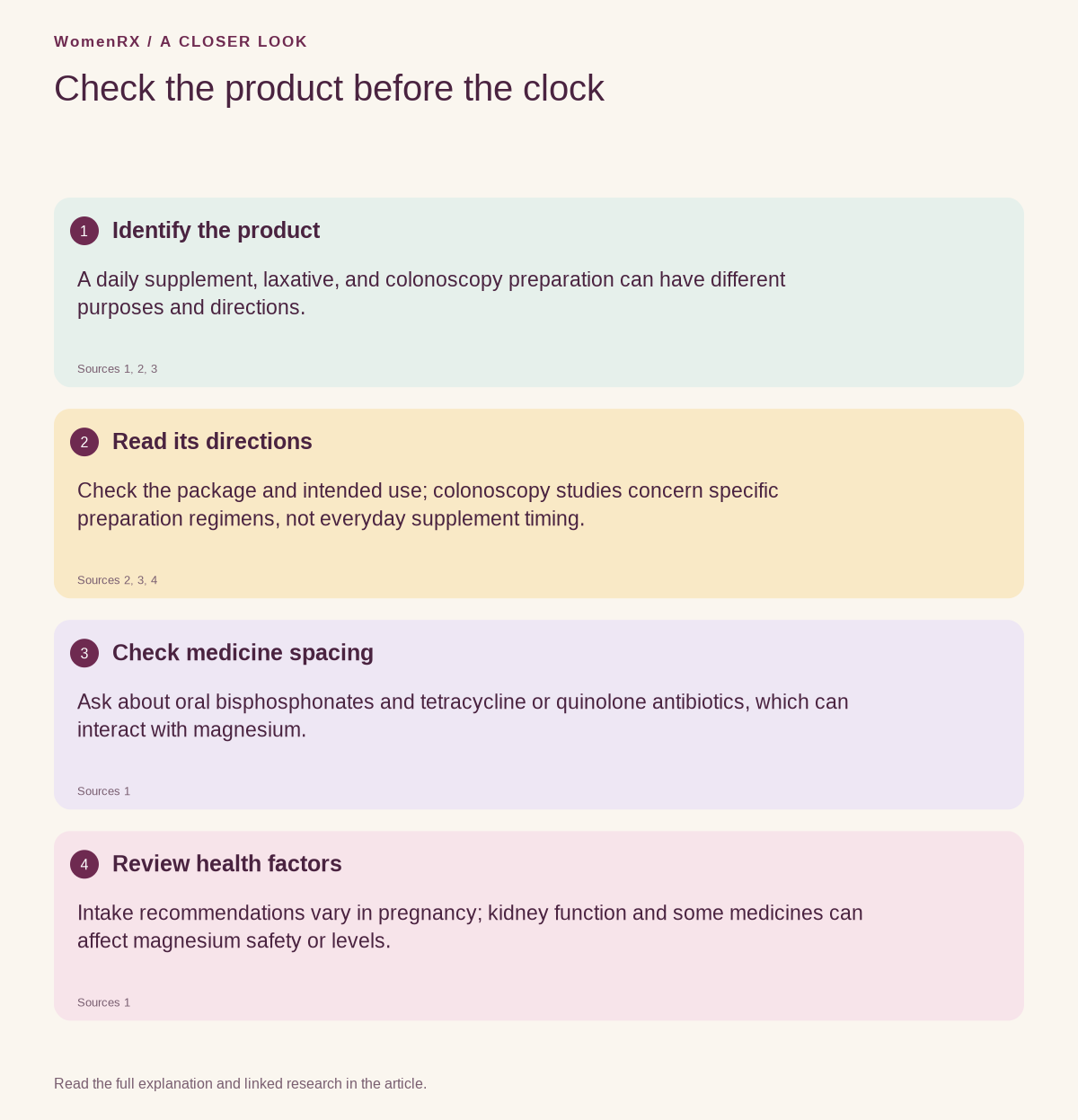
Check the product before the clock
Identify the product: A daily supplement, laxative, and colonoscopy preparation can have different purposes and directions.123
Read its directions: Check the package and intended use; colonoscopy studies concern specific preparation regimens, not everyday supplement timing.234
Check medicine spacing: Ask about oral bisphosphonates and tetracycline or quinolone antibiotics, which can interact with magnesium.1
Review health factors: Intake recommendations vary in pregnancy; kidney function and some medicines can affect magnesium safety or levels.1
Read the figure as text
Use this sequence to distinguish a supplement from a laxative or bowel preparation, then check for medicine-spacing needs.- Identify the product: A daily supplement, laxative, and colonoscopy preparation can have different purposes and directions.123
- Read its directions: Check the package and intended use; colonoscopy studies concern specific preparation regimens, not everyday supplement timing.234
- Check medicine spacing: Ask about oral bisphosphonates and tetracycline or quinolone antibiotics, which can interact with magnesium.1
- Review health factors: Intake recommendations vary in pregnancy; kidney function and some medicines can affect magnesium safety or levels.1
More questions, answered
Should you take magnesium citrate with food?
The guidance cited here does not establish a universal with-food rule for magnesium citrate supplements. Check your product’s directions rather than assuming food is required or will prevent diarrhea, nausea, or cramps. 1
Does magnesium citrate help you sleep better if taken at night?
The guidance here does not establish bedtime as a way to improve sleep. Choose timing based on the product instructions and any medicine-spacing needs, not an assumed sleep benefit.
Sources you can check
- Magnesium - Health Professional Fact SheetAccessed 2026-09-25Return to first citation
- Split-dose administration of a dual-action, low-volume bowel cleanser for colonoscopy: the SEE CLEAR I study.Rex DK, Katz PO, Bertiger G, Vanner S, Hookey LC, Alderfer V, Joseph RE. · Gastrointestinal endoscopy · 2013Return to first citation
- A dual-action, low-volume bowel cleanser administered the day before colonoscopy: results from the SEE CLEAR II study.Katz PO, Rex DK, Epstein M, Grandhi NK, Vanner S, Hookey LC, Alderfer V, Joseph RE. · The American journal of gastroenterology · 2013Return to first citation
- Optimal bowel preparation for colonoscopy.Tamai N, Sumiyama K. · Digestive endoscopy : official journal of the Japan Gastroenterological Endoscopy Society · 2025Return to first citation