Magnesium Citrate: Uses, Side Effects, and Safe Use
Magnesium citrate can be a mineral supplement or part of a bowel-cleansing medicine, so the product and purpose matter as much as the name.
Magnesium citrate supplements and magnesium-containing laxatives aren’t interchangeable by purpose or dose. Supplement labels report elemental magnesium, while a studied colonoscopy preparation combines magnesium citrate with another laxative. Magnesium can cause diarrhea, nausea, or cramps; impaired kidney function raises the risk of magnesium building up. Check the exact product and its intended use before taking it. 1 4
Start with the product’s purpose
“Magnesium citrate” names a form of magnesium, not one standardized product or dose. A dietary supplement is intended to add magnesium. Some laxatives contain magnesium, and a colonoscopy preparation may combine magnesium citrate with another laxative. Those products have different purposes; the name alone doesn’t tell you how much to take or how to use it. 1 4
For a supplement, the Supplement Facts panel lists the amount of elemental magnesium, not the weight of the entire magnesium citrate compound. Use that figure when checking how much magnesium a supplement provides. Don’t use a supplement’s serving size to work out a laxative dose, or borrow directions for bowel preparation as if they applied to a supplement. 1
One clinical trial studied sodium picosulfate combined with magnesium citrate as a colonoscopy bowel preparation. That combination and use are not evidence for the directions, dose, or safety of every magnesium citrate product used for constipation. 4
Why magnesium can loosen stool
Magnesium salts that remain unabsorbed in the intestine draw water into the bowel and stimulate gut movement. That laxative effect can bring on diarrhea, nausea, or abdominal cramping, particularly with high amounts from supplements or medicines. If diarrhea is heavy or persistent, fluid loss can become a concern. 1 3
The adult upper limit of 350 mg a day applies to magnesium from supplements and medicines, not magnesium naturally present in food. It is a general limit for healthy people, not a dosing guide for treating constipation or preparing for a colonoscopy. Because some magnesium medicines work by causing a laxative effect, don’t use that limit to calculate a dose for a particular laxative product. 1
Kidney function changes the safety picture
Your kidneys help remove excess magnesium. If kidney function is impaired, magnesium can accumulate, increasing the risk of toxicity. Very high magnesium levels can cause problems ranging from low blood pressure and lethargy to breathing difficulty and an irregular heartbeat. Kidney disease or a history of kidney failure is a reason to check the specific product and intended use with a clinician or pharmacist before taking magnesium. 1
Check medicines, too
Magnesium can reduce absorption of some oral antibiotics, including doxycycline, ciprofloxacin, and levofloxacin, and of oral bisphosphonates such as alendronate. Ask a pharmacist how to time magnesium around these medicines rather than taking them together by default. Some diuretics can increase magnesium loss, while others reduce it; long-term use of some proton pump inhibitors can also lower magnesium levels. 1
A small crossover study in 15 healthy adults also tested magnesium citrate taken with levothyroxine. Thyroxine exposure was 7% lower with citrate, but the difference wasn’t statistically significant. The study’s authors advised people taking levothyroxine to separate it from magnesium-containing products, especially when keeping thyroid levels in a narrow range matters. 5
If constipation is the reason
Constipation can have several causes, including medicines. A change in your usual bowel habits deserves attention, and constipation that keeps returning is a reason to look beyond repeated laxative use. Fiber-rich foods, regular movement, and making time to use the bathroom when you feel the urge are general measures that may help. 2
If you have a magnesium citrate product labeled for constipation, don’t infer its directions or cautions from a supplement label or research on colonoscopy preparations. Read the directions on that specific package rather than assuming the products are substitutes. If you’re pregnant or breastfeeding, confirm the intended product and amount with your care team; magnesium needs and supplemental limits depend on life stage, but that doesn’t establish a special benefit for pregnancy-related constipation. 1
The practical check is simple: identify whether the product you’re holding is a supplement or a medicine, then check what that particular product is meant to do. If you take regular medicines or have impaired kidney function, bring its exact package or label to a pharmacist or clinician before using it.
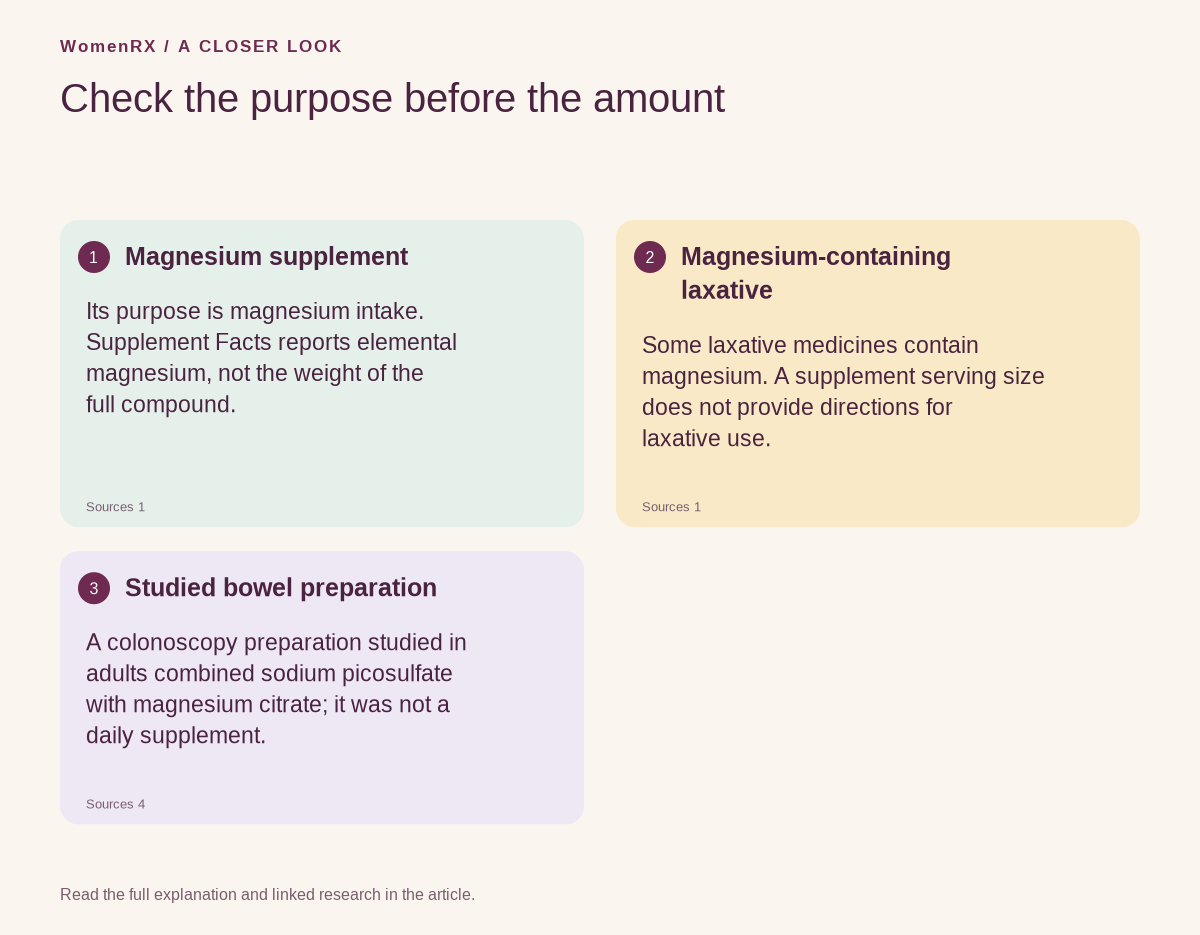
Check the purpose before the amount
Magnesium supplement: Its purpose is magnesium intake. Supplement Facts reports elemental magnesium, not the weight of the full compound.1
Magnesium-containing laxative: Some laxative medicines contain magnesium. A supplement serving size does not provide directions for laxative use.1
Studied bowel preparation: A colonoscopy preparation studied in adults combined sodium picosulfate with magnesium citrate; it was not a daily supplement.4
Read the figure as text
A shared ingredient name does not make supplement information or bowel-preparation directions transferable to another product.- Magnesium supplement: Its purpose is magnesium intake. Supplement Facts reports elemental magnesium, not the weight of the full compound.1
- Magnesium-containing laxative: Some laxative medicines contain magnesium. A supplement serving size does not provide directions for laxative use.1
- Studied bowel preparation: A colonoscopy preparation studied in adults combined sodium picosulfate with magnesium citrate; it was not a daily supplement.4
Sources you can check
- Magnesium - Health Professional Fact SheetAccessed 2026-09-25Return to first citation
- Constipation | MedlinePlusAccessed 2026-09-25Return to first citation
- Dehydration: MedlinePlusAccessed 2026-09-25Return to first citation
- Randomized controlled trial comparing efficacy and acceptability of split- and standard-dose sodium picosulfate plus magnesium citrate for bowel cleansing prior to colonoscopy.Manes G, Repici A, Repici A, Hassan C, MAGIC-P study group. · Endoscopy · 2014Return to first citation
- Single Center, Open-Label, Randomized Crossover Trial on Drug-Drug Interactions of Levothyroxine/Magnesium-Citrate and Levothyroxine/Magnesium-Aspartate in Healthy Subjects-The ThyroMag Trial.Attinger MC, von Felten S, Rodrigues CL, Krützfeldt J, Risch L, Bonzon J. · Clinical and translational science · 2025Return to first citation