Fiber: Food Sources, Types, and How to Increase It Comfortably
A gradual increase from foods you already enjoy can support bowel regularity, while a slower pace may help limit gas and bloating.
Start with a manageable fiber-rich food, such as a whole grain, fruit, or vegetable, and increase gradually. Drink plenty of fluids as you work on constipation. 1 2 Fibers differ, so a trial of chicory inulin doesn’t show that every supplement works the same way. 7 8 If dietary changes aren’t helping, seek advice about ongoing constipation. 3
Start with foods you can add consistently
Fiber comes from plants. Whole grains, fruits, and vegetables are practical places to find it, and a mix of sources can make it easier to build the habit into meals and snacks. 1
For example, you might add fruit to breakfast, choose a whole-grain option you like, or include a vegetable with a meal. These are examples, not a required menu. The useful first step is to notice what you currently eat and choose one addition that feels manageable.
Different fibers can feel different
Food labels may distinguish soluble and insoluble fiber, but those labels alone don’t tell you exactly how a food or supplement will affect your symptoms. Another useful distinction is whether a fiber is fermentable: some fibers are used by gut bacteria, while others contribute more to stool bulk without being fermented. Inulin and pectin are examples of fermentable fibers; cellulose is an example of a non-fermentable fiber. 7
That difference matters because “more fiber” isn’t a guarantee of the same experience with every source. In a small trial, 44 healthy volunteers with constipation received chicory inulin or placebo in a crossover study. During the four-week inulin periods, median stool frequency was four per week, compared with three per week during placebo periods. That finding applies to this specific fiber and study group, not to all supplements or everyone with constipation. 8
A review of seven randomized trials in 187 adults over 50 with chronic constipation found no significant improvement in stool frequency from fiber supplementation overall. The review also notes that insoluble fiber may worsen abdominal pain and bloating. This is a reason to pay attention to your own tolerance, not proof that insoluble fiber will cause symptoms for everyone. 5
Choosing between food and a supplement
If you can comfortably add a fiber-rich food, that’s a straightforward first change to try. Choosing food first is a practical starting point, not proof it works better than a supplement. Choose a food you can include consistently, then notice whether it agrees with you.
If you’re considering a supplement, look at the specific fiber rather than treating all products as interchangeable. The chicory-inulin trial is evidence about that particular fiber in a specific group, not a ranking of supplements or a guarantee of benefit for you. 7 8 If dietary changes aren’t helping, seek advice about the ongoing constipation. 3 You can bring the name of any supplement ingredient you’re considering to that conversation.
Increase slowly, and check your comfort
Adding fiber too quickly can bring on gas, bloating, or cramps. Increase it gradually rather than making several large changes at once, so you have a better chance of noticing what agrees with you. 1 A gradual increase is also commonly recommended in guidance for adults with chronic constipation. 6
Drink plenty of water and other fluids as you work on constipation. 2 If a new addition repeatedly makes you feel worse, pause and consider a different food source or a smaller change. A supplement isn’t automatically a better choice than food, and evidence about one fiber type shouldn’t be treated as proof about another.
If constipation is the reason you’re changing your diet
Constipation can mean fewer than three bowel movements a week, hard or dry stool, or painful passage. You don’t have to have a bowel movement every day for your pattern to be normal. If your bowel habits change, check with a provider rather than assuming fiber is the only answer. Medicines can contribute to constipation, so it can be useful to review them with your care team. 2
Constipation is common during pregnancy and after giving birth. If you’re pregnant, gradual dietary changes and fluids are among the simple measures described in constipation guidance, but ongoing symptoms still deserve attention if they don’t improve. 3
Seek assessment for a sudden change in bowel habits, blood in your stool, unexplained weight loss, ongoing tiredness, or abdominal pain alongside constipation. 2 3 If you’re often bloated or it doesn’t go away, that also warrants attention. 4
Fiber can be a useful part of bowel care, but it’s not a substitute for figuring out why a persistent change is happening. Start with a manageable food change, increase gradually, and use your symptoms as feedback.
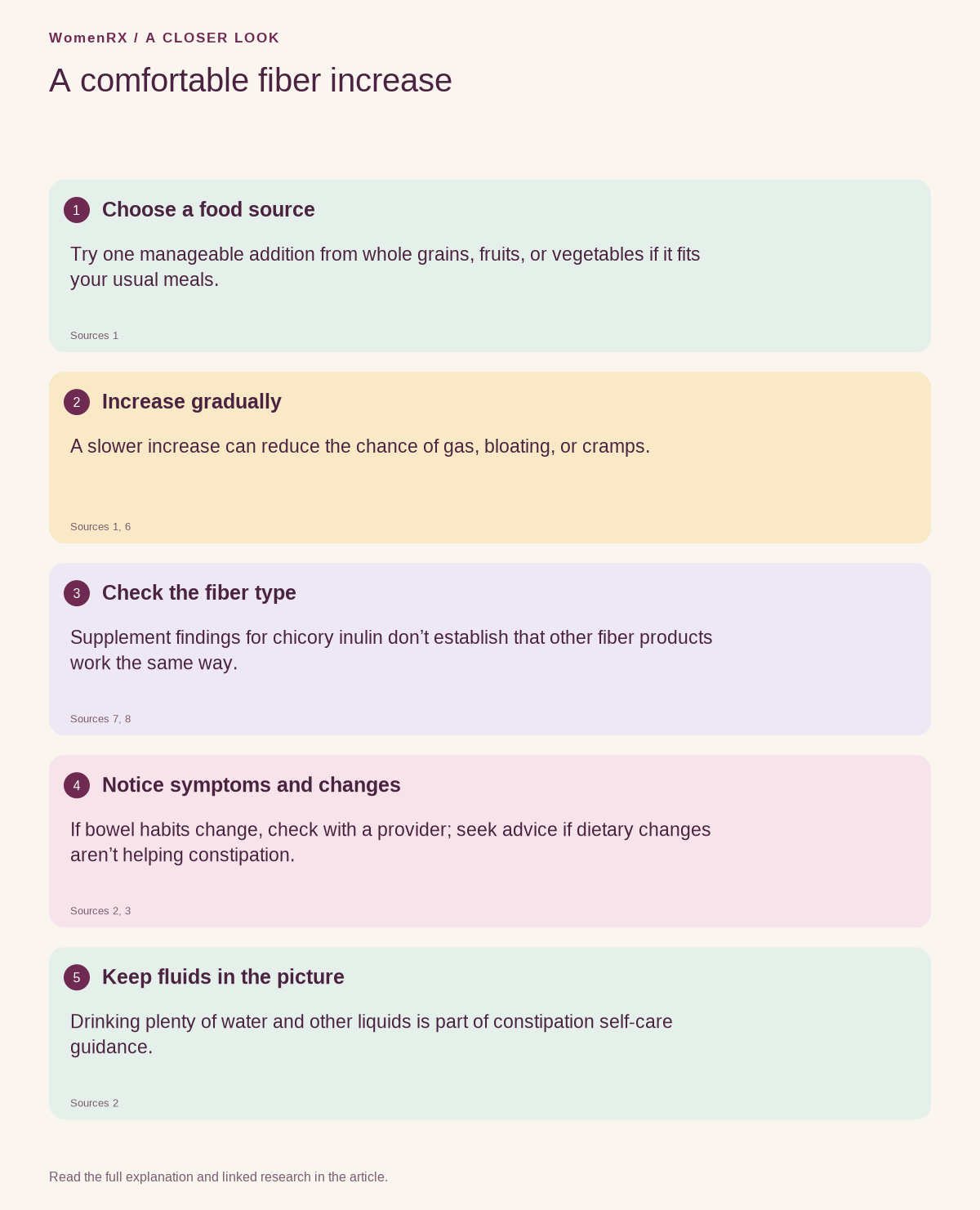
A comfortable fiber increase
Choose a food source: Try one manageable addition from whole grains, fruits, or vegetables if it fits your usual meals.1
Increase gradually: A slower increase can reduce the chance of gas, bloating, or cramps.16
Check the fiber type: Supplement findings for chicory inulin don’t establish that other fiber products work the same way.78
Notice symptoms and changes: If bowel habits change, check with a provider; seek advice if dietary changes aren’t helping constipation.23
Keep fluids in the picture: Drinking plenty of water and other liquids is part of constipation self-care guidance.2
Read the figure as text
A simple sequence for trying a food change, considering a supplement without assuming fibers are interchangeable, and noticing when constipation needs assessment.- Choose a food source: Try one manageable addition from whole grains, fruits, or vegetables if it fits your usual meals.1
- Increase gradually: A slower increase can reduce the chance of gas, bloating, or cramps.16
- Check the fiber type: Supplement findings for chicory inulin don’t establish that other fiber products work the same way.78
- Notice symptoms and changes: If bowel habits change, check with a provider; seek advice if dietary changes aren’t helping constipation.23
- Keep fluids in the picture: Drinking plenty of water and other liquids is part of constipation self-care guidance.2
More questions, answered
Do I need to have a bowel movement every day?
No. MedlinePlus says it isn’t necessary to have a bowel movement every day. If your bowel habits change, check with a provider. 2
Can fiber cause bloating?
Yes. Increasing fiber too quickly can cause gas, bloating, or cramps. Try a more gradual increase, and get frequent or persistent bloating assessed. 1 4
Sources you can check
- Dietary Fiber: MedlinePlusAccessed 2026-09-25Return to first citation
- Constipation | MedlinePlusAccessed 2026-09-25Return to first citation
- Constipation - NHSAccessed 2026-09-25Return to first citation
- Bloating - NHSAccessed 2026-09-25Return to first citation
- Effects of Dietary Fiber Supplementation on Chronic Constipation in the Elderly: A Systematic Review and Meta-Analysis of Randomized Controlled Trials.Xi N, Yang X, Liu J, Yue H, Wang Z. · Foods (Basel, Switzerland) · 2025Return to first citation
- An assessment of nutrition and physical activity guidelines for adult patients with chronic constipation: A systematic review.Kamareddine S, Bhurosy T. · Clinical nutrition ESPEN · 2025Return to first citation
- Effects of Dietary Fiber Supplementation on Gut Microbiota and Bowel Function in Healthy Adults: A Randomized Controlled Trial.Inoue R, Suzuki K, Takaoka M, Narumi M, Naito Y. · Microorganisms · 2025Return to first citation
- Effect of consumption of chicory inulin on bowel function in healthy subjects with constipation: a randomized, double-blind, placebo-controlled trial.Micka A, Siepelmeyer A, Holz A, Theis S, Schön C. · International journal of food sciences and nutrition · 2017Return to first citation