Which Fiber Helps Constipation, and How to Start Gently
Psyllium has the strongest evidence among fiber supplements for chronic constipation, but a gradual increase may matter as much as the product you choose.
If you want to try a fiber supplement for ongoing constipation, psyllium is a reasonable option: evidence supports it better than several other supplement fibers, though that evidence is moderate, not conclusive. 4 5 Add fiber gradually, since a quick increase can cause gas, bloating, or cramps, and drink plenty of fluids. 1 2 Pregnancy and postpartum constipation deserve separate consideration. 3
Fiber isn’t one interchangeable ingredient
Fiber from food and fiber supplements can both contribute to a higher-fiber approach, but a label that says “soluble,” “viscous,” or “bulk-forming” doesn’t, by itself, tell you how well a particular product will ease constipation. The useful distinction is what has been studied: psyllium has the best support among fiber supplements, while evidence for some other isolated fibers is less certain.
Psyllium is a soluble fiber. In a systematic review of over-the-counter treatments, it had moderate evidence for chronic constipation. A later scoping review also identified psyllium as the strongest dietary recommendation in the evidence it surveyed. That makes psyllium a sensible supplement to consider, not a guarantee that it will work for everyone. 4 5
Inulin and fructooligosaccharide (sometimes listed as FOS) had insufficient evidence in the systematic review. That doesn’t prove they never help; it means the available trials didn’t support a confident recommendation for chronic constipation. 5
A practical way to choose
If you want a supplement, psyllium is better supported than choosing a product just because its label highlights a fiber type. If you’d rather start with food, fruits, vegetables, grains, oats, and linseed are ways to add fiber. There’s no need to treat food and supplements as competing options. The evidence comparison favors psyllium over inulin or FOS for chronic constipation, but it doesn’t establish which of these choices will cause less bloating for you. 1 3 4 5
Whichever approach you choose, make a gradual change rather than a big jump in fiber. Increasing it too quickly can lead to gas, bloating, and cramps. Constipation guidance also pairs higher fiber intake with plenty of fluids; it doesn’t give one extra-fluid target for everyone or establish different fluid needs for these fiber choices. Follow a supplement’s directions for how to take it and how much fluid to use. 1 2
If bloating gets worse after you increase fiber, don’t keep increasing it at the same pace. Step back from the recent increase and try a slower change. That’s a practical way to apply the guidance to increase fiber gradually, not proof that every kind of fiber causes the same symptoms. If constipation continues or your bowel habits have changed, check in with a healthcare professional rather than relying on repeated increases in fiber alone. 1 2
Pregnancy and postpartum aren’t the same decision
Constipation is common during pregnancy and after giving birth. General guidance supports gradual dietary changes during pregnancy, but that doesn’t establish that every fiber supplement is right for every pregnant person. 3
One randomized trial studied 376 pregnant women at high risk of metabolic syndrome. The intervention group received soluble fiber supplements from early pregnancy until delivery, and the study reported less need for constipation medication. But constipation wasn’t the only focus, and the finding doesn’t establish that all supplement types work the same way or that the result applies to every pregnancy. 6
After birth, constipation is common too. The pregnancy trial did not study supplementation after delivery, so its result cannot tell you which supplement approach to use postpartum. If you’re postpartum and considering a supplement, factor in your individual situation and any guidance from your maternity care team rather than assuming pregnancy findings apply unchanged. Ongoing constipation or a change in your usual bowel habits is a reason to seek advice. 2 3 6
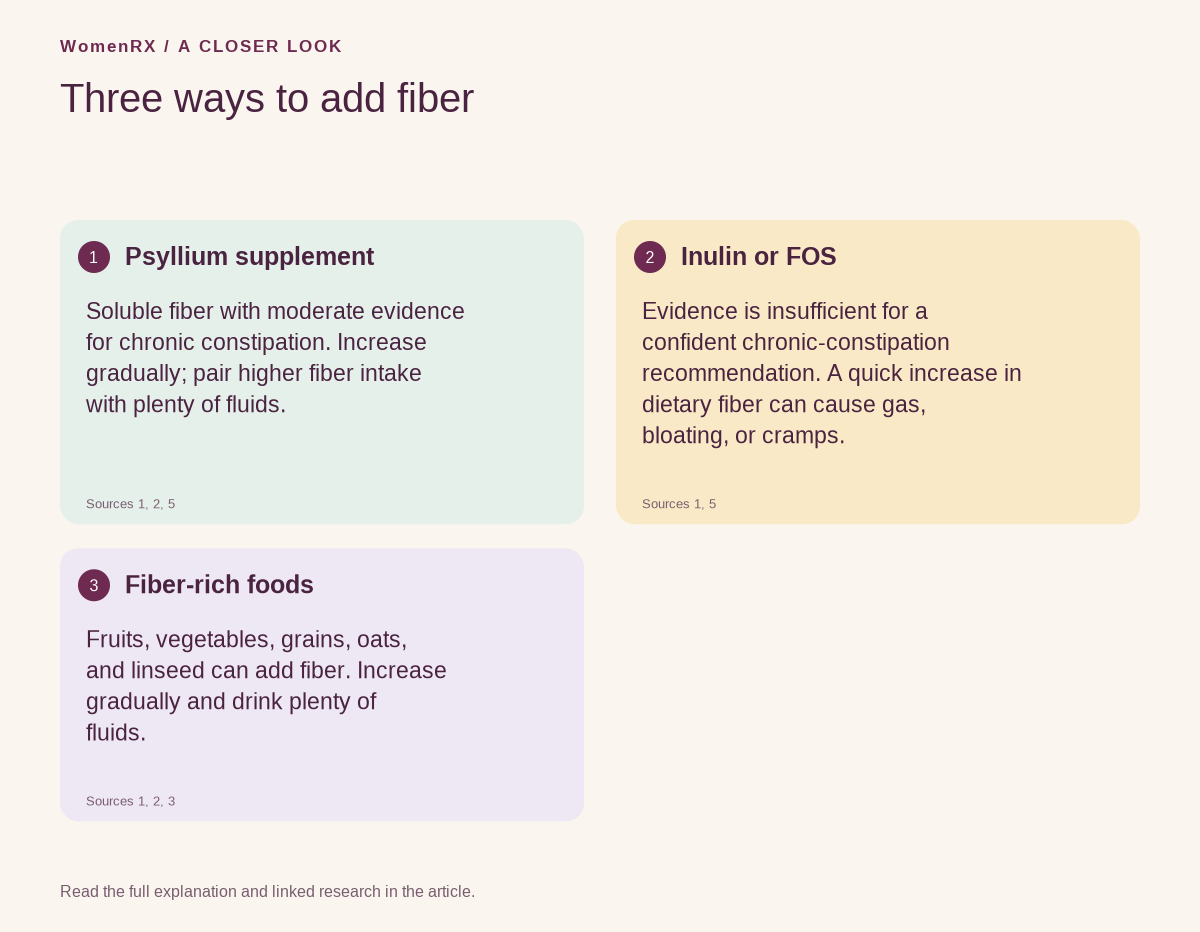
Three ways to add fiber
Psyllium supplement: Soluble fiber with moderate evidence for chronic constipation. Increase gradually; pair higher fiber intake with plenty of fluids.125
Inulin or FOS: Evidence is insufficient for a confident chronic-constipation recommendation. A quick increase in dietary fiber can cause gas, bloating, or cramps.15
Fiber-rich foods: Fruits, vegetables, grains, oats, and linseed can add fiber. Increase gradually and drink plenty of fluids.123
Read the figure as text
Compare what supports each choice for constipation, while keeping the same gradual approach to increasing fiber.- Psyllium supplement: Soluble fiber with moderate evidence for chronic constipation. Increase gradually; pair higher fiber intake with plenty of fluids.125
- Inulin or FOS: Evidence is insufficient for a confident chronic-constipation recommendation. A quick increase in dietary fiber can cause gas, bloating, or cramps.15
- Fiber-rich foods: Fruits, vegetables, grains, oats, and linseed can add fiber. Increase gradually and drink plenty of fluids.123
Sources you can check
- Dietary Fiber: MedlinePlusAccessed 2026-09-25Return to first citation
- Constipation | MedlinePlusAccessed 2026-09-25Return to first citation
- Constipation - NHSAccessed 2026-09-25Return to first citation
- Dietary management of functional constipation in disorders of gut-brain interaction - A scoping review.Quan V, Carey S. · Clinical nutrition ESPEN · 2026Return to first citation
- Efficacy and Safety of Over-the-Counter Therapies for Chronic Constipation: An Updated Systematic Review.Rao SSC, Brenner DM. · The American journal of gastroenterology · 2021Return to first citation
- Effects of dietary fiber on maternal health in pregnant women with metabolic syndrome risk: a randomized controlled trial.Shen H, Chen D, Wang S, Jin Y, Cheng W. · Food & function · 2024Return to first citation