Fiber Supplements for Constipation: Start Gently
Adding fiber gradually can limit gas and cramps, while psyllium has clearer evidence for chronic constipation than inulin.
A fiber supplement may help with constipation, but the type and how you take it matter. Increase your total fiber gradually to limit gas, bloating, and cramps. Psyllium has better evidence for chronic constipation than inulin, and it needs to be taken with enough liquid. If you use psyllium, don’t take it for longer than one week unless your doctor advises it. Seek assessment if constipation persists or comes with warning symptoms. 1356
Start with the problem you’re trying to solve
If your goal is to eat more fiber, food is a useful first place to look. Whole grains, fruit, vegetables, nuts, and seeds provide dietary fiber, and gradually adding them can help prevent constipation. A supplement is another way to add fiber, but if you’re trying to treat constipation, the specific fiber matters. 13
If your goal is relief from constipation, notice what has changed. Constipation can mean stools are harder to pass, bowel movements happen less often than usual, or you feel you haven’t fully emptied. It has several possible causes, including medicines and changes around pregnancy or childbirth. Adding more fiber may help, but it won’t address every cause. 26
Choose by purpose, not just the word “fiber”
Psyllium is the supplement with the clearer case for chronic constipation among the types discussed here. A systematic review of randomized trials in adults rated the evidence for psyllium as moderate. That supports considering it, not assuming it will work for everyone. The review also rated the evidence for polyethylene glycol and senna more highly, a reminder that adding fiber isn’t the only approach when constipation continues. 3
Inulin is also an added fiber, but the same review found insufficient evidence to recommend it for chronic constipation. “Insufficient” doesn’t mean it never helps. It means the reviewed trials didn’t establish its benefit as clearly as they did for psyllium. 34
Make room for your gut to adjust
Start with one change to your fiber intake, whether a food or a supplement, rather than adding several sources at once. Increase your total fiber gradually; increasing it too quickly can bring on gas, bloating, and cramps. If you choose a supplement, check that product’s directions for its serving size and preparation. General advice to add fiber slowly does not specify a starting dose for every product. Bloating, nausea, diarrhea, and abdominal pain were among the adverse effects reported in the adult review of over-the-counter constipation treatments. 13
If you choose psyllium, the liquid is part of taking it properly. MedlinePlus directs people to mix psyllium powder or granules with 8 ounces of liquid immediately before use and to drink at least 8 ounces of liquid when taking psyllium, including other forms. Follow the directions for the form you buy rather than assuming a capsule, wafer, and powder are prepared the same way. MedlinePlus says not to take psyllium for longer than one week unless your doctor advises it. If constipation persists, seek assessment rather than continuing it on your own. 56
Medication timing is another reason to check the ingredient, not just the front of the package. MedlinePlus specifically says not to take digoxin, aspirin or other salicylates, or nitrofurantoin within 3 hours of psyllium. If you take one of those medicines, or you’re unsure about another medicine you take, ask a pharmacist how to fit psyllium into your routine. These timing instructions apply to psyllium; check the directions for other products and ask a pharmacist about medication timing. 5
You can also build fiber through food at a pace that feels manageable. For example, adding a fiber-containing food to a meal is a different choice from adding a supplement on top of everything you already eat. Either way, avoid a sudden jump in total fiber. 1
When more fiber isn’t the whole answer
If constipation began after a medicine change, the medicine may be part of the picture. Iron supplements and opioid pain medicines are two possible contributors. Ask whether a medicine could be contributing before repeatedly increasing fiber. Difficulty emptying the bowel can also have causes other than low fiber, including pelvic floor problems, which are especially relevant in women. If symptoms don’t improve with self-care, they need assessment rather than another increase in fiber. 6
Some symptoms call for prompt assessment instead of a supplement trial. Seek care right away if constipation comes with rectal bleeding or blood in the stool, constant abdominal pain, an inability to pass gas, vomiting, fever, lower back pain, or weight loss you didn’t intend. Difficulty swallowing also matters before taking psyllium; MedlinePlus lists it among the conditions to discuss before use. 56
Constipation is common during pregnancy and after giving birth. If it starts in either period, mention the pregnancy or recent birth, along with any medicines or supplements you take, when discussing treatment choices. For example, iron supplements can contribute to constipation; that’s a reason to discuss the problem, not to stop a recommended supplement on your own. 26
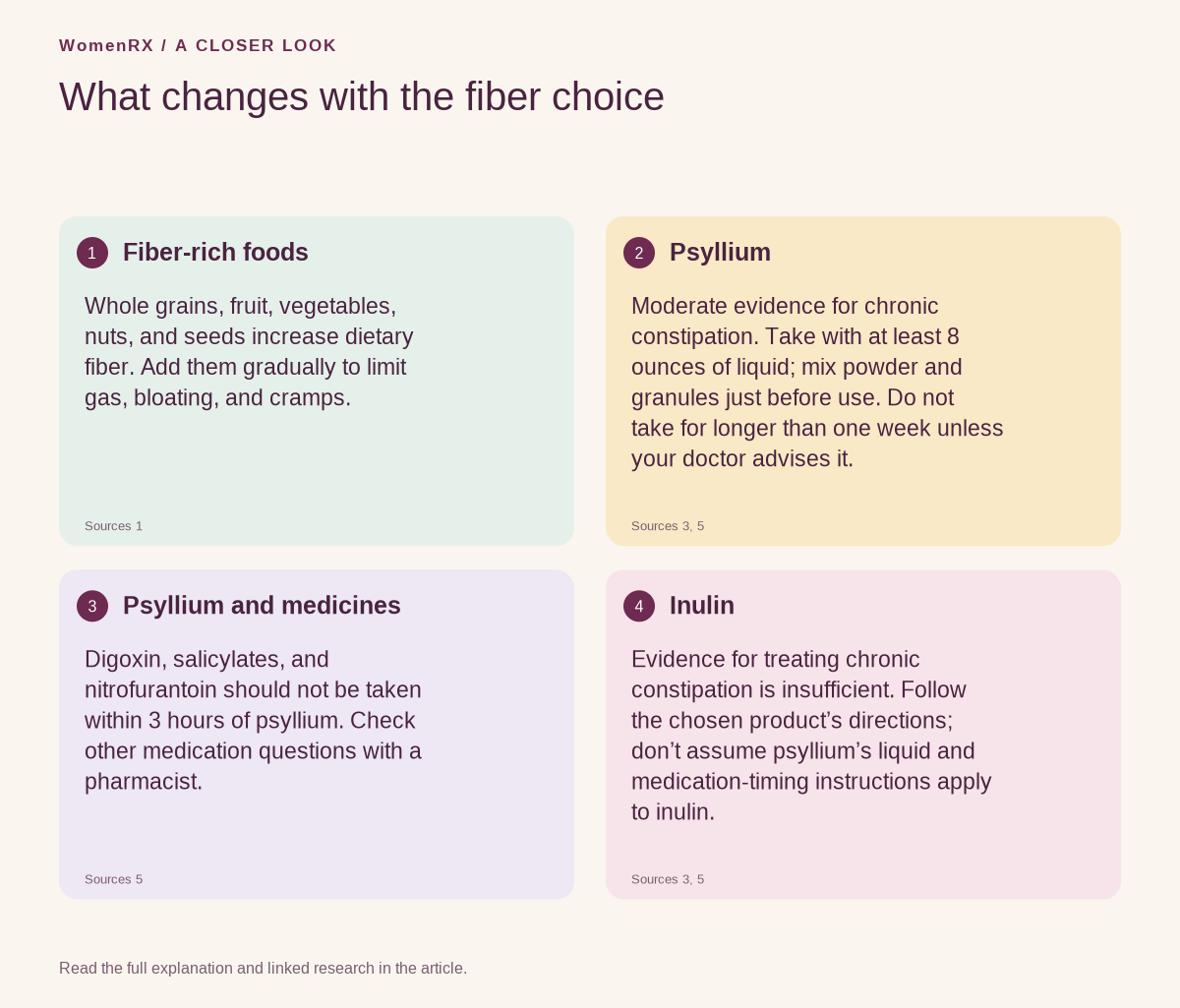
What changes with the fiber choice
Fiber-rich foods: Whole grains, fruit, vegetables, nuts, and seeds increase dietary fiber. Add them gradually to limit gas, bloating, and cramps.1
Psyllium: Moderate evidence for chronic constipation. Take with at least 8 ounces of liquid; mix powder and granules just before use. Do not take for longer than one week unless your doctor advises it.35
Psyllium and medicines: Digoxin, salicylates, and nitrofurantoin should not be taken within 3 hours of psyllium. Check other medication questions with a pharmacist.5
Inulin: Evidence for treating chronic constipation is insufficient. Follow the chosen product’s directions; don’t assume psyllium’s liquid and medication-timing instructions apply to inulin.35
Read the figure as text
The useful differences are the reason for taking fiber and the instructions tied to a particular supplement. The details below are also explained in the article.- Fiber-rich foods: Whole grains, fruit, vegetables, nuts, and seeds increase dietary fiber. Add them gradually to limit gas, bloating, and cramps.1
- Psyllium: Moderate evidence for chronic constipation. Take with at least 8 ounces of liquid; mix powder and granules just before use. Do not take for longer than one week unless your doctor advises it.35
- Psyllium and medicines: Digoxin, salicylates, and nitrofurantoin should not be taken within 3 hours of psyllium. Check other medication questions with a pharmacist.5
- Inulin: Evidence for treating chronic constipation is insufficient. Follow the chosen product’s directions; don’t assume psyllium’s liquid and medication-timing instructions apply to inulin.35
More questions, answered
Does bloating mean I picked the wrong fiber?
Not necessarily. Gas, bloating, and cramps can happen when fiber increases too quickly. If you made several fiber changes at once, go back to changing one source at a time and increasing your total fiber gradually. 1
Sources you can check
- Dietary Fiber: MedlinePlusAccessed 2026-09-25Return to first citation
- Constipation - NHSAccessed 2026-09-25Return to first citation
- Efficacy and Safety of Over-the-Counter Therapies for Chronic Constipation: An Updated Systematic Review.Rao SSC, Brenner DM. · The American journal of gastroenterology · 2021Return to first citation
- The Role of Dietary Fiber in Health Promotion and Disease Prevention: A Practical Guide for CliniciansDaley SF, Vadakekut ES. · 2026Return to first citation
- Psyllium: MedlinePlus Drug InformationAccessed 2026-09-25Return to first citation
- Symptoms & Causes of Constipation - NIDDKAccessed 2026-09-25Return to first citation