How to Choose Fiber for Constipation
For ongoing constipation, psyllium has better clinical support than inulin, but the right next step depends on what’s changed in your bowel habits.
For ongoing constipation, psyllium is a reasonable fiber supplement to consider: adult trials offer moderate evidence for it, but insufficient evidence for inulin.6 Methylcellulose is another option, though its evidence is less direct.7 Increase fiber gradually to limit gas and bloating.1 If constipation comes with an inability to pass gas, vomiting, or constant abdominal pain, seek medical care right away instead of trying fiber.8
Start with the problem you want to solve
Constipation isn’t just missing a daily bowel movement. Your stools might be hard and painful to pass, you might strain, or you might go less often than is normal for you. You don’t need to have a bowel movement every day, but a change in your usual pattern is worth paying attention to.23
If this is a familiar, ongoing problem and you’re considering a supplement, the useful question isn’t “Which fiber is best for women?” It’s “Which fiber has evidence for my goal, and how will I know whether it agrees with me?” The adult constipation studies below don’t establish a separate best fiber for women.6
Match the fiber to the goal
| Your goal or situation | What the evidence suggests | A useful next move |
|---|---|---|
| Help with ongoing constipation | A systematic review of adult trials lasting at least four weeks rated the evidence for psyllium as moderate and its overall benefit as modest. The highest-graded placebo-controlled psyllium study found no significant benefit over placebo.6 | Psyllium is a more evidence-backed supplement to compare than inulin for this goal. |
| Consider a different bulk-forming fiber | Methylcellulose is listed alongside psyllium as a fiber that may improve constipation symptoms in guidance focused on older adults. That doesn’t establish that it works better, or that the two are interchangeable for everyone.7 | Compare the active fiber on labels rather than assuming all products called “fiber” contain the same thing. |
| Choose inulin mainly to relieve constipation | A review of longer adult constipation trials found insufficient evidence for inulin. A separate review of plant-based approaches described evidence for chicory inulin, so assessments differ; the longer-trial review is a cautious basis for choosing a constipation treatment.65 | Don’t treat “prebiotic” on a label as proof that a product will relieve constipation. |
| Address a sudden change in bowel habits | A sudden change calls for assessment rather than an automatic switch of supplements. Medicines can contribute to constipation, including opioid pain medicines.3 | Ask about the change and any possible medicine contribution before trying to solve it with more fiber. |
Psyllium’s moderate rating is useful, but it isn’t a promise of relief. In the systematic review, some head-to-head comparisons favored other treatments over psyllium. If a fiber trial isn’t helping, repeatedly adding more isn’t the only path forward.6
There’s also a point where fiber isn’t the next step. Constipation together with an inability to pass gas, vomiting, or constant abdominal pain calls for medical care right away.8
Why one fiber might feel different from another
Fiber can add bulk to the diet and help prevent constipation. Adding it too quickly, though, can bring gas, bloating, and cramps. That makes tolerability part of the choice, especially if bloating is already bothering you.1
A small crossover experiment gives a closer look at that tradeoff, but not a treatment ranking. In 22 healthy volunteers, researchers compared methylcellulose and psyllium gels when each was taken with inulin. They measured changes in intestinal water and gas; they did not test whether either fiber relieved chronic constipation. Its findings can’t tell you which product will work best for constipation or for IBS symptoms.4
Check the label before you settle on a product
Products containing psyllium, methylcellulose, or inulin don’t all have the same constipation evidence.67
Look first for the named fiber ingredient. Then check that product’s directions for preparation and liquids, and ask a pharmacist how its directions fit with any medicines you take. This evidence doesn’t establish one fluid amount or a medicine-separation interval that applies to every product.
Give your gut room to adjust rather than making a large jump in fiber intake at once. If increasing fiber brings troublesome gas, bloating, or cramps, that’s useful feedback, not a reason to keep escalating it.1
Constipation is common during pregnancy and after birth. During pregnancy, simple diet and lifestyle measures are safe to try; that advice does not establish which supplement to choose during pregnancy or after birth.3
A supplement also shouldn’t distract from a new problem. Seek medical assessment for a sudden change in bowel habits, constipation alongside persistent tiredness, or constipation that may be related to a medicine. Don’t stop a prescribed medicine on your own.3
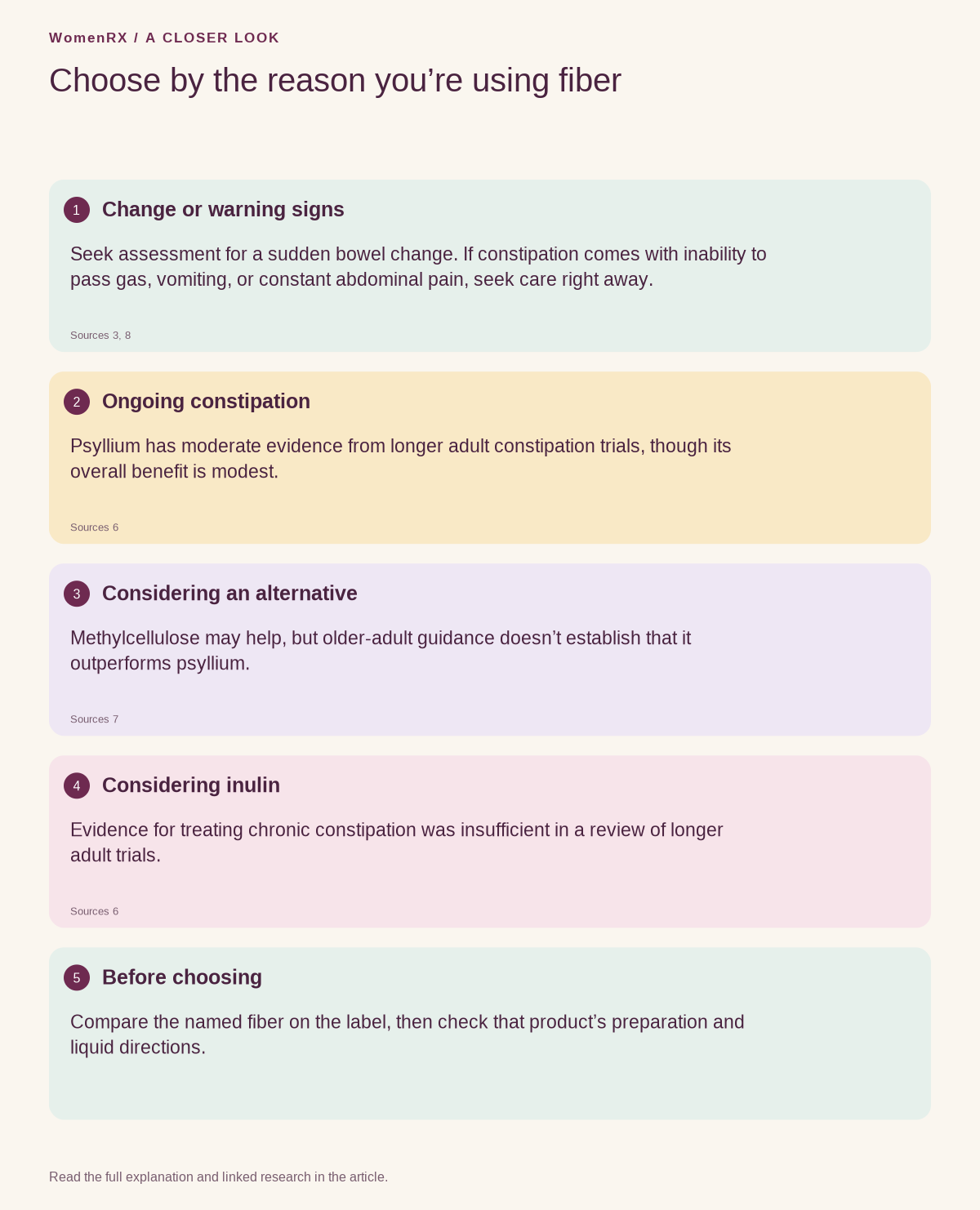
Choose by the reason you’re using fiber
Change or warning signs: Seek assessment for a sudden bowel change. If constipation comes with inability to pass gas, vomiting, or constant abdominal pain, seek care right away.38
Ongoing constipation: Psyllium has moderate evidence from longer adult constipation trials, though its overall benefit is modest.6
Considering an alternative: Methylcellulose may help, but older-adult guidance doesn’t establish that it outperforms psyllium.7
Considering inulin: Evidence for treating chronic constipation was insufficient in a review of longer adult trials.6
Before choosing: Compare the named fiber on the label, then check that product’s preparation and liquid directions.
Read the figure as text
Start with your bowel concern. Warning signs lead to assessment; if you’re comparing supplements, check the named ingredient and product directions.- Change or warning signs: Seek assessment for a sudden bowel change. If constipation comes with inability to pass gas, vomiting, or constant abdominal pain, seek care right away.38
- Ongoing constipation: Psyllium has moderate evidence from longer adult constipation trials, though its overall benefit is modest.6
- Considering an alternative: Methylcellulose may help, but older-adult guidance doesn’t establish that it outperforms psyllium.7
- Considering inulin: Evidence for treating chronic constipation was insufficient in a review of longer adult trials.6
- Before choosing: Compare the named fiber on the label, then check that product’s preparation and liquid directions.
More questions, answered
Does bloating mean fiber isn’t right for me?
Not necessarily. Adding dietary fiber too quickly can cause gas, bloating, and cramps, so the amount and pace of change matter. If symptoms remain troublesome, reassess the product and the reason you’re taking it rather than assuming more fiber will help.1
Sources you can check
- Dietary Fiber: MedlinePlusAccessed 2026-09-25Return to first citation
- Constipation | MedlinePlusAccessed 2026-09-25Return to first citation
- Constipation - NHSAccessed 2026-09-25Return to first citation
- Clinical Trial: Randomised Placebo-Controlled Trial of Methylcellulose and Psyllium Gels on Inulin-Induced Colonic Gas.Dellschaft N, Alhasani A, Reid JESJ, Hoad CL, Gates E, Whymark M, Yakubov G, Marciani L, Warren FJ, Modasia A, Spicer A, Crooks C, Corsetti M, Gowland PA, Spiller R. · Alimentary pharmacology & therapeutics · 2026Return to first citation
- [Phytotherapeutic recommendations in medical guidelines for the treatment of gastroenterological diseases - a systematic review].Utz S, Bittel M, Langhorst J. · Zeitschrift fur Gastroenterologie · 2024Return to first citation
- Efficacy and Safety of Over-the-Counter Therapies for Chronic Constipation: An Updated Systematic Review.Rao SSC, Brenner DM. · The American journal of gastroenterology · 2021Return to first citation
- Management of Constipation in Older Adults.Mounsey A, Raleigh M, Wilson A. · American family physician · 2015Return to first citation
- Symptoms & Causes of Constipation - NIDDKAccessed 2026-09-25Return to first citation