Which Fiber Supplement Fits Your Goal?
Psyllium and pectin have evidence for adult constipation, while a dietary fiber shortfall calls for a different first check: what’s on your plate.
For adult chronic constipation, trials found benefits for psyllium and pectin, though neither was established as better. If you’re trying to fill a dietary gap, first look at how often you eat fiber-rich foods such as whole grains, fruits, and vegetables. In the pooled constipation trials, stool-frequency benefits were apparent only with fiber doses above 10 g/day and treatment lasting at least four weeks. Results varied considerably, so that is not a dosing rule for everyone. Add fiber gradually, and consider gas, fluids, and your medicines when deciding what fits. 1 2 4
Start with the problem you want to solve
Fiber supplements can help adults with chronic constipation, but “fiber” isn’t one interchangeable ingredient. In a systematic review and meta-analysis of 16 randomized trials involving 1,251 adults, 66% of participants assigned to fiber responded, compared with 41% assigned to control. The response figures came from different participant denominators: 311 of 473 in fiber groups and 134 of 329 in control groups. The analysis found considerable variation between trials, so those pooled results don’t guarantee an individual result. The pooled results reported in the review do not provide a women-specific effect estimate. 4
If your main aim is more frequent bowel movements, both psyllium and pectin showed significant effects on treatment response and stool frequency in that review. The review did not establish that one was superior to the other. Fiber overall improved stool consistency, but that finding should not be attributed to psyllium alone. 4
If your goal is simply to get more fiber, start with your usual meals rather than a constipation trial result. Do whole grains, fruits, and vegetables show up regularly? They’re food sources of fiber, and MedlinePlus notes that most Americans don’t get enough. That check can help you spot an opportunity to add fiber through food. It can’t, by itself, tell you that you need a supplement or that one fiber type will benefit you more than another. 1
What the different fibers can tell you
Psyllium: It showed significant effects on response and frequency in adults with chronic constipation. The research doesn’t prove that it is the best option for every person or every bowel symptom. 4
Pectin: It also showed significant effects on response and frequency in the review. These findings do not establish whether pectin or psyllium is the better choice for you. 4
Methylcellulose and inulin: The constipation findings above don’t establish how methylcellulose or inulin compares with psyllium or pectin. Don’t assume a product labeled “fiber” has the same demonstrated effect on stool frequency or consistency.
The mechanism helps explain why products can feel different. Soluble, viscous fibers can hold water in the colon and soften stool; insoluble fibers can stimulate the gut mechanically. Fermentable fibers can add bulk through fermentation, but that process can also produce gas. These are general fiber mechanisms, not proof that every product in a category will have the same effect. 4
Make tolerance part of the decision
A sudden jump in fiber can bring gas, bloating, or cramps. MedlinePlus recommends increasing dietary fiber slowly, and constipation guidance also emphasizes drinking plenty of water and other liquids. The research review found more flatulence with fiber than with control, so a supplement that worsens discomfort may not be a good fit even if it helps stool frequency. 1 2 4
MedlinePlus advises increasing dietary fiber slowly; if you try a supplement, avoid a sudden jump in your total fiber intake. In the adult chronic-constipation trials, a higher treatment response was apparent only at fiber doses above 10 g/day, regardless of treatment duration. Improved stool frequency was apparent only at doses above 10 g/day and treatment lasting at least four weeks. Results varied considerably across trials, so these findings are not a dose or schedule that suits everyone. 1 4
Check medicines separately from supplement timing
Some medicines can contribute to constipation. If your bowel habits change, ask whether one of your medicines could be a cause. Supplement timing is a separate question: ask a pharmacist to check your exact fiber product and medicine rather than assuming one spacing interval works for every combination. 2
Pregnancy and after birth are their own contexts
Constipation is common during pregnancy and after giving birth, but the adult chronic-constipation trials above do not establish which supplement is best in either setting. If you’re pregnant or have recently given birth, seek individualized advice when choosing a product rather than assuming results from the general adult trials apply. 3 4
If your bowel habits change, MedlinePlus advises checking with a healthcare provider. A supplement comparison isn’t a substitute for assessing a change in bowel habits. 2
Match the fiber choice to your goal
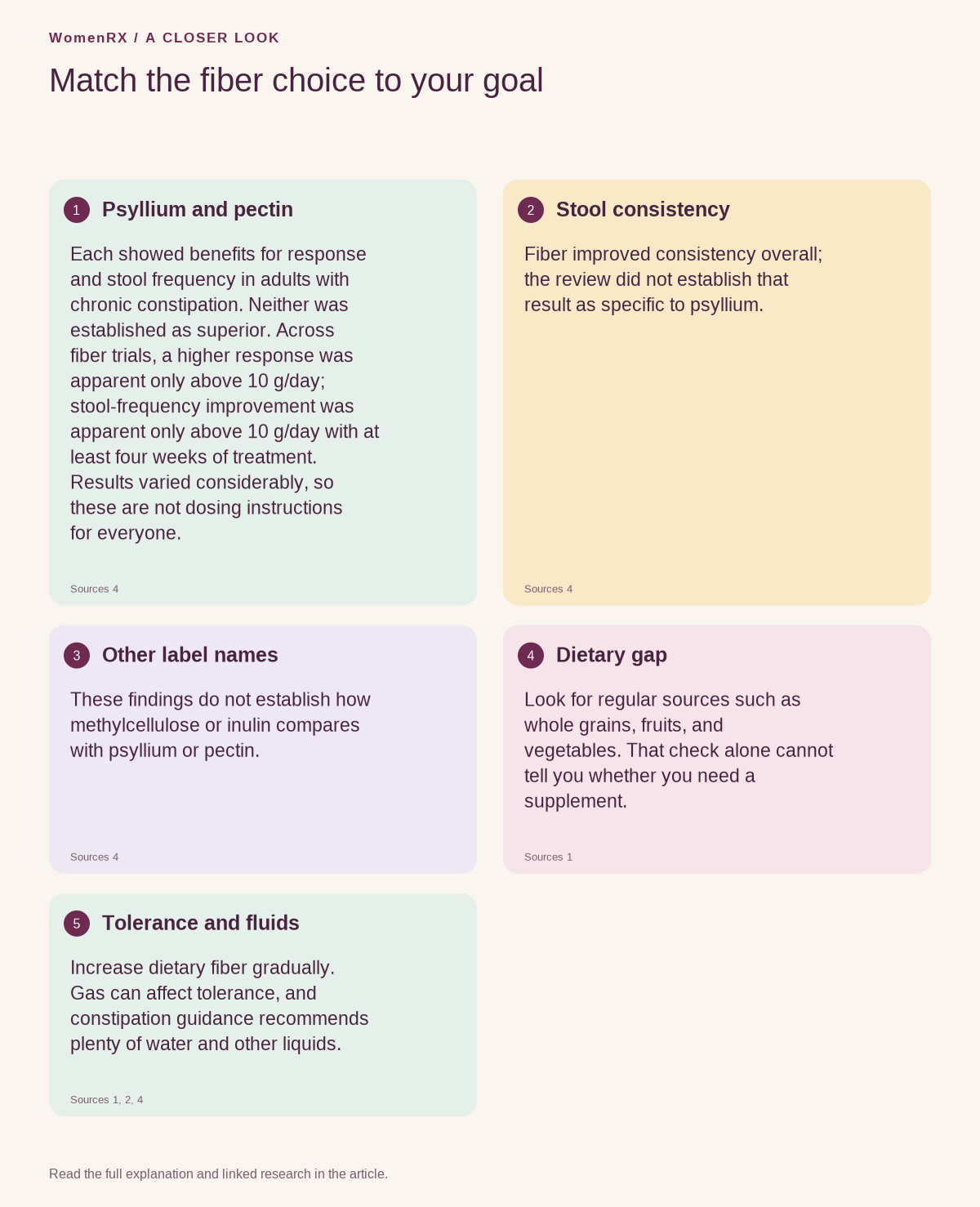
Psyllium and pectin: Each showed benefits for response and stool frequency in adults with chronic constipation. Neither was established as superior. Across fiber trials, a higher response was apparent only above 10 g/day; stool-frequency improvement was apparent only above 10 g/day with at least four weeks of treatment. Results varied considerably, so these are not dosing instructions for everyone.4
Stool consistency: Fiber improved consistency overall; the review did not establish that result as specific to psyllium.4
Other label names: These findings do not establish how methylcellulose or inulin compares with psyllium or pectin.4
Dietary gap: Look for regular sources such as whole grains, fruits, and vegetables. That check alone cannot tell you whether you need a supplement.1
Tolerance and fluids: Increase dietary fiber gradually. Gas can affect tolerance, and constipation guidance recommends plenty of water and other liquids.124
Read the figure as text
Compare the reported constipation findings with a food-first check for dietary fiber, then consider tolerance.- Psyllium and pectin: Each showed benefits for response and stool frequency in adults with chronic constipation. Neither was established as superior. Across fiber trials, a higher response was apparent only above 10 g/day; stool-frequency improvement was apparent only above 10 g/day with at least four weeks of treatment. Results varied considerably, so these are not dosing instructions for everyone.4
- Stool consistency: Fiber improved consistency overall; the review did not establish that result as specific to psyllium.4
- Other label names: These findings do not establish how methylcellulose or inulin compares with psyllium or pectin.4
- Dietary gap: Look for regular sources such as whole grains, fruits, and vegetables. That check alone cannot tell you whether you need a supplement.1
- Tolerance and fluids: Increase dietary fiber gradually. Gas can affect tolerance, and constipation guidance recommends plenty of water and other liquids.124
More questions, answered
Does fiber help everyone with constipation?
No. In adult trials, fiber improved outcomes on average, but results varied substantially between studies. Gas was also more common in fiber groups, so benefit and tolerance can differ from person to person. 4
Is there a standard time to separate fiber from medicine?
Don’t assume a single spacing interval works for every fiber product and medicine. Ask a pharmacist to check your exact combination. Separately, some medicines can cause constipation. 2
Sources you can check
- Dietary Fiber: MedlinePlusAccessed 2026-09-25Return to first citation
- Constipation | MedlinePlusAccessed 2026-09-25Return to first citation
- Constipation - NHSAccessed 2026-09-25Return to first citation
- The Effect of Fiber Supplementation on Chronic Constipation in Adults: An Updated Systematic Review and Meta-Analysis of Randomized Controlled Trials.van der Schoot A, Drysdale C, Whelan K, Dimidi E. · The American journal of clinical nutrition · 2022Return to first citation