Choosing a Fiber Supplement for Constipation
No single fiber supplement is proven best for every kind of constipation, so match the evidence to your symptoms and introduce fiber gradually.
For constipation, compare fiber supplements by the condition studied, not by a “best for women” claim. Small or condition-specific trials have examined pectin, acacia fiber, psyllium, and agave fructans, but they don’t establish one winner for everyone. Check the exact fiber and amount on the label, add fiber gradually to limit gas and bloating, and seek care for a sudden change in bowel habits. 12467
Start with the kind of constipation you have
Fiber can help with constipation, but a product that showed a benefit in one group may not help another. Slow-transit constipation, irritable bowel syndrome with constipation (IBS-C), and constipation during pregnancy aren’t interchangeable situations. Trials have tested different fibers in different populations, so they don’t support a universal winner.
Before buying, check the product’s specific fiber ingredient and serving information. “Fiber” alone doesn’t tell you which ingredient was studied. If you already get a lot of fiber from foods, or if adding fiber tends to worsen your discomfort, that’s useful context when deciding whether a supplement is worth trying.
What the studies say about specific fibers
Pectin: In a randomized trial, 80 adults with slow-transit constipation received pectin or placebo for four weeks. The pectin group had faster colonic transit and improved constipation scores compared with the placebo group. That’s a promising result for this particular group, not proof that pectin is the best choice for other forms of constipation. 4
Acacia fiber: A four-week randomized trial studied 180 people with IBS-C. Stool frequency improved in the acacia group compared with placebo, but the study didn’t find significant between-group changes in stool consistency, stool mass, or quality-of-life measures. The published results reported overall findings, not a separate effect for women. 7
Psyllium and agave fructans: A small study of people with functional constipation compared these two fibers. A secondary analysis evaluated 20 participants, 18 of them women, and found similar clinical response rates between groups, with no difference in measured transit times. With only five people in each intervention group in that analysis, it can’t reliably settle which fiber works better. It also didn’t test inulin. 6
These trials don’t provide a dependable head-to-head ranking of psyllium, methylcellulose, inulin, and other supplements for constipation overall. A product’s popularity or a broad “gut health” claim isn’t a substitute for evidence in the condition you’re trying to address.
A gentler way to add fiber
A sudden increase in fiber can bring gas, bloating, or cramps. Increase it gradually rather than making a large jump, and include plenty of fluids. MedlinePlus also points to fruits, vegetables, and whole grains as food sources of fiber, which can be part of your overall approach. 12
If you’re comparing labels, look for the named fiber ingredient and how much is in a serving. For a first trial, choosing a product with a clearly identified fiber rather than a blend can make it easier to tell what you’re taking. Follow the product directions, and don’t keep increasing the amount if your symptoms are getting worse.
Pregnancy needs its own evidence check
One randomized trial included 376 pregnant women at high risk of metabolic syndrome. The intervention group received soluble fiber supplements during pregnancy and had a lower need for constipation medication. This finding is encouraging, but it doesn’t identify a best product for every pregnancy: the trial enrolled women at higher risk of metabolic syndrome and evaluated soluble fiber, rather than comparing different supplements. 5
That pregnancy trial did not study postpartum or midlife constipation, so it cannot guide a product choice for those situations. If constipation begins during pregnancy or after birth, or is new around menopause, consider the timing and any other changes in your health or medicines rather than assuming a supplement will address the cause.
When to look beyond a supplement
Fiber isn’t a complete answer for every cause of constipation. Medicines can contribute, and a change in your usual bowel habits deserves attention. Check with a healthcare professional if your bowel habits change suddenly, or if you suspect a medicine is contributing; don’t stop a prescribed medicine without discussing it. 23
A useful next step is to bring the supplement label and note whether constipation means hard stools, infrequent stools, or both. That distinction can help clarify whether a fiber trial is a reasonable option or whether another cause needs attention.
What constipation fiber trials studied
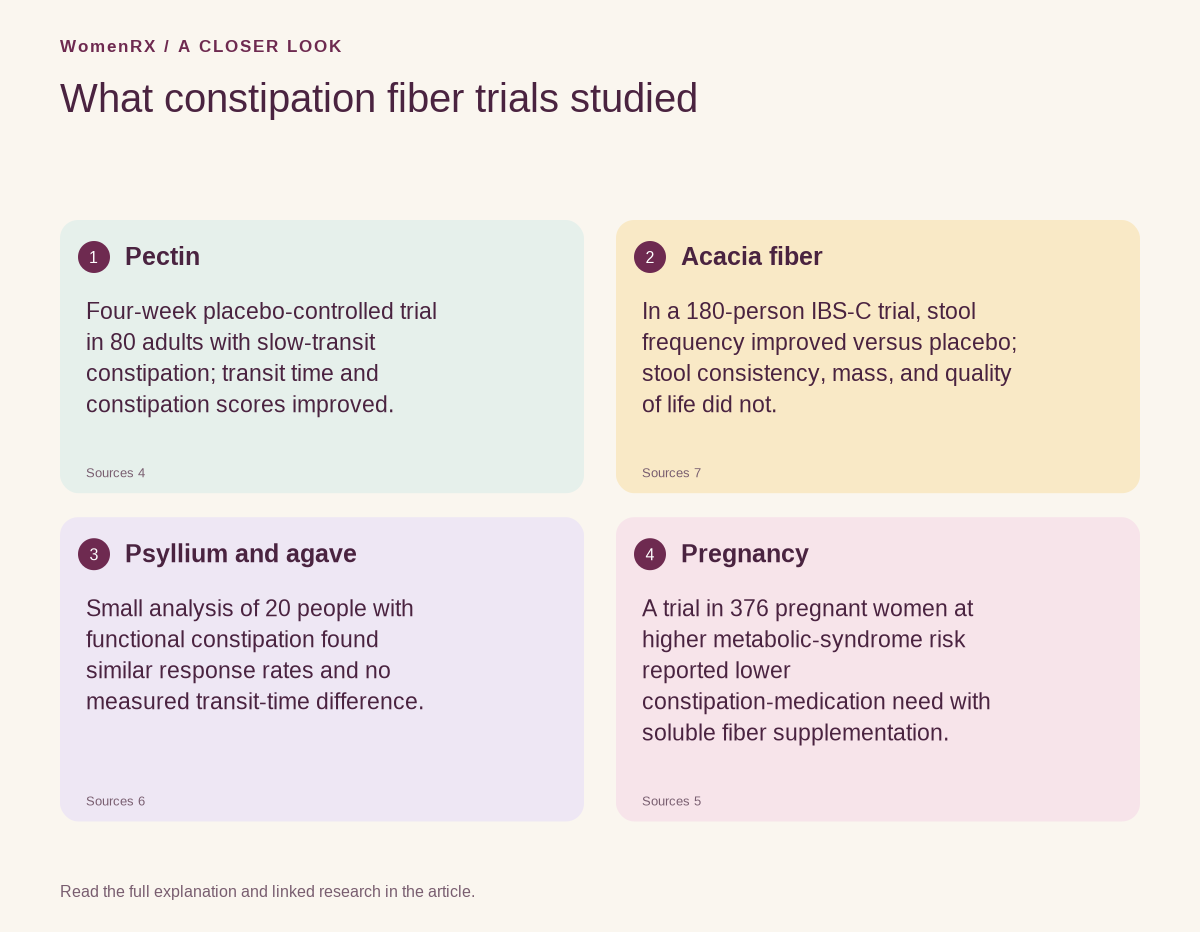
Pectin: Four-week placebo-controlled trial in 80 adults with slow-transit constipation; transit time and constipation scores improved.4
Acacia fiber: In a 180-person IBS-C trial, stool frequency improved versus placebo; stool consistency, mass, and quality of life did not.7
Psyllium and agave: Small analysis of 20 people with functional constipation found similar response rates and no measured transit-time difference.6
Pregnancy: A trial in 376 pregnant women at higher metabolic-syndrome risk reported lower constipation-medication need with soluble fiber supplementation.5
Read the figure as text
These trials examined different fibers in different groups. Their results help frame the evidence, but they don’t produce a universal ranking.- Pectin: Four-week placebo-controlled trial in 80 adults with slow-transit constipation; transit time and constipation scores improved.4
- Acacia fiber: In a 180-person IBS-C trial, stool frequency improved versus placebo; stool consistency, mass, and quality of life did not.7
- Psyllium and agave: Small analysis of 20 people with functional constipation found similar response rates and no measured transit-time difference.6
- Pregnancy: A trial in 376 pregnant women at higher metabolic-syndrome risk reported lower constipation-medication need with soluble fiber supplementation.5
More questions, answered
Is psyllium proven to work better than other fiber supplements?
The small comparison of psyllium with agave fructans found similar clinical response rates and no difference in measured transit times. Its 20-person analysis was too small to establish that the fibers are equally effective or to show that psyllium is better. 6
Can I add fiber quickly if I’m constipated?
A large, sudden increase can cause gas, bloating, and cramps. Increase fiber gradually and include plenty of fluids. 12
Sources you can check
- Dietary Fiber: MedlinePlusAccessed 2026-09-25Return to first citation
- Constipation | MedlinePlusAccessed 2026-09-25Return to first citation
- Constipation - NHSAccessed 2026-09-25Return to first citation
- [Clinical benefits after soluble dietary fiber supplementation: a randomized clinical trial in adults with slow-transit constipation].Xu L, Yu W, Jiang J, Li N. · Zhonghua yi xue za zhi · 2014Return to first citation
- Effects of dietary fiber on maternal health in pregnant women with metabolic syndrome risk: a randomized controlled trial.Shen H, Chen D, Wang S, Jin Y, Cheng W. · Food & function · 2024Return to first citation
- The effect of fiber supplementation with agave fructans or psyllium plantago in symptoms of constipation and its relation with whole and regional transit time and pH.Coss-Adame E, Arenas-Martínez JS, García-Cedillo MF, Nosthas LC, Bustillo-Armendriz G. · Neurogastroenterology and motility · 2024Return to first citation
- Acacia fiber or probiotic supplements to relieve gastrointestinal complaints in patients with constipation-predominant IBS: a 4-week randomized double-blinded placebo-controlled intervention trial.JanssenDuijghuijsen L, van den Belt M, Rijnaarts I, Vos P, Guillemet D, Witteman B, de Wit N. · European journal of nutrition · 2024Return to first citation